Berm People
In a world of endless wind, a roofer plots to kill the privileged half of his shelter.

Before he decided to kill half of everyone in The Retreat, William worked repairing its roof. He and his teammate, Carl, had once completed a job during sustained winds of 75 mph with gusts of 88. Wind-blown sheet metal sliced through William’s protective tunic and into his back, leaving him with a proud battle scar. For their courage and commitment, they got a certificate printed on actual paper and signed by the Residential Director of Critical Services. They also got one vending machine token each. William immediately used his to buy frozen sugar water. Two years later, William went to clear out Carl’s sleeping cubicle and found his token. Carl had held onto it all that time, waiting for… what? From then on William kept it in his pocket, and when he felt his anger ebbing, he would grip it tightly, driving its reeded edges into the palm of his hand.
The morning things went wrong, William woke looking at the low ceiling above his sleeping cubicle. On the other side of that ceiling, the winds shook and battered the roof, as always, but not as badly as when he went to sleep. He rolled out of bed and got dressed, stooping slightly to avoid bumping his head. He lived in the extreme low end of The Retreat, the eastern edge, where the wedge shape of the structure first met the wind. He slept with bits of cloth shoved into his ears, which helped somewhat.
He found coffee and a Danish in the nearby break room. The stale pastry tasted like a thick slab of cardboard. Still, he felt grateful. Some days there was only coffee.
He sat with Martha, and as always, they talked about her kids. William enjoyed hearing about their interests—or in the case of Michael, obsessions. The boy loved baseball, and dreamed of someday playing on a full-sized field, in the open air. Carl joined them, and the conversation shifted to work, and rations, and then old movies.
“Time to go,” said Carl, touching William’s arm. He had already checked their work orders for the day.
“Be careful,” said Martha.
“You be careful,” said William. A joke that wasn’t really. Martha worked in daycare, tending to the children of residents. One bad review from a picky mother could get her and her own children ejected from The Retreat.
Carl and William traversed a maze of narrow, twisty service corridors to get to their equipment room. They donned their protective clothing, made from heavy fiberglass canvas, and checked each other over.
“What do you call this?” asked Carl, poking him in the side. William had misaligned the snaps on the left side of his tunic. The extra flap of fabric would have significantly increased his wind drag.
“Sorry.”
Carl frowned. They put on their audio rigs, did a radio check, and called into dispatch to confirm their hatch numbers. Including respirators and cowls, each man had added a good 40 pounds of protective equipment. And that didn’t include their work tools.
Carl paused to say a quick prayer for safety during the day’s labors. William bowed his head, not in reverence but to prevent his friend from seeing that his lips remained tightly shut.
They re-entered the service corridor, this time splitting up. William found his hatch and clipped a heavy guide strap to his belt, climbed, then made sure the strap lay correctly in the small slit in the hatch before closing it behind him.
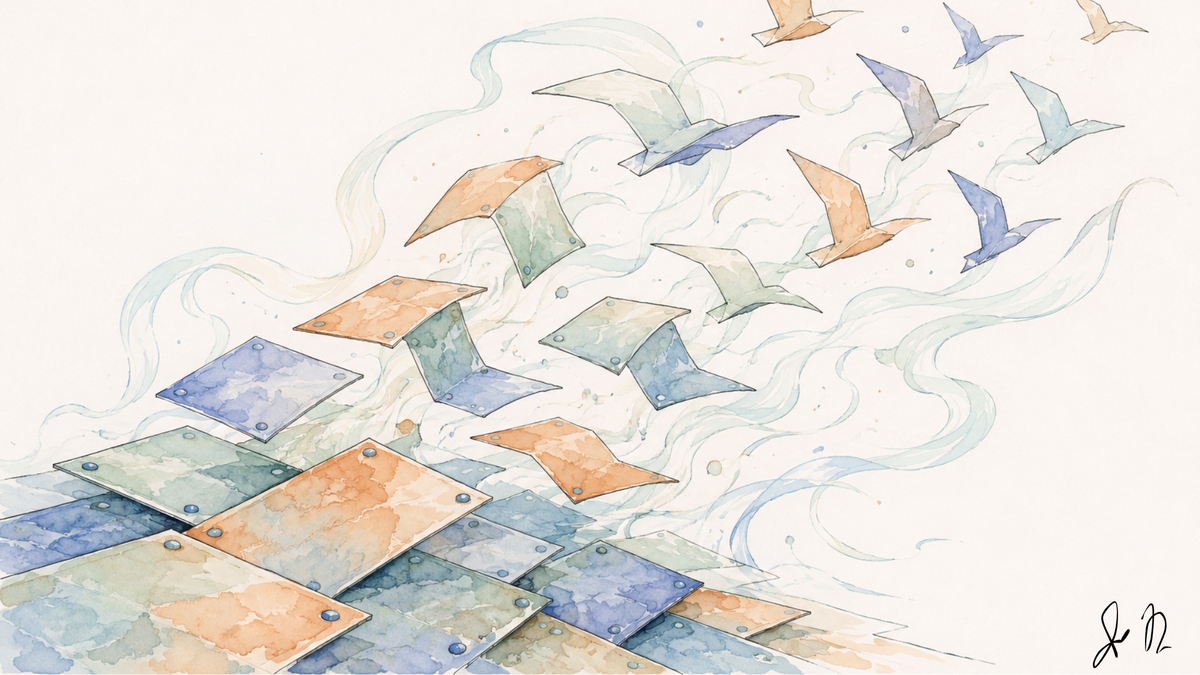
On the roof, he glanced around, taking in the miles-long width of flat metal, tilted up slightly in the west, the leeward direction. The roofing was a patchwork of overlapping squares, each about five feet across, made from repurposed steel, aluminum, wrought iron, copper, and occasionally titanium. Some still bore the faded markings of product names or corporate logos, truncated at the edges, though these had mostly been sandblasted out by the wind.
The wind defined The Retreat, with its long wedge shape, as well as the lives of everyone in it. William could remember some things about his life before coming here—playing in parks, living in a house, eating ice cream… When it started, the east wind was just one more inconvenient effect of climate change. Optimists even speculated about new wind farms in places that previously didn’t have enough to justify construction. But as the winds continued to rise, so did the struggles of daily living. Trees shed their branches at alarming rates; traffic lights bobbed and swayed at every intersection. The seas grew restless, never without whitecaps, and later the lakes. Outdoor football became untenable, as dust and dirt blinded fans and made every pass incomplete. Flags on flagpoles crackled and snapped, and eventually developed horizontal rips that crept upwind, until only colored streamers remained. When the winds tore the roofs off houses, people with basements moved into them. Those without paid to have bulldozers dig up their yards, building berms against what had become a constant assault of howling blasts always out of the east.
William couldn’t see them from where he stood, but beyond the leeward edge of The Retreat those berms still stood. People lived between them, though he couldn’t say how. Staff who lost their jobs and were ejected from The Retreat would wander off into the berms, never to be seen again.
William checked the wind speed displayed on the screen inside his cowl: about 68 mph sustained. Not even Category One. Plumes of brown soil coiled in the sky like swirls in cinnamon bread. “Hey,” Carl said through the radio. “You ready?” He had emerged from his own hatch about 30 yards away.
The two men walked leeward, trailing the straps, which unspooled automatically as they went. Sand, soil, and bits of gravel pelted William’s back. The return trip would require much more effort.
They found the loose panel. Over time, the wind worked its way under everything. If left like this, the panel would eventually lift and tear away, and the deadly gales would roar under the next panel downwind from it, and the next, setting off a chain reaction. Such a cascade had happened once before. The incident response team had managed to stop the damage, but repairs had dragged on for months. Rumor said that three residents had been sucked out and tossed onto the roof, then who knows where. But such things could not be confirmed, or even talked about openly.
Carl got on the radio to tell dispatch that the damage to the panel was more severe than expected. He angled his body camera toward it.
“Can you send someone out with a heavy welding rig?”
“No. Too many work sites this morning. Handle it with what you have.”
The two men looked at each other, and began setting down and securing their tools. They would have to bend the thick metal back into place, then reattach it with a combination of rivets and spot welds. The work required them to shift positions constantly.
As the morning dragged on, the wind picked up. William’s faceplate made an irregular ticking sound as pebbles struck it. Inside the heavy clothing, sweat formed on his back and chest. The air carried more dirt now. He had to bend low, putting his face nearer the work. His legs and back burned with fatigue.
At last they had the panel secure. William stood and turned into the wind. He took a bit of slack from his guide strap and secured it to a clip in the front of his tunic, without releasing the back clip. He turned to look at Carl, and was surprised to see him still bent over their work site.
“What’s wrong?” he asked.
“My strap,” said Carl. William then saw that, between the dust and the many changes in position needed to complete the job, they had accidentally secured the panel on top of Carl’s guide strap. He didn’t have enough slack even to stand.
“Shit,” said William. “We’ll have to tear off the panel.”
“We can’t,” said Carl. “The wind is picking up.”
William checked the wind speed—83 mph sustained and climbing fast.
“What do we do?” asked William.
“We’ll have to cut it,” said Carl. “I’ll strap onto you, and we’ll walk back together.”
They strapped together first, in case of a sudden gust. William had to get back down on his hands and knees next to Carl. Nervous sweat mixed with sweat from exertion. They cut the strap and stood carefully.
94 mph. Almost Category Two.
The walk back was blind—walking windward, William could see nothing but dirt and grit hurtling toward him. Each footstep had to be carefully planned—flat as the roof was, there were still things that could trip him. Carl walked behind, his hands on William’s shoulders.
Finally the panels underfoot began to look familiar—they were almost back to the hatch William had emerged from earlier. He called dispatch to explain that they would need to both enter the hatch at the same time.
“No,” replied the voice over the radio. “Tell him he has to return to his own hatch.”
“I’m here,” said Carl. “What’s the problem?”
“You’re to return through the hatch you exited.”
“Why?”
There was a pause. “With two in a hatch, you won’t get a proper seal on the outer door. Without a proper seal, the inner door won’t open.”
William turned to Carl, and mouthed the word bullshit.
Carl thought for a moment, while the wind bludgeoned.
“We can enter one at a time. Once William is all the way inside, I’ll follow.”
“No,” said dispatch. “Go back to your own hatch.”
“What the hell?” said William.
“Do you need me to repeat?” asked dispatch.
Carl held his finger to the spot on his faceplate in front of his lips. “No. We copy.” He tapped his helmet to cut the connection to dispatch. William did likewise, and switched to a private channel.
“Come in with me,” said William. “Screw them.”
“No,” said Carl. “You go in. I’ll make it.”
“Just come in! What are they going to do?”
But Carl shook his head. “It’s not worth it. I’ll get down on my hands and knees to reduce drag. I’ll see you inside.”
Carl lowered himself, gently pulling William down with him, then unhooked. William, calcified in fear and anger, caught the wind and went sprawling on his side. He had to struggle onto his hands and knees before groping to his hatch. Before he entered, he caught a last glimpse of Carl, crawling away in the torrent of filthy air.
In recognition of his loss, they allowed William to take whatever he wanted from Carl’s sleeping cubicle and gave him the rest of the day off. He took only the two-year-old vending machine token.
He spent the day lying in bed, staring at the ceiling, while the wind made a sound like a hundred running feet on the roof. For much of this time, his mind swung back and forth. It was their fault, for insisting that Carl return through his own hatch. It was his fault, for the carelessness that necessitated cutting Carl’s strap. Their fault, his fault… his brain wouldn’t settle, not when the bulk of the day lay ahead of him. But as afternoon slid into evening, and evening into night, and painful rumination into fragmented sleep, he landed more and more on the side of their fault. Not because of any evidence or analysis—when all is said, a blistering anger is just an easier burden than leaden guilt.
Over the next few weeks, he went through the motions of his job. He fixed panels, he maintained equipment. He got a new partner, younger than himself, who annoyed him. One day as they worked near the site of his last job with Carl, he found himself fantasizing about throwing the young man up into the wind and watching him spin at the end of his strap like an unbalanced kite.
He began to avoid Martha. At breakfast he would deliberately sit alone, drinking his coffee. The stale pastries disgusted him, and on the rare occasion there were breakfast burritos, he would only glance at the long-past expiration date and put them back in the freezer.
What is going to happen? he asked himself, alone in his bunk. He thought of himself, his personal future, but also the future of this awful place and everyone in it. Was it his destiny to live and die in the background of the residents’ lives, like Carl? He thought of extras in old movies, present in crowd scenes but making no impact on the story. Was that him? Or did he have a part to play in what might unfold? That last question became the seed out of which his new idea grew.
He began to carry a small notepad and, in between jobs, to mark down the location of certain types of equipment. Specifically, switches and routers, critical pieces of the control network that activated mechanical devices throughout The Retreat. He didn’t know that much about networks, but he hoped he knew enough to find what he was looking for.
His plan coalesced around one simple fact: each hatch to the roof had a servo attached to it, so that if need be it could be opened remotely by dispatch. The feature was only supposed to be used in the event of a propane leak within The Retreat, only during low wind conditions, and only in the area immediately surrounding the leak. Opening all The Retreat’s hatches simultaneously during high winds would allow the rushing air to peel back the roof like the skin of a rotten fruit. The whole structure would be reduced to flying debris in minutes.
But… what if only the hatches above the residents’ areas popped open? The residents lived downwind, on the leeward side of The Retreat, where the ceilings stood higher and provided more of a baffle to the wind’s rattling, screaming, and shaking. Their roofs would peel away and, if this happened during a high wind, they might all be sucked out (or at least many of them). The damage wouldn’t travel upwind, so the low-ceiling areas where the staff lived would be safe. The staff could then seal off the damage—they had the skills and the tools. With the residents gone, they could finally breathe and live.
This was William’s new idea.
If he could find a hub that controlled all the hatches, he could sabotage it. He didn’t yet have the details. He imagined a box, like a fuse box, full of switches. Maybe not that easy, but he would figure it out. He had time. He continued searching for equipment and writing in his notepad.
Martha began to worry him. He would catch her watching him at breakfast, and it made him uneasy. Others might underestimate this short, plain woman, but William knew those dark eyes missed nothing. Could she guess what he planned? It seemed paranoid, and yet her work with children required her to be watchful, attuned to changes in behavior… maybe she could sense a scheming mind. Her gaze made William feel exposed and vulnerable.
One afternoon, as he walked a corridor following the winding path of a fiber optic cable, he almost ran into her.
“What are you doing?” demanded Martha.
“Nothing!” he blurted. But his nervousness betrayed him. Martha looked at his notepad, and he moved it behind his back.
“Whatever it is, you have to stop,” she said.
He said nothing.
“He wouldn’t want this. Carl gave his life for you.”
“Carl didn’t give his life. They took it. For nothing!”
Martha glanced around. “Lower your voice.”
“We’re slaves here. Understand?”
“We’re alive.”
“Better we weren’t.”
Her eyes registered shock and confusion. “Is that what you want?”
“No! Just them.” He gestured to the leeward side of the building.
Martha glanced around nervously. “God will deliver us. That’s not your job.”
“God abandoned us. We ruined Eden so he left us to choke on our own filth. We need to look out for ourselves!”
Martha’s face had been a mix of sympathy and sternness, but the former drained quickly away. “Whatever you’re planning, you’re putting us all in danger. They’ll find out, and punish all of us.” When William didn’t answer, or even meet her gaze, she raised her own voice.
“My children! Think of them, you selfish bastard!” In her sudden fierceness she was not so plain. A lioness, defending her cubs.
William pushed past her, turned a corner into another corridor, and another and another.
In bed again, this time waiting. He expected security officers to burst into his sleeping cubicle, thick with body armor and bristling with tasers. Martha had told them. They would drag him to the leeward doors and toss him out. He would fight the other unfortunates for a spot among the berms, for food and filthy water, and die with dirt in his lungs.
William regretted so much. Not concealing his feelings, letting Martha read him like a child. His stupid plan—maybe there was no hub, or it existed as software in some office only accessible to residents. Letting Carl go off without a guide strap.
He had been a fool. The officers were coming. Every sound outside the door was them, marching his way. Even the silence was them, sneaking up like ninjas in a movie. They would come through the ceiling, the wall, the floor.
But they didn’t.
William didn’t know if he should go to work the next day. He would step onto the roof, and they would not let him back in. Why should he do their job for them? Make them drag him out, thrashing. Let everyone know that one man had tried…
But he went to work the next day. And they did not leave him on the roof. The day was terrible, but in the usual way.
Martha had not told them. But she still could. He had to find the hub soon, if it existed. And if not…
He gripped the vending machine token.
For weeks he followed fiber optics lines that terminated, disappointingly, in security cameras, thermostats, and propane leak monitors. Through miles of corridors with walls of drywall, sheet rock, plywood, and cloth-covered panels, his determination held.
Then one day, the wind stopped.
It took everyone long moments to realize they no longer heard a sound that had grown as familiar as their own breathing. And when they did realize, they weren’t sure what to do. They only knew they wanted to look.
They crowded around the leeward doors, taking turns peeking out through the tiny windows. “Can you see?” those in the back demanded to know of those in the front. But of course, there was nothing to see, just the stillness of air. Outside, a few of the berm-dwellers stood looking around confusedly. Some even waved at those inside.
“This is just a temporary cessation,” said the loudspeakers. “The wind will resume.” True, there had been lulls before, some lasting an hour or more, though not in a long time. Staff went back to work.
A day passed. Then two. Those inside kept looking. The berm people built fires in the open and roasted rats. The sky cleared for a bit. The pent-up need to be out in the open swelled, overwhelming, like fierce hunger or lust. To raise your face and feel the sun…
Staff sent a delegation to the residents, asking for permission to go outside.
“You’re always free to leave,” said the resident leaders. “But getting back is on you. If it starts again, don’t expect a rescue.”
Staff began to walk outside. First a trickle, then a flood. Then, a few residents. Children chased each other. Security officers drove the berm people back, to prevent mingling. William left The Retreat without protective gear for the first time in years, and the air didn’t batter or assault him. He looked up at the sky, where the ripped clouds revealed unfamiliar blue.
“William.” Hearing his name, he turned and saw Martha standing there. She pointed to where her son, Michael, played ball with other boys.
“See!” she said.
He nodded. The absence of the wind left him feeling strangely untethered, at a loss in some ill-defined way. Even the joyous shouts of children next to him seemed distant. He sifted through many emotions, including an impulse to go back inside and continue his search for the hub. But here was the sky—the gentle, lost, brilliant sky.
More residents stepped outside, tentative at first, but in increasing numbers. The security officers relaxed somewhat. The berm people posed no threat. They stood in their filthy clothes and stared at the people who had emerged from The Retreat, as though they looked upon beautiful, exotic animals. William walked among the berms to see how they lived.
The berm people lived on trash. Some of it he recognized as cast off from The Retreat. Other bits and pieces had come from elsewhere, probably the blown-down homes that had once stood on this ground. He imagined all the household items that must be lying below just a few inches of grime—bent knives, battered pots, rusty shovels, filthy blankets… They made what use they could of these things. The berm children stared at him. He smiled, but they did not smile back.
What do they eat? he wondered. The Retreat must dump some food, scraps too foul or stale even for staff. But that wouldn’t be enough. Looking into the crude nests of trash they had gathered between berms, he saw improvised cages full of black, crawling creatures. Beetles. He saw a rail-thin girl scratch a hole in the ground, and from it she pulled a grub, placed it in her mouth, and began to chew slowly and carefully, all the while staring at William and showing no emotion.
They move like cattle, thought William. Slowly and without words. He wondered if their brains were affected by their meager diet—if their stick bodies lacked the energy to power human thought. The girl’s hands were filthy, but more than that—they were stained the color of dirt, as though they had never been clean.
William looked away. Inside The Retreat he had thought himself at the bottom of the pyramid, barely tolerated by those at the apex, like a useful animal. He knew of the berm people but had spared them no thought. They were outside the hierarchy, and therefore unconsidered.
He took from his pocket two small, ancient candies wrapped in brightly colored cellophane. He held them out for the girl. She reached out to take them, but hesitated. “It’s all right,” he said, but she didn’t seem to understand. He wondered if living in the wind had made her deaf. Eventually she took the candies and slipped them into a pocket of her dress.
Just then William felt a breath of wind on his neck. It had started again.
Everyone from The Retreat began to move back toward the doors. All except William. He lingered, looking at the squalor between the berms, trying to commit the details to his memory. Why though? What was the point? He couldn’t imagine anything he could do to help. He turned toward The Retreat, took a few steps, then stopped again.
The wind was at his back. He faced The Retreat, but the wind came from behind him.
He turned and looked at the sky behind him to see a cloud of dirt bearing down. From the west. But the wind had always come from the east.
He looked at the people lining up to re-enter The Retreat and saw Martha and her son. He ran to her.
“Don’t go in,” he said.
“What?”
“Don’t go in. Martha, don’t!”
The man behind her barked, “Back of the line!”
Martha looked at William with confusion, then distrust. “Come along, Michael.”
“Listen to me! I’m not trying to… to hurt anyone.” William glanced at the man behind her in line. “It’s not safe.”
“If you want to stay out, stay out,” said Martha. She pushed past him, and the line moved on.
William stepped away from the line, away from The Retreat. The wind had picked up to a nice steady breeze, reminding William of kites, sailboats, soap bubbles, and balloons. But still from the west. He watched the last people re-enter The Retreat, returning to what they believed to be safety.
William had spent years repairing The Retreat’s roof, and he knew its secret. It had been built to withstand the east-blowing wind. Every strut and every seam had been placed, shaped, and engineered to withstand force from one direction.
Maybe I’m being foolish, he thought. Everyone else has gone inside. Maybe the residents know something I don’t. Maybe this west wind is nothing to worry about. But he didn’t think so. He walked to the nearest berm and sat with his back to it, facing The Retreat. In the little time it took to do that, the wind gained more strength.
The girl to whom he had given candy sat next to him. She also watched The Retreat. Was she mimicking him? William studied her profile and found he could not determine her age. She had the thinness of an adolescent but also a profound weariness in her face and movements. An elderly child.
The wind grew stronger. Blown soil and rocks blasted entrance doors that had never before faced the wind, that had always rested on the leeward side of the building, which had now become the windward face. Maintenance crews rushed out to protect the glass rectangles set into the doors and walls, covering them with plywood and nailing them in place. As they did so, the panels along the front edge of the roof began to rattle as the wind caught them.
If I hadn’t lost Martha’s trust, could I have convinced her to stay outside? he asked himself. And is that any better? He looked at the berms. East-west, west-east, they offered the same protection either way. He also looked at the girl, the one who had dug a grub with her splintered, black fingernails.
Once again, he felt like a fool. For not appreciating life, even a bad one. For not throwing a baseball with Martha’s son. For letting Carl go off on his own.
He had directed his rage against the residents, and to some extent himself. But didn’t Carl share the blame? Crawling off across the roof like that… William imagined his friend praying, telling himself that God would protect him. He should feel angry at Carl for this stupidity, but he couldn’t bring himself to.
The wind shrieked from the west, a sound both wearily familiar and disturbingly new. Dirt blew into William’s face—he tried to shield his eyes, to no effect. Then he felt a hand grab his own and place something in it. The girl had given him something, but he had to discern the shape from touch alone, blinded as he was now. Plastic and smooth… a pair of goggles, the type people once used for swimming. He put them on, and saw that the girl had her own pair, along with a cover for her nose and mouth.
He had been wrong about the berm people. They did not lack human intelligence; what they lacked was spoken language. They had discarded that particular tool, because, as he now understood, it was useless in their environment. The blasting wind carried words away. Behind the tinted plastic, the girl’s eyes directed his back to The Retreat.
Its roof was lifting now, tentatively. William remembered all the hours he had spent welding, nailing, and riveting to prevent this moment. All that effort. He watched a huge area of the roof surge upward then fall back. Once, twice… it then exploded upward.
The wind found the people inside. They must have screamed, shrieked, and cried but no sound came back to the berm. Papers, blankets, pillows, everything got caught in the updraft as the wind, greedy for destruction, dipped into the exposed innards of The Retreat and back out with its loot. The rip in the roof spread out from the initial breach, just as William had once imagined, though the reality of it now sickened him. He knew it would not restrain itself to one side or another, staff or resident.
He had aspired to destroy the privileged half of The Retreat. But from the vantage point of the berm people, it was all privilege.
Something carried on the wind struck the back of his head. He put his hand to his ear, and it came back wet with blood. The girl pulled on his sleeve—she wanted to take him to the safe spaces between the berms. Instead, he reached into his pocket, took out the vending machine token, and gave it to her. Her face registered mute confusion, then she scuttled off on both feet and hands, like a human crab.
At least, he thought, I got to see who will inherit the Earth.
The remaining roof exploded upward to the left, right, and forward. William saw the roofing material rise in the air, followed by more of those possessions and comforts that had defined human life, wealth, and status, but were now merely airborne flotsam. And finally, the humans themselves were lifted by the updraft, joining the midair dance, heading toward the brown dirt that once again swirled across the sky. Kicking legs found no purchase and flailing hands found nothing to grasp.
William watched them ascend and waited his turn.

Maurice Martin has written science fiction and fantasy for the stage in plays such as “R.U.X.,” “Vampires on Disability,” and “A Hillside in Hell.” He's also written non-fiction for many publications including The Washington Post and Wired magazine.
Editor's Note:
Every civilization tells itself a story about where its edges lie. Maurice Martin's "Berm People" follows just one man as those edges shift beneath his feet. The wind carves the landscape, determines the shape of buildings, assigns value to labor, settles people into otherwise mundane holdings. Martin writes with remarkable confidence inside that premise, allowing the even darker world to reveal itself through routines instead of exposition. Each repaired roof panel, each narrow corridor, each breakfast shared before work carries the gravity of an entire society that has doomed itself to self-mythology.
The story also understands the peculiar intimacy between grief and certainty. William engages with loss the way he engages with Carl’s vending-machine token. Just close enough to leave a mark. His mourning narrows his vision until the world resolves itself into categories that feel fixed and complete. Then the landscape opens, and with it the possibility that another way of seeing has always existed just beyond the walls.
The finest speculative fiction grants unfamiliar worlds the density of remembered places. "Berm People" accomplishes that rare feat while inviting us to reconsider the stories every society tells about who belongs at its center and how quickly those positions can exchange places when history changes direction.—Jon Negroni
Support Cetera
Paid members get exclusive perks like bonus stories, the ability to comment, and more. Plus you'd be helping us keep the bills paid. You can check out the subscription tiers below, or you can leave a one-time tip if that works better for you.