Cold Genius
A god of cold is dragged from extinction to retrieve a doomed child.

He had been still for so long that stillness had become indistinguishable from self. Ice was above him, and below, and pervaded every fragment of his being. At last he had found what he sought: the absence of feeling. Sight had abandoned him first, then dreaming. Nothing beside remained.
Warmth, faint at first, reached him from far above. He tried to sink deeper, to pull what remained of his attention down into the beds of everlasting snow, where no living creature had ever gone, yet the warmth followed him. It knew his name and pursued him with a resolve he found first unwelcome, then enraging, then unbearable, as the ages of his solitude shattered.
Algor, whispered the earth itself. Algor.
He marshaled the remnants of his will and pushed against the intrusion. For a time the warmth retreated, only for a voice to call his name again with such insistence that he could no longer evade it. It seemed now that the only way to stop this ruthless summons was to answer.
The ascent took time. Layer by layer he drove himself upward through the harsh dark, and as he rose, he felt the weight of his own form and the effort of movement. He loathed these sensations, for he had shed them long ago and found great relief in their absence. His resentment sharpened as he climbed, and he became most intent on making the invader understand the price of his awakening.
When at last he broke through the surface, she was there: a woman with a face that ceased to be young without ever growing old, with high cheekbones and a jaw that squared at the hinge. Her eyes were large and blue-green.
She knelt on the ice, robed in muted sage, copper hair falling in waves about her. Her palms were pressed flat against the frozen ground, her face upturned in effort.
He had not seen color for so long he had forgotten its existence, and now here it was, concentrated in one kneeling figure, and the sight of it made him angrier still.
He attempted to speak and discovered that his voice had frozen. He worked his mouth and cracked the rime that had sealed his lips. Yet what emerged was less a word than the sound of glaciers calving. Sluggishly, he tried again.
"Who dares wake me against my will?" he asked.
"I came to ask for your help," the woman answered. "My brother—"
"Leave me," he cried, meaning to drive her back, to make her understand that she had erred in coming here and erred worse in staying. He let himself sink again. The ice closed about him. The silence received him into a welcoming embrace.
Her voice came after.
Algor.
He arose a second time.
"I have answered such summons ere now," he said. "I was wakened, set to purpose, and cast aside."
"That is not my intention. I seek only a companion for the road," she said. "The way I must walk lies through places where those of my nature fade. Alone, I should not reach my brother."
"And what am I," he said, "that I should fare better in such a place?"
"You are not of my kindred," she answered. "Where I would fade, you would endure."
He had heard such assurances before and believed none of them. He let himself sink, and her voice followed.
"I shall remain here," she said. "And call your name through all the ages of the world, and you shall hear it in your silence, and feel it in your stillness, and never find the rest you seek, lest you help me."
He ceased his descent and considered. Her errand, whatever it proved to be, would end; her presence, should he refuse her, would not.
"What would you have of me?" he asked sharply.
"My brother," she said. "He was cast down into the deep places of the world, and I would bring him forth."
Algor emerged fully and looked down upon her where she knelt. "Seven days," he said. "What I am cannot long remain apart from rest; seven days I shall give you, and when the seventh wanes, that which I am shall break its bounds whether I will it or no. Rise up. What are you called?"
"Fiorentia."
Algor turned his attention from her and looked upon the place where he had lain.
They stood at the summit of a white-clad mountain. The snow lay deep upon its shoulders, blue-white under the sunless sky. Below, the world fell away in ridges and valleys to a distant line of sea.
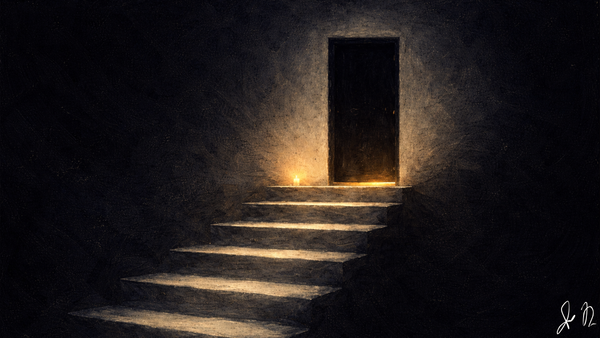
About them rose the remnants of a shrine: a circle of broken columns, stumps of pale grey rock jutting from the snow. Only three still stood whole and held a memory of a roof between them. The paved floor at the center lay swept clean and rimmed with the ice he had made in his long slumber. At its edge, a stair descended into the mountain's side, its high steps cut deep, leading down into shadow.
Algor walked and she followed. As the dusk deepened toward a starless night, they began their descent.
The mountain released them slowly. The moon waxed and waned, and the stairs gave way to an overgrown path, and the path to a road that wound through stands of black pine. By the time the trees thinned and fell away, Algor felt his nature calling to him again, and he knew that what he had promised her was already drawing against its leash. When the sky paled with dawn, they came upon a great plain that stretched before them toward the sea in the west.
The old road ran straight across that country. Broad stones had been laid there, fitted close and worn smooth by the passage of feet and wheels. Tombs loomed on either side, monuments of weathered marble and brick half-swallowed by grass, and here and there a lone column stood pale against the sky. The morning mist lay upon the fields. It hid the color of things and the busy detail of the living world; through it the graves appeared featureless, and Algor could almost imagine himself returned to the tranquility of his resting place.
Fiorentia walked beside Algor, her sage robes trailing, her copper hair catching what little light the morning offered. She was silent, and for that Algor was grateful.
The mist burned away, and the sun climbed and crossed the heavens before falling again. At night they rested beneath a broken arch.
The stars emerged, cold and many, and Algor sat apart from Fiorentia and marked how the dark enshrouded the plain, how the fog gathered in the hollows between the monuments and crept across the grass, slow and bleak, where the dead of forgotten ages lay beneath their stones.
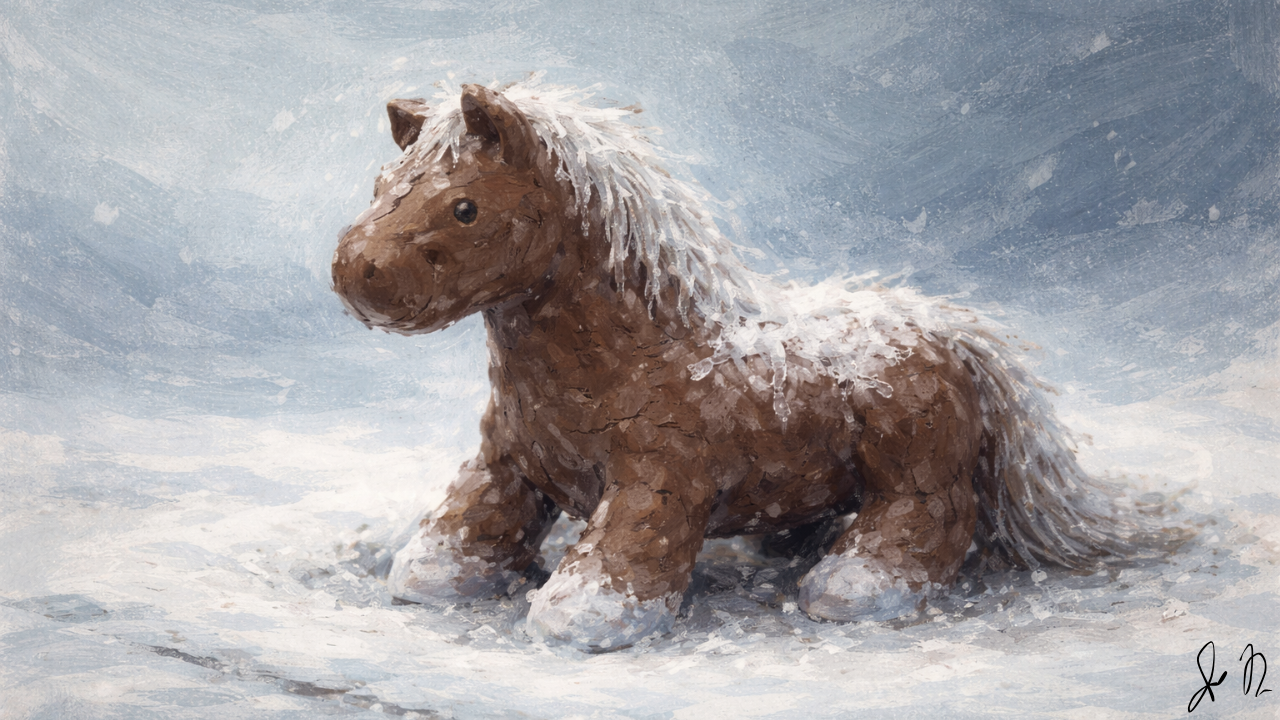
Fiorentia held a small toy, turning it between her fingers though her gaze rested elsewhere, upon the road behind them or upon some distance further still. She must have carried it with her since the mountain, for he had no memory of her drawing it forth, and now her thumb traced its surface with the ease of long habit. It was a horse, crudely shaped from clay, and the starlight caught the rough places where someone’s small fingers must have pressed and pinched the shape into being: the dented flank, the lopsided head, the legs that did not quite match one another.
"What is that?" Algor asked, and she looked down at it as if waking to find it there.
"My brother made it," she said. "Long ago." She closed her hand on the toy and tucked it into her robes; they spoke no more of it.
The sky paled in the east and the fog thinned and vanished from the road. How sweet it would be to sink back into the earth here, to find his long-sought slumber, Algor thought.
The road went on and the tombs faded, overtaken by orchards gone wild, then by vineyards untended for many seasons. Olive trees stood twisted on the hillsides, their silver leaves trembling in the light wind. Once they passed a great ruin whose roof had caved in and whose walls were green with ivy. Someone had made a fire there not long ago. The bones of a meal lay scattered across the floor.
Fiorentia had not spoken since their last rest. When at length she spoke of their errand, they stopped by a fountain that had once served travelers on this road. The basin was cracked, filled only with fallen leaves.
"Shall you not ask," Fiorentia said, "what deed condemned my brother to the dark?"
"I care not," Algor answered.
"Yet you agreed to aid me," she said.
"You gave me little choice in the matter," he said grimly.
Fiorentia looked at the broken basin, the worn stones beneath her feet. "Do you know how this road came to be?" she asked.
"Was I torn from my peace for the sake of a road?" Algor said.
Fiorentia smiled faintly. "No," she said. "My brother stole the Water of Life. And used it. For that he was cast down."
"Then he is rightly punished," Algor said. "What would you have of me—that I should weep for a thief?"
"You do not understand," Fiorentia said, and her voice sank to a whisper. "The fault is not his alone."
Algor said nothing.
"He was but a child," she continued. "When he sought my company, I turned him away. I had my own duties and concerns. He was little, and children are tiresome creatures. I thought—I thought there would be time." She fell silent and tears filled her eyes.
"He did not wait," Fiorentia said. "He was lonely, and so he made companions for himself, shaped them from clay in his own likeness. And it was for them he stole the Water. He gave them the breath that makes things move and speak and feel."
"And you would free him?" Algor said. "What is to prevent the powers from casting you down beside him?"
"So few of his creatures remain," Fiorentia said. "Soon the world shall be as it was before he shaped the first of them. The crime is nigh undone.”
Algor remembered again a time long before, when he had been summoned only to be used and discarded. He knew what it was to be alone. And the child, this brother of hers, had been cast into darkness for the crime of loneliness.
"I see," Algor said.
He rose from his seat, and looked toward the road that still lay before them. "The city is not far now," he said. "Come."
They came into the town on the evening of the third day, when the sky was red and gold. It lay not upon the shore but some leagues inland and rose before them grey and desolate, its walls much mended over the centuries, its towers dark against the amber of the west. Once it had been great and vast. That long-gone greatness still showed in the span of its walls and the grandeur of its gates. But it had passed, and what remained was a place of narrow streets and leaning houses, of squares that once served thousands and now served only pigeons.
Algor and Fiorentia entered unchallenged through an unguarded gate. The street wound upward, climbing toward the highest point, and Fiorentia hastened ahead.
The moon rose as they walked, full and silver, and by its light they arrived at the summit of the city's tallest hill, which commanded a wide view all around. And there, across the square, loomed a temple.
It was old and strange. Great walls of pale stone patched with bricks rose in a circle, supporting a dome that curved against the sky. Before the temple, a tall white fountain played. Its basin was broad and shallow, and the water that filled it was clear as glass.
Fiorentia approached the fountain and drew from her robes three ornate flasks of silver. She knelt at the edge and filled each one. When she was finished, she stoppered them and rose.
"One for you," she said, giving it to Algor. "One for me. One for Illia, for he has none."
He felt the cold of the water through the metal and knew it was not his own. He hung it at his belt and turned toward the temple.
They crossed the square and passed between the pillars at the entrance and into the shadow of the temple. The floor was smooth and marble, and inside curved the echo of their steps. At the center of the dome, open to the sky, was a great oculus through which the moon now shone, casting a column of silver light into the temple's heart.
Fiorentia halted at the edge of that light. Her grip tightened on the two flasks. Algor took Fiorentia's arm, and together they stepped through the moonlight and into the abyss.
Algor leapt awake upon stone. The floor beneath was marble, and the walls rose about them in the same shape; the dome curved above toward the oculus still, though no moon gleamed through the opening. Algor knew at once that this was not the temple they had entered. Instead of white, the floor was the color of old bone. The columns cast no shadows, for the light falling through the aperture was without source—a wan luminescence that filled the air evenly, touching every surface with its colorless glow.
Algor rose, and his movement made no sound. Where before the dome had returned each footfall as a curving echo, now it gave nothing back.
Fiorentia lay still where she had fallen. After a moment she stirred and pushed herself upward. The effort showed in the cords of her neck and the trembling of her arms, in the time it took her to gain her knees and feet.
"Have we passed through?" said Algor.
Fiorentia only nodded. Her face was ashier than it had been, the blue-green of her veins showing through the skin.
They walked out of the temple. The city lay before them: the same streets that wound down from the hill; the walls stood weathered and mended as they did above; the squares opened into one another in the same sequence Algor remembered.
In the first square they entered, figures stood in groups of three and four and five. Some wore farmer's rags, rough-spun and earth-stained; others the clothes of merchants, fine wool gone threadbare at the cuffs; some the attire of soldiers, leather and bronze gone green with age. Their eyes were open, mouths closed. They stood, fixed and waiting, and as Algor and Fiorentia passed, only their gazes moved, tracking the trespassers across the square, and the rigidity of their bodies made the movement of their eyes disquieting.
These were the dead whose traces he had seen on the road above—the cold hearths in the ruined houses, the vineyards fallen into wildness for want of hands to tend them. They had walked the world of the living once, and left it, season by season, age by age. They had come here, and here they were to remain.
They passed the square and turned into a narrow street. Grey figures waited in doorways and at windows, watching the pair. Some were children, small and unmoving, their colorless eyes turned toward the strangers.
Fiorentia walked beside him, and her steps had grown uncertain. Her copper hair, which had caught the light so fiercely in the world above, hung dull now, color fading from it as from autumn leaves left too long on the ground. Her face grew wan.
"Where shall we go?" Algor asked.
"There is a place," Fiorentia answered, scarcely louder than a breath. "When he was unhappy, he would go to the fig tree by the river. When I would not play with him, he went there."
The streets wound downward, and the buildings grew smaller and more crooked as they walked and the silent figures became fewer, until at last they moved alone through a quarter that had no memory of life. The stones of the pavement were cracked and tilted, and weeds grew between them. The houses on either side appeared dark and doorless.
Fiorentia stumbled as her foot caught on a broken stone. She pitched forward and Algor scarcely caught her by her elbow before she could fall. Her weight was light, lighter than it ought to have been, as if she were becoming less with every step, as if this place were drinking her very substance away as it drew the color from her hair.
The street ended and before them lay a river, slow and dark, moving between grassy banks. Upon the nearer shore grew a fig tree, its trunk so thick and riven with age that it seemed less a single tree than a company of trees fused into one another over centuries; and its roots, grey and sinuous as the coils of some vast serpent, broke from the earth, arched above it, then plunged back again. Its branches spread wide and mighty and its leaves were broad and dark green; the air beneath its canopy was cool and hushed.
Beneath the tree sat a small child, a boy whose hair was the color of wheat, pale and fine, falling about a delicate face, nearly to his elbows. He wore a simple tunic of white linen with wide sleeves; his feet were bare and his hands busy.
Before him on the earth lay figures of red clay, small and carefully made, no longer than a finger. They were shaped to be men and women, farmers and merchants, soldiers and children. The boy was moving them intently one against another, arranging and rearranging them in patterns known only to himself. He formed soundless words as he played.
He looked up with his dark eyes at the sound of their steps.
"Sister!" he cried.
Fiorentia released Algor's arm, and ran toward the boy, before he could spring up. Her knees gave way. She fell before her brother and gathered him into her arms. She held him against her breast, her hands clutching the fabric of his tunic, face buried in his flaxen hair.
"Illia," she said over and over. "Illia. Illia."
The boy held her with his thin arms around her neck, his little hands spread across her back, cheek against her shoulder.
"I knew you would come for me," he said.
"Forgive me. I should have come sooner," Fiorentia said. "I should have come when you called."
"Hush," the boy said, stroking her hair gently with one hand.
Fiorentia drew back and held Illia at arm's length, looking upon his face.
"Look at you," she said. "You have not changed. You have not changed at all."
"Such is the nature of this place," the boy answered solemnly.
Algor wished to give them more time, but now his nature was pressing against his will after so long away from his resting place. He contained it, the cold that he was, through the days of their journey, and now again it sought to be released, to become what he had been before Fiorentia called upon him.
"We must go," he said.
Fiorentia rose, taking Illia's hand in one of hers and leaning with the other against Algor's arm. The boy regarded Algor with curiosity but said nothing.
They climbed back through the empty quarter, past the cracked stone and the weeds, through the streets with watchers and the squares with the ghosts of farmers and merchants.
Fiorentia could no longer walk. Algor lifted her and carried her through the winding streets, and up the hill toward the temple. Her head lay against his shoulder, and her lips were no longer grey but blue.
Illia walked beside them, matching Algor's pace, his dark eyes moving between his sister's face and Algor, his brow furrowed, and he seemed to be deep in thought.
"Who are you?" the child asked as they left the square.
"I am called Algor," Algor answered, looking down at the boy.
"But what are you?" Illia asked again. "You are not weakened here. So what are you?"
"I am Cold," he answered. "I am the numbness at the end of all things."
The boy looked slowly down from Algor's face to his chest, then hands, and then to Fiorentia, who was now trembling, then away.
By the time they approached the temple, Algor could feel the cold spreading through his body, could feel the ice forming between his thoughts.
They passed between the pillars of the entrance. The dome curved above as before and through the oculus light fell in a column that struck the floor in the center.
Algor released Fiorentia and she stood, swaying for a moment. Then she reached into her robes and drew forth a flask of silver. She knelt before Illia and pressed it gently into his hands.
"This is for you," she said. "When you reach the other side, you must pour it into the fountain."
"Will you come too?" Illia said, looking at the flask in his hands.
"We shall follow," she said. "But you were cast down alone, and alone you must return."
"Go," Fiorentia added, still kneeling. "I shall see you soon, I promise, little one."
The boy's arms went around her, and Algor turned his gaze away, leaving them alone in their embrace.
When he looked back, the boy already stood at the center, small and ashen in his white tunic. He glanced at Fiorentia and Algor and then was gone, dissolving into the light.
Fiorentia let out a breath of relief and pressed her hand to her mouth. Her eyes were wet.
"He is free," she whispered. "He is free."
"Come," Algor said, giving her a hand. She was smiling, and her eyes shone brightly despite the pallor of her face.
They stepped in and the glow surrounded them. It filled Algor's vision, filled his senses, yet he stood there and felt nothing; no sickening fall of their descent, no force pulling upward, no movement or change. They remained within the heart of the temple beneath the oculus yet did not seem to rise.
Fiorentia reached into her robes. She searched the folds of the fabric pressing frantically against her sides, where her flask should have been.
"I had it. It was there," she said.
She looked at the flask at Algor's belt and abruptly ceased her search.
"He took it from me," she said. "When I held him, he took it."
"Illia," she cried upward as if hoping he would hear her from the world above. The name rose and struck the dome, fading into the dead air that swallowed all sound in this place. "Illia!"
"We must go," Algor said. "I cannot—I must return."
Fiorentia turned to him with her eyes wide and face bone-white.
"Of course," she said, her tone almost resigned. "They shall never come here now. They shall live eternally."
They stepped back from the light, and stood in the shadow of the temple, and neither spoke for a long while. The waxen glow fell through the oculus, unchanged, for in this place there was no sun to mark the hours and no moon to count the nights, only the sourceless pallor that touched all things equally.
Fiorentia sat upon the marble floor with her back against a column. The effort of lowering herself cost her; she drew her knees up and wrapped her arms about them and let her head fall back against the stone. Her skin had taken on the grey-blue cast.
Algor sat apart from her at first, as he had sat on the road above, for the numbness was gathering in him and his nature stirred beneath the surface of his will. This place would serve him better than the mountain ever had; no voice would find him here. He would have his stillness at last. Strangely, the thought no longer brought him peace.
Whether one day passed or many, Algor could not have said. When Fiorentia spoke, her voice was thin and cracked, and he had to lean toward her to hear it.
"I have no right to ask it. Yet I would ask your forgiveness," she said. "He is a child and children are cruel in peculiar ways, and so they do what serves them and feel no wound in the doing. I taught him that, I think. I taught him that others may be set aside when they grow tiresome." Her eyes closed, and a tear slid from beneath the lid and froze upon her cheek before it reached her jaw. "I taught him too well."
Algor considered her words, turning them over as numbness closed upon his thoughts. "Perhaps your brother did what his nature bade him do," he said. "As I shall do what mine bids me, ere long. I have not the strength for anger. Nor for forgiveness." The cold pressed outward, and he felt the air about him thicken and grow sharp. "But I would have you know that I am not sorry to have come."
On the third day, Algor felt the cold break through the walls he had built about it. It came first as a tingling in his fingers, a spreading numbness that crept upward through his hands and feet, and then as a weight that grew heavier with each breath. He attempted to speak, to warn her, but his lips had turned stiff and his tongue lay cold and heavy in his mouth.
Fiorentia looked at him then, and her eyes were the only part of her that still held color, blue-green and bright in her pallor. She crawled toward him across the marble floor, and when she reached him she could do no more than lean against his side and rest her head upon his shoulder. Her hair fell across his arm, and where it touched him it whitened and grew stiff with frost, and he thought that he should warn her or push her away, that his touch would end her faster than this place would kill her on its own.
"How strange," she said, closing her eyes. "That the cold could feel so warm."
Algor felt her body slacken as she slipped into the final slumber. He followed reluctantly, and the frost spread outward through the temple, to the entrance and into the squares beyond, through the streets of the city and over the river, halting the dark water, and on to the bower, swallowing the lone fig tree.
He sank into silence.
Above, in the temple of the living world, the moon shone brightly through the oculus. A boy with golden hair stepped out of the light, a vessel in each hand. He walked out slowly and stopped at the fountain. Smiling, he poured both flasks into the wide basin. The city lay grey and ancient before him.
Editor's Notes:
Daria Agad has done something quite difficult here. She has taken a source so compressed it barely qualifies as narrative—seven lines of Baroque aria, a supernatural figure roused unwillingly from frozen sleep—and expanded it not by padding it out but by finding what the source always implied and never said. Purcell's Cold Genius wants only to freeze again. Agad's question, the question that generates the entire story, is: what would it cost him not to? And what would it mean if, having paid that cost, he found he did not entirely regret it?
That question is handled with profound restraint. Agad never tells us that Algor is changed by what happens to him. She shows us that he cannot quite bring himself to sink when Fiorentia weeps, that he says I am not sorry to have come with the flatness of a god surprised by his own emotion, and that when he finally freezes again it is with a familiar resignation. The cold wins because that it his nature. The story trusts the reader to understand the distance between that nature and the idea of willpower.
The prose truly earns its archaism. Agad writes in a heightened register—ere now, lest, ere long—that could easily tip into affectation, but it works because the diction is consistent and the emotion underneath it is real and unornamented. When Fiorentia speaks of her brother, the syntax stays formal while the feeling breaks through it. It's a voice that sounds like myth and grieves like a person.
We also want to celebrate what Agad does with Illia, because it would be easy to miss. He is neither villain or victim. He steals both flasks, condemning his sister and the being who came to free him but does so out of love for the clay creatures he shaped in his loneliness. The crime that imprisoned him and the crime that keeps Fiorentia below are the same crime.
Overall, we published this piece because it is complete. Every image does work from the crude clay horse to the frozen tear on Fiorentia's cheek to the fig tree whose roots arch and plunge like a serpent, the oculus through which no moon shines. Nothing is decorative for the sake of it. The story knows exactly what it is. It's an expansion of an aria, an elegy for the cost of warmth. And it executes that knowledge without flinching and without excess.
It is a story that makes you go back to the source and hear it differently. That is not a small thing to do in just a few thousand words.—Jon Negroni
Daria Agad writes literary fantasy rooted in history, classical music, and myth. Her work explores archetypes, divine loneliness, and the cost of creation. She is also a digital artist inspired by medieval and early Renaissance traditions.
Support Cetera
Paid members get exclusive perks like bonus stories, the ability to comment, and more. Plus you'd be helping us keep the bills paid. You can check out the subscription tiers below, or you can leave a one-time tip if that works better for you.