Holiday Party
He told himself another ten minutes would not kill him.

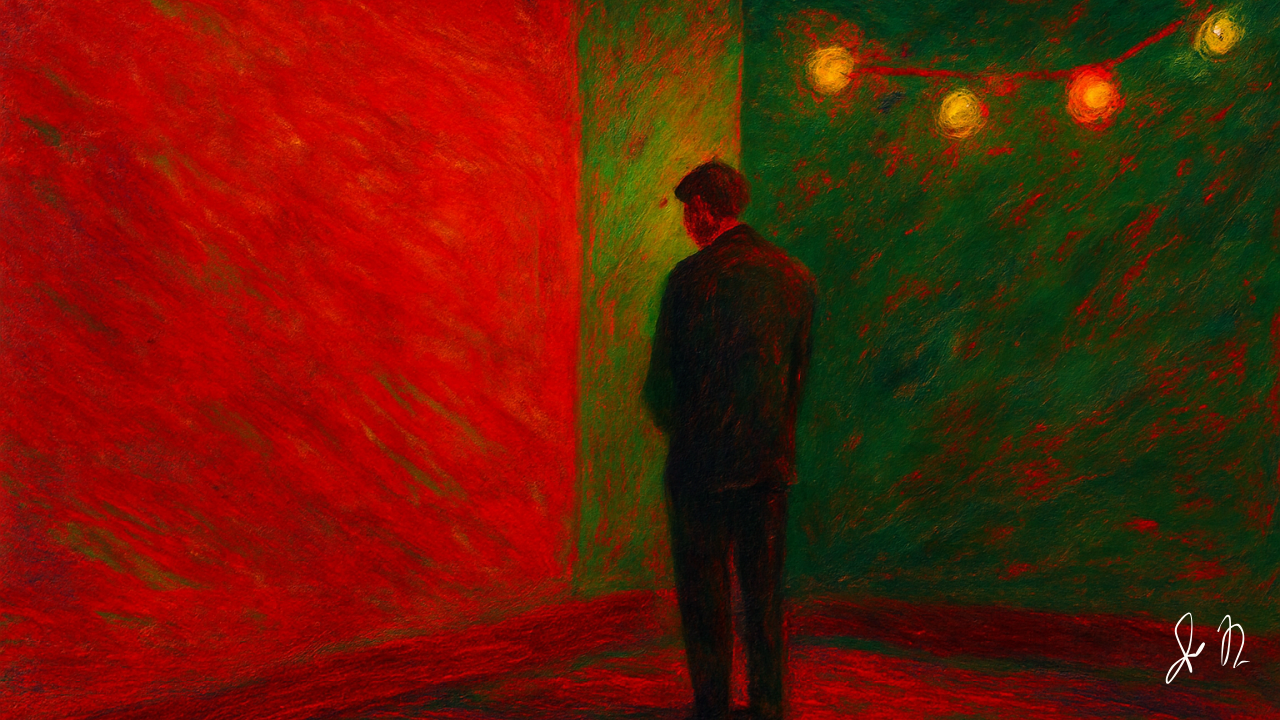
He arrived early because early felt safer. The hotel ballroom was already warm. The team had hung lights along the walls. A bar had been set up with white cloths and small napkins folded into shapes that did not look like anything. He took one and set it down to pass the time.
His name was Richard. He was twenty-four and new to the state and new to the job. He had driven in from an apartment that still echoed when he spoke. He wore a jacket that fit and shoes that did not squeak. He told himself this as he handed his coat to the girl at the door. She smiled and took it. He felt lighter.
He stood near the bar and watched people arrive. They arrived in pairs and in groups and with voices already warmed. Names were called and arms opened and shoulders turned inward. He recognized faces from meetings where people spoke in turn and from emails signed with first names. Here the names moved faster. He held his glass and moved his fingers to avoid the cold from the ice.
The bartender asked him what he wanted.
“Whatever,” Richard said.
The bartender gave him a gin with something green in it and slid it across. Richard took it and nodded as if the drink was talking to him.
He watched the room fill. The lights made the walls flatter. Music played and the volume would fade into the next song artificially. He could not place any of the songs. Holiday music, but that was all he could tell. A wreath hung crooked over the exit sign. A hotel employee fixed it and it sagged again.
He saw the groups of employees form without having to communicate with one another. There were the ones who talked loud and touched each other’s arms. There were the ones who stood back and laughed late. There were the couples who did not say they were couples. There were the people who worked together and did not speak at work now speaking too much. He tried to see where he might fit and found only edges.
A woman he recognized from accounting came over and said hello. She asked him where he was from. He said where. She said she had an aunt there and asked about the weather. He said it was warmer than here. She nodded and turned to someone he didn’t recognize behind him and Richard stepped aside and let it happen.
He drank too much, too quickly. The glass was empty before he noticed. He set it down and went to the food table. The food was arranged in careful rows, none of it doing anything for his appetite. He took one small thing and then another. He decided not to take a third so no one would notice. He wiped his fingers on a napkin and folded it twice and put it in his pocket. Just in case.
He checked his phone without reason. No messages. He put it away and stood by the window. Outside the street was wet and clean. The cold made a bright line along the curb. Cars passed and the light slid over them and was gone.
An important person clapped hands near the center of the room and called for attention. The manager said a few words about the year and the team and the season. Richard listened and nodded at the right places. Applause came and went. He clapped with the rest and felt the sound pass through him.
He moved to the side and stood where the wall made a corner. It was easier there. He could see and not be seen as much. He could feel the wall at his back and know where he was. His hands did not know what to do with the glass so he held it with both.
A man from sales stood nearby and told a story that had a beginning everyone knew and an end everyone liked. Richard smiled when the others smiled. The man looked at him once and nodded and kept going. Richard felt grateful for that nod. It counted as something.
He considered leaving. He had planned to stay an hour. He looked at his watch and saw that he had stayed thirty minutes. He told himself another ten would not kill him. He took a sip and let it burn a little.
A woman stepped outside onto the small patio and stood there alone. She wore a simple dress and held her coat over one arm. She breathed out and looked up at the sky as if checking it. Richard watched her through the glass and felt the tug of it. He waited. She stayed.
He went out.
The cold surprised him. The noise from inside fell away and left a thin hum. The woman nodded to him like she knew exactly who he was.
“Cold out here,” she said.
“Good,” he said.
She laughed once, short.
“I needed it,” she said.
“Me too,” he said.
They stood without looking at each other. Cars passed. Some of the sounds from inside managed to escape.
“I’m new,” he said.
“So am I,” she said. “Six months.”
“Two,” he said.
She bobbed her head like she was counting. She yawned.
“Do you like it?” she asked.
“I don’t know yet,” he said.
“That’s honest,” she said.
They stood a moment longer. He felt the need to say something and also the need not to spoil it. He thought about the napkin in his pocket.
“Well,” she said. “I should go back in.”
“Yeah,” he said. “Me too.”
They went back in separately, which felt right.
Inside, the music had changed. They turned the lights down a little. Richard felt steadier. He went to the bar and asked for water. The bartender gave it to him without comment. He drank it slow.
He did not stay much longer. He said goodbye to one person and then another. He found his coat and put it on. The room did not notice him leaving. That was fine.
Outside, it was still cold. He decided to walk for a while before calling a ride. The streetlights made small islands of light and he stepped from one to the next. His breath showed and then did not.
He tried to remember the woman on the patio and the way the cold had felt. He wondered if he should’ve stayed ten minutes longer than he had planned. He wasn’t sure what might’ve happened. He wasn’t sure if he wanted to know.
At the corner he stopped and looked back once at the hotel. The windows glowed. He turned and kept walking.
Author's Notes:
Sometimes, being introverted makes me feel guilty. Loneliness makes me feel guilty. I go to parties and gatherings and other places where I should feel privileged to attend, and I end up resenting the whole production and performance of it. The guilt comes from multiple places, actually. It also comes from a place of feeling like I'm rejecting a part of myself that I think I could cultivate, if only I worked harder, tried harder, changed myself harder.
Earlier this year, I completed a short story collection I'm planning to self publish in the spring called All Our Bright Ruins, and it's the culmination of my work as a literary fiction writer. Holiday Party is one of several concepts I had in mind for the collection but ultimately decided to save for Cetera based on its seasonality. Plus the fact that the length serves the newsletter/magazine format quite well.
Regardless, this type of short fiction writing is based mostly on my admiration for Ernest Hemingway, Raymond Carver (specifically "Why Don't You Dance?"), and Charles D'Ambrosio. Obviously, I am not foolish enough to compare any of my work to theirs, but the point is to strive toward reaching a place where someone can make the comparison and it won't make me cringe too obviously.
The intention is to write a spare, controlled piece that is deeply attuned to the emotional architecture of isolation and performance. To get the idea of loneliness across without using the word lonely. That takes a lot of restraint in the prose, which is the hardest thing about this style. You have to show what profound loneliness feels like to people who might not readily understand what it's like, or to make it resonate with people who know exactly what it feels like and are easily capable of seeing through inauthentic phrasing.
This is why I use the prose rhythm I do in this piece. It purposely mirrors Richard's psychological state (which is something I do for most of my stories, to be clear). The sentences are short. They're declarative. They stop where they need to and the syntax should feel like someone trying to maintain control and barely succeeding to not let anything spill over. That's how social anxiety works.
I also had this idea of making Richard an anthropologist of his own life. He watches the room "fill" and sees groups "form without having to communicate." These are all specific social observations that only someone on the outside would notice. Even when he does engage with someone in a somewhat genuine way, it's a minimal exchange on the patio. In the cold, so robbed of warm sentiment. She's "new" as well. Which is why it feels right for them to go back in separately. They're too honest for anything else.
I get that for some people, these types of stories can be frustrating or even accuse this of being a story where "nothing happens." But everything happens emotionally. The structure of arriving, observing, briefly connecting, and leaving? That mimics the shape of so many failed attempts at belonging that ring true for me and plenty of other people who either get it or get it by association.
Hence, I set it in a hotel. Hotels are "nowhere." They're corporate, temporary. Even the holiday decorations are messed up (napkins are folded weird and the wreath won't stay straight). The environment itself reflects Richard's displacement.
One more author you might want to check out if you're curious about more pieces operating in this vein would be Ottessa Moshfegh, specifically her short story "The Weirdos." My work isn't as dark as hers (or close to as good obviously), but it approximates that feeling of being outside of a person you're technically in close proximity to.
If there's one thing I hope my writing achieves as I continue to grind these stories out, it's helping people give a name to what their loneliness feels like on a deep, existential level. The first odd truth about it is that people like Richard want connection desperately, but their entire nervous system is wired for withdrawal. And it's not something we usual "say" or even think to ourselves in perfectly clear diatribes and monologues. It's through the simplest gestures and observations on nights where nothing seems to change. And it's not a call for sympathy, not even close.

Jon Negroni is a Puerto Rican author based in the San Francisco Bay Area. He’s published two books, as well as short stories for IHRAM Press, The Fairy Tale Magazine, and more.
Support Cetera
Paid members get exclusive perks like bonus stories, the ability to comment, and more. Plus you'd be helping us keep the bills paid. You can check out the subscription tiers below, or you can leave a one-time tip if that works better for you.