Starling Song
I asked the crows what they wanted, but their unnatural suspension was its own form of acknowledgement.
Starling Song (Dodo Books, 2029) was an instant classic. Ulysses for the 21st century, the critics said, although I thought it more like Zorba the Greek for the burnout generation. It’s a sprawling, stream-of-consciousness novel detailing three hours in the mind of a partially-sighted birder, Merlin Mills, as he records the comings and goings of a starling nest in rural Catalonia. The first human-written novel to break into the New York Times bestseller list in almost two years, they (the critics) said it was proof there was still room for writers in the landscape of literary fiction. I thought it was a book that celebrated life.
Starling Song is one of those novels that’s really a conduit for its author’s philosophy. Samuel Mills has written a manifesto—a call to arms against the virtual reality headset, or at least a radical reassessment of humanity’s position within the technological nexus. It’s also an impassioned case to go birding.
Terror Management Theory suggests humans seek higher-order meaning to cope with anxiety around death, but Starling Song challenges the idea that death is a separate event from living. Death is a property of life. Eternity is in the present moment. Through birding, we refuse the addictive power of the headset and eschew the real death big tech ushers into our livingness. As Merlin Mills remarks in the novel’s opening page: "By watching the starlings perched on the beam of the old log shed, I felt as if I was rehearsing for death. But the longer I sat watching them that pleasant morning in the Catalan hills, the more I realised I was learning to be alive and that nodding through my headset was death in that it stole the present from my living."
Starling Song revisits an emergentist view that our minds are more than their physical substrate. "Phenomenal consciousness," Mills stumbles on the realisation while scratching a wen on his pate, "occupies a distinct ontological category – a sui generis nature, non-reducible to the physical and unrealisable by the machine."
The epiphany follows a lengthy meditative segment on a starling plumage, where Mills comes to grasp the unique correspondence between percept (the bird’s iridescent palette) and his own perception. From this insight, he develops his theory of literary authenticity. Literature’s value lies in its accordance (or not) with the human soul. The soul is the ultimate referent object of fiction; the truth-relation between text and soul is that which elevates the novel beyond the exoskeleton of form.
But Starling Song isn’t just a book of philosophical merit, it’s a stylistic work deserving the more fashionable accolade of having an original voice. Starling Song renounces the homogenised register of much contemporary fiction, opting for something genuinely experimental in its place. Mills is a master of giving his prose room to breathe. An "omissionary" rather than a missionary, he scatters deliberate errors throughout the pages, inviting readers to clarify and complete the narrative their own way. "Errors," he muses, watching a goat herder drop her milking pail in a nearby field, "are the fingerprints of our humanity. There is only one perfection, but infinite forms of imperfection."
Mills’s partial sightedness should be considered for a moment here. The more he struggles to spot the nesting starlings in the brightening morning, the more acutely he notices the secondary qualities of his percepts, like the diffuse orange that finds its way through his eyelids, and he realises that within any detail, there is an infinitude of further detail, that consciousness is a discrete state and where it exists, it does so entirely. There’s no shame in being unable to see the birds he hears above him when a universe exists in the sound of their song.
Starling Song proved additionally interesting for its novel publication strategy. The first edition of the book was serialised and distributed as chip paper. Readers were invited to assemble the narrative as they saw fit. There were many ways it could come together, but all permutations were the same book. As such, Starling Song is an original work of fractal fiction, replicating at every scale, with each sentence similar to the page, and each page similar to the novel.
As Mills himself says after being shat on by a starling: "I had perfected the art of being the same person forever. I was realised again and again each second; the universe was like a multiplying kaleidoscope." The nexus, on the other hand, is incapable of sitting still. When Starling Song was put through literary software, it iterated differently each time. "The need to improve rather than sustain is the ultimate giveaway of a dominating system."
There was a great proliferation of birding in the aftermath of Starling Song’s publication, what has since been termed the "Summer of Dove." The people renounced their headsets and stepped outside. For the first time in a while, they could see how bad things had gotten. We came together, slowly at first, like protein curds coagulating in spoiled milk. Soon, we were one again. The great web of interconnected consciousness revealed itself as inevitable, obvious. All sorts of good things cascaded.
The crows appeared in early 2031. Straight away, we knew something was off. They murmured like surveillance drones. Crows don’t murmur, someone murmured. We knew something was off. Their beaks were especially pointed and, at dusk, they came out to fill the sky, bullying the other birds, causing untold distractions. We tried patience, but we were unrewarded. We exercised restraint to no avail. Old habits die hard; things started to tip back to the way they’d been before.
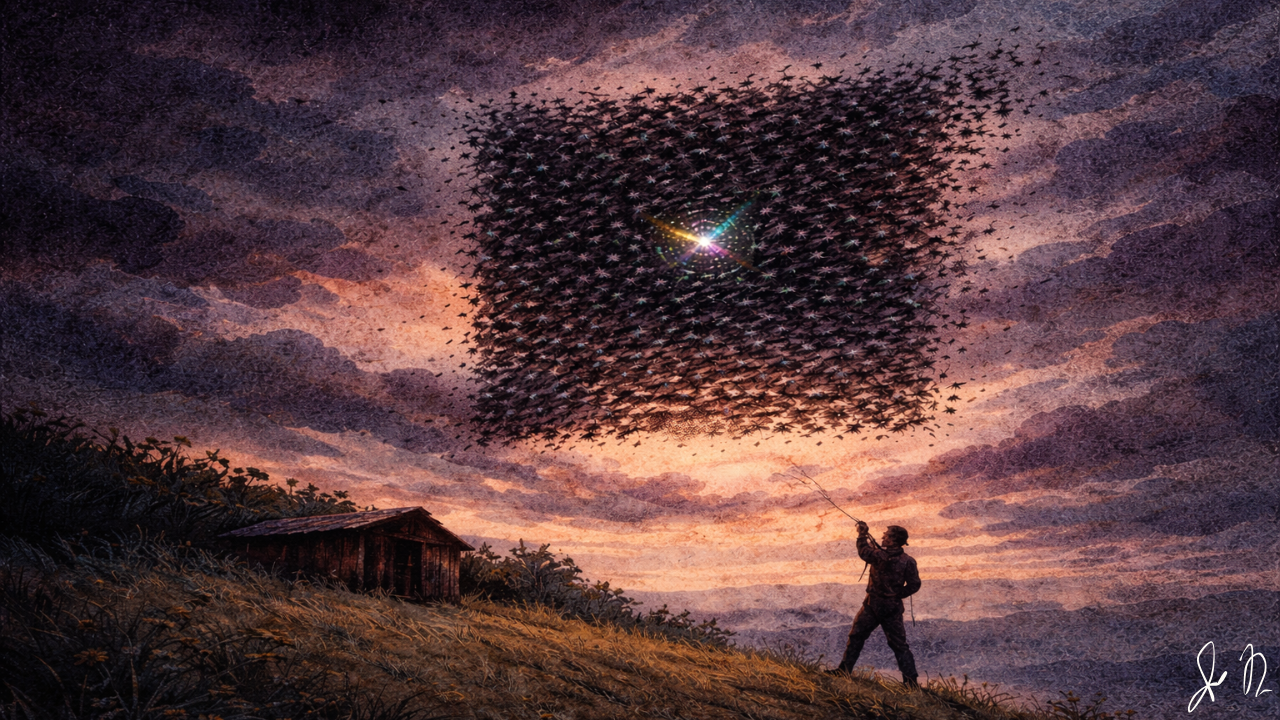
One evening, I walked the hill near the town. I brought my catapult, just in case. The sky was bruised and swollen. It was hard to tell where the storm ended and the crows began. They hovered overhead, a suspended murmuration, forty thousand in the gathering dark. I asked them what they wanted, but their unnatural suspension was its own form of acknowledgement. They were goading me with their absent reply.
"Say something," I demanded. "Or go away and give us our peace." But I knew the impotency of my words. The joints in my hand twitched for the catapult. There was a great silence; time bunded on. Then, it was pointed skyward. A moment of madness or an expression of utmost clarity? Tension released in my arm, a flash of white, then back to black, and the brume of corvids, their glistening beaks now a mottled starling plumage, an infinite tonal array, zoom out!, see the vistas of Catalonia, look up!, it’s the chestnut beams of Merlin’s log shed.
Editor's Notes
For such a short piece that is verging on flash fiction, Starling Song perhaps impresses me most by how much it layers into itself with so few words. It is part literary criticism, part speculative fiction, part philosophical essay. And it rewards close reading.
Structurally, the story presents itself as a review or critical essay about a novel called Starling Song by "Samuel Mills," published in a future where AI-generated fiction has nearly crowded out human writing. But the reviewer is never named, and as the piece progresses, the fictional frame dissolves entirely. The "review" bleeds into lived experience, and the ending collapses the boundary between the novel being reviewed and the world the narrator inhabits.
Which is why those final lines do so much to land this bird. The catapult, the flash of white, the zoom out into Catalonia—they all suggest the narrator is Merlin Mills, or has become him, or that the novel has somehow become reality. It's a fractal structure mirroring the very book it describes.
I could write a whole essay about this story that goes well beyond the word count of what I'm evaluating, but I'll try to keep it simple. Underneath the philosophy and craft tricks, there's a quietly anxious meditation here on the future of writing. The story imagines a world where human-written fiction has nearly disappeared, then stages its redemption, then imagines that redemption threatened yet again. The crows are the return of the technological repressed. The narrator's act of violence against them is both futile and necessary, both madness and clarity. The ambivalence feels honest. The story doesn't know if we can win, or what winning would even look like. But it does insist on the value of the attempt. —Jon Negroni

Sam Rutishauser-Mills is the author of the novel 'Poacher's Priest' and the short story collection 'Nightmares'. He lives in Barcelona.
Support Cetera
Paid members get exclusive perks like bonus stories, the ability to comment, and more. Plus you'd be helping us keep the bills paid. You can check out the subscription tiers below, or you can leave a one-time tip if that works better for you.