The Afternoon Paper
Brian hasn’t thought about Lindy in years. Then he finds her obituary in the afternoon paper.
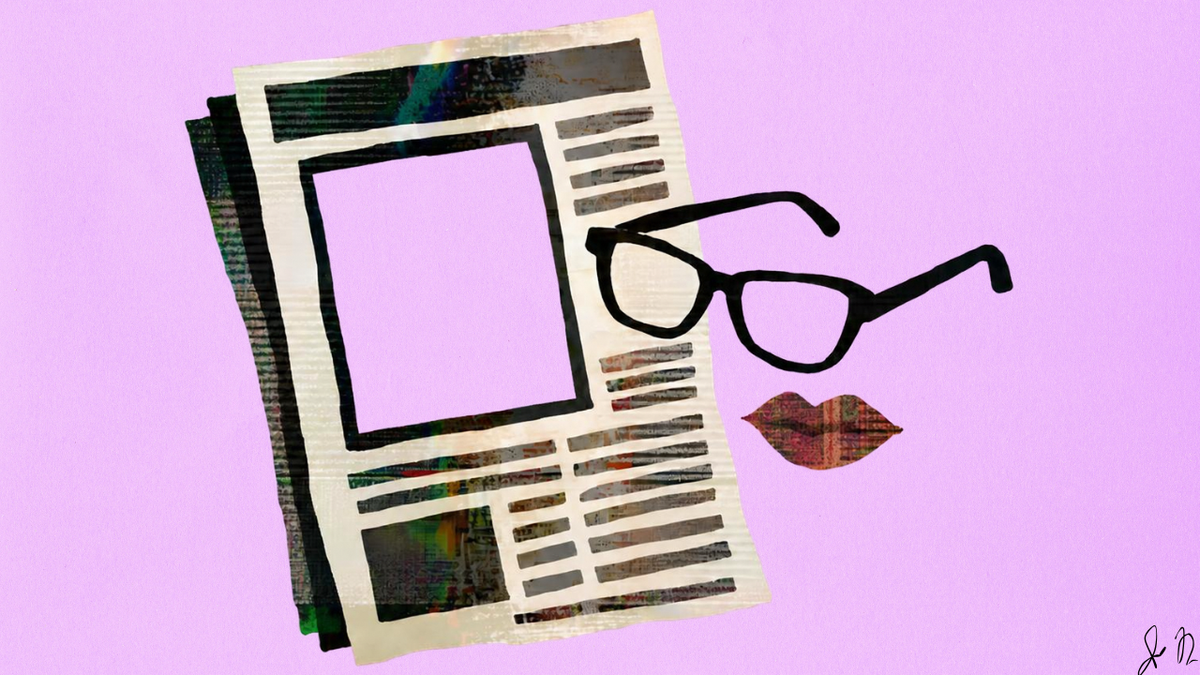
I sit in the kitchen and flip the pages of the Classifieds. I’m not looking for anything in particular, though, if I’m honest, I’m always looking to see what used Escorts are going for these days. I sold mine back to the dealer two years ago, and I’ve always wondered since if I got screwed. But I’m not really looking for used Escorts today. In fact, I don’t even read the ads. I just flip and sip coffee. Then boom — there she is with a black-and-white expression: Lindy MacIntyre.
I haven’t thought of Lindy in a long time. But there’s her picture framed in black on page D23 of the paper. And while I know I’m looking in the Classifieds, what the hell is her picture doing in the Classifieds? As I sit there, considering her face, all I can think about is how old she looks. But she isn’t, can’t be, that old. I notice her glasses are gone, and that her hair, grey from newsprint, is clipped short.
I stare at the print, her name in bold capitals: “MELINDA (LINDY) MACINTYRE.” They only use bold capitals for an announcement of some kind. Then I see what comes next: “…died on March 8 in her thirty-second year.” No mention of a partner or child. Then I say, “March 8,” but it comes out like a question. So, I read it again to be sure I’ve got the information right: “Survived by her loving parents, Theresa and Raoul, and her devoted siblings, Joshua and Lenora. In lieu of flowers, donations can be made to Covenant House, Lindy’s favourite charity. We hope she’s at peace in a better place.”
I lean back in my chair and look up. The calendar — the one I got from my friend Lanny, one of those real estate calendars with seventies-style photos of global landscapes — tells me it is Sunday, March 13. Also, according to the calendar, March is a spring-like ride down the Meguro River to gawk at cherry blossoms. And, Lindy died five days ago. I try the words out loud: “Lindy died five days ago on Tuesday.” My voice sounds unsure. Like I was, at that moment, back in high school.
Then I think, What did I do on Tuesday? I try to remember Tuesday, what it was. And as far as I remember, it was a regular day. The usual happened. Work. Lunch at a Thai place with Dale and Mark and Kyle. Brief talk with Mom in the afternoon. Grocery shopping. But I can’t recall details, like what I ate at the Thai place or what the hell we talked about. And it’s the details that are bugging me. I want, desperately, to remember what I did down to the details on Tuesday.
My hand shakes as I raise my mug. More coffee, I think. I get up and go to the counter where my coffee machine sits like a distraction. I stand there, not knowing what to do, holding half a mug of coffee I suddenly can’t stand the smell of. I can’t remember what my plans for the day are, or what happened yesterday, let alone in the days before Lindy died.
“Are you gonna finish that?”
I look up. A girl, with big red lips and thick black glasses, looks down at me.
“What? Am I gonna finish what?”
“Your lunch.” She sits. “It’s just sitting there, and you’re reading, so I assume you’re done? And if that’s true, why waste food? Besides, I forgot my lunch.” Man, she talks fast.
I look at my tray. I had only eaten half of a chicken salad sandwich and completely ignored the apple and granola bar. I look back at her. Well, actually, I look at those big red lips. “Go for it.”
“Thanks.” She picks up the sandwich and takes a bite. Between chews, she says, “I’m Lindy. Just moved here from New York. First day.”
“Brian.” I half-smile, then turn back to my book.
“Hey, you’re not gonna ignore me while I sit here eating your sandwich, are you?” she says, eyes staring into me.
“Uh, no. No.” I put my book down and drum my tray with my right hand. I don’t know what to say. I mean, I don’t even know her.
Then she asks, “So, what’s your deal?”
“My deal?”
“Yah, your deal. You know.”
“No, I don’t know.”
“Oh, come on. Where do you fit in here?” She pauses and looks around. “There’s some kind of system, isn’t there? I mean, there always is. I just wanna be up on it, you know? Who to avoid, who to really avoid.” She pulls the wrapping off the granola bar, then smells it. “I can’t eat anything that smells like porridge,” she explains.
I nod. This is weird. I don’t know anyone who speaks, well, so to the point. “I hate the smell of popcorn,” I admit.
“Really?” Her eyes widen. “That’s funny, cause it’s such a nice smell. This may sound super cliché, but that smell’s all about going to the movies. And I love going to the movies. Even if the movie’s dumb, going is the fun part.” She bites into the granola bar but keeps talking. “It’s funny how you can associate a smell with something you like, you know? Like the movies or a person. Like, whenever I smell anything cherry, I think of my friend Evelyn. She loves everything cherry, especially lip gloss. She’ll eat the frickin’ stuff.”
“Uh-huh,” I say for no reason.
“Well, Brian, you mind if I take the apple? I’m gonna go exploring. Unless you’d like to take me on a tour?” She pushes her chair back and stands, one hand on her hip. Like she’s waiting. And she is.
I shrug, say, “Sure,” glad she let go of the “what’s your deal” bit, glad when she hands me back my apple for a bite.
That day I took Lindy for a tour around the school. I pretty much liked her right away. Though she asked a million questions, she also told dirty jokes. She wasn’t at all awkward. I remember she smelled nice. Like wood that’s been cut.
I stand in the kitchen and remember that day, those big red lips, and wonder why, out of all the people in the cafeteria, she picked me. Why she didn’t pick anyone else. I remember my coffee and take a sip. It’s cold. I look at March’s cherry blossoms and wonder what I’ll do today. What I could possibly do today.
I can’t do anything but lie on the couch and pretend to watch TV. The obituary lies at my feet, and I catch myself glancing over at it every other minute. Lindy’s picture seems to be from another time. And I guess it is. I mean, all this time between graduating and now, I haven’t known her. What she’s been doing, where she’s been living, if she’s been happy. I knew her so briefly, so long ago, that I can’t fairly say I knew her much at all.
I turn the channel to CNN. News tidbits scroll along the bottom of the screen as Wolf Blitzer’s mouth opens and closes soundlessly. I turn my eyes to the newspaper on the floor.
We walk through the corridor, arguing about who’s braver.
“You’re so dumb,” Lindy spits, dragging her feet. “You won’t even talk to Sara.”
“What are you talking about? I talk to her in math class. I just don’t get a vibe. If I got a vibe, I’d ask her out. But I’m not gonna put it out there if I don’t get a vibe. What’s dumb about that?” I take a sip of soda.
Lindy snorts. “Please. Your idea of talking to her is asking her for an eraser.” She flashes her ticket for the ticket guy.
“I need to check it,” he says, frowning, holding out his hand.
Lindy rolls her eyes but hands her ticket over. “It’s true,” she says to me, smiling at the ticket guy as if he’d been part of our conversation and was about to agree that my attempts at small talk were subpar. Like the ticket guy cares.
I hand him my ticket after he splits Lindy’s in half. “You know, you’re one to talk. How long have you gone on about Greg? And what have you done about that? Nada.”
“Fine. We need to change our game plan,” she says, striding into the theatre.
“What do you mean?” I say to her back. She goes up the steps two at a time to the very back row and plops into the aisle seat. “Can I take the aisle seat? Just in case I gotta rush out to use the can.”
I manoeuvre around her knees and sit on her left side. “Nice of you to ask.”
She punches my arm. “Don’t be sarcastic.”
“Lindy…” I rub the spot where she’d laid her knuckles.
She just laughs, takes a mouthful of popcorn, and says, “So, what was I saying? You need a game plan.”
“What sort of game plan?”
“Well, for starters, you could try having a real conversation with her beyond math equations. Like offer to drive her home or ask her out for a coffee. Have a conversation.” She pauses, chewing. I can’t help but notice her lips are greasy with butter. They look so tasty. I look away and shift in my seat.
“Well, not everybody’s easy, like you are, to talk to.”
Lindy takes another handful of popcorn. She doesn’t respond, and I don’t know what that means. We’re both quiet for a while as the screen posts stupid movie trivia and the odd ad for dental cleaning. I feel like I’ve said something out of the ordinary.
Then she asks, “How can you stand it?”
I gaze at her profile. She looks different from this angle — the bulge of her eyes, the way her glasses stick out. “Stand what?”
“The smell of popcorn.” She eyes me sideways.
My cheeks go hot. “Well, I guess cause it’s your thing. How could I not stand it?”
She grins. Then the lights go down, the music starts, and we watch our umpteenth movie together.
For the life of me, I can’t remember what movie we had gone to see that night: some forgettable action thriller, probably. Whatever was out at the time. I only remember feeling different about Lindy after that. I didn’t think much about Sara anymore, who’d been out of my league anyway.
God. I haven’t thought of those days in forever. I’m still on the couch, flipping channels, not interested in anything. I leave it on a CSI marathon, and tune out to an old episode, a good one, where Grissom investigates a suspected killer whose touch is so hot it burns.
The Lindy from the Obituary picture sits at my kitchen table. It’s the kitchen table of my current life. She smokes. I don’t remember her ever smoking.
“I’m tired,” she says.
“Why?” I ask. I’m in a bathrobe. It’s the me of my current life. There’s half a tallboy in front of me.
“I just am.” She sighs, runs a hand over one cheek. “Of this. Of everything.”
“What’s ‘this’?” I shrug, pick up my tallboy, take a sip.
“Are you going to pretend you don’t know?” She stares hard.
“Look, I don’t know what you mean by ‘this.’” I shrug again.
“We used to be able to talk about anything,” she says, pulling out another cigarette. As she lights it, I see we’re no longer at my kitchen table. Now we’re in Lindy’s parents’ backyard, and it’s summer, and I feel claustrophobic. I look down at my legs and see I’m in a black tux. The Lindy from the Obituary picture is in an off-white dress.
“Did you come to talk me out of it?” She’s grinning.
“I don’t know why I came,” I say, and this is the truth.
She covers her face with the veil. “I don’t want to ever get married.” Those red lips shine through white tulle.
“So, why are you?”
“I’m not.”
“Then, why the hell are you in a white dress?”
“Aren’t we going to the stupid formal?” she says loudly before flicking her cigarette to the ground and mashing it with the sole of her white pump, no longer embarrassed by her parents’ knowing smiles and flashbulbs. Now we’re just bored, sitting in the bleachers of our school’s auditorium, downing schnapps from a flask, watching everyone dance.
“I thought you couldn’t care less if we went to this thing,” I say, wiping my mouth with my jacket sleeve.
The Lindy from the Obituary picture purses her lips, shrugs. “I just want to say I went, you know?” She eyes the dance floor. “I mean, I don’t really care.”
“Well, let’s get outta here, go do something,” I say, standing. “I don’t wanna sit here all night.”
She pushes herself up. “Well, what about one dance? I mean, we’re here. We may as well.”
I throw my head back, irritated. But there’s no protesting. I’m on the dance floor, and Lindy and I are moving together. Her arms are slung around my neck, my hands are clenched to her waist. We’re moving in a circle, and it’s warm and nice. We circle the auditorium, and I get warmer the more aware I become of her. Her head’s against my chest, and it’s like we’re hugging goodbye. She smells nice too: a mixture of vanilla and wood. We keep circling, round and round. We could keep going on like this, if we wanted…
I wake and the TV blares creepy music as Warrick and Catherine examine an SUV for blood spatters. My head pounds. I force myself up and notice the bay windows are dark. I search for the converter and turn the volume down. I need water.
I get up and almost slip on the newspaper. I want to kick it, but then I remember what it is. I grab it angrily and make my way to the kitchen, heading straight for the sink. I put the obituary down, grab a dirty glass, fill it with water. Then I pour it over my head.
Coolness fills my pores. I lick the drips that come off my nose, walk to the fridge and open the door. The light hurts my eyes, but I manage to find a beer.
I ignore the picture-perfect composition that is March in Tokyo and retreat to CSI, its blue glare. The obituary’s in my grasp. I lie back down, the tallboy in my other hand.
I bring Lindy’s picture up to my eyes. She no longer looks old. She smells like vanilla and wood, has full red lips and black glasses and black hair. She’s telling me a filthy joke, and I’m laughing, and breathing all of her in.
Adrienne Weiss is the author of Awful Gestures (Insomniac Press, 2001) and There Are No Solid Gold Dancers Anymore (Nightwood Editions, 2014). Her work has appeared in ARC Poetry, MockingHeart Review, Canadian Literature, Taddle Creek, and Room Magazine. She lives in Toronto, Canada.
Editor's Note:
Thank you for reading Adrienne Weiss’s “The Afternoon Paper.”
An obituary has the peculiar task of compressing an entire life into facts and figures. Obituaries include a name, an age, a date, a few surviving relatives. Brian responds to Lindy’s obituary by moving in the opposite direction. He wants details of the ordinary Tuesday on which she died, then of the years when he actually knew her. Memory begins supplying what the newspaper cannot, including the cause of death.
What makes “The Afternoon Paper” so affecting is the instability of that recovery. Brian remembers smells, greasy popcorn, a stolen sandwich, the unusual cadence of Lindy’s conversations with him. Yet the woman in his dream wears the face from her obituary and speaks from years he never witnessed. His memory invents a person who never existed but also did.
Brian grieves her, yes. But he also never knew her, not really. And he knows it too well. The point is that she is lost to him in many ways he can't care to wrap his head around. Brian can’t recover Lindy’s missing years, but he can recover the sensation of having known her for a moment in time. So by the final page, that sensation has become vivid enough to breathe in and move on from.—Jon Negroni
Support Cetera
Paid members get exclusive perks like bonus stories, the ability to comment, and more. Plus you'd be helping us keep the bills paid. You can check out the subscription tiers below, or you can leave a one-time tip if that works better for you.