The Silence Between My Thoughts
I counted three sets of eyes. Looking out at me. Judging my frailty.

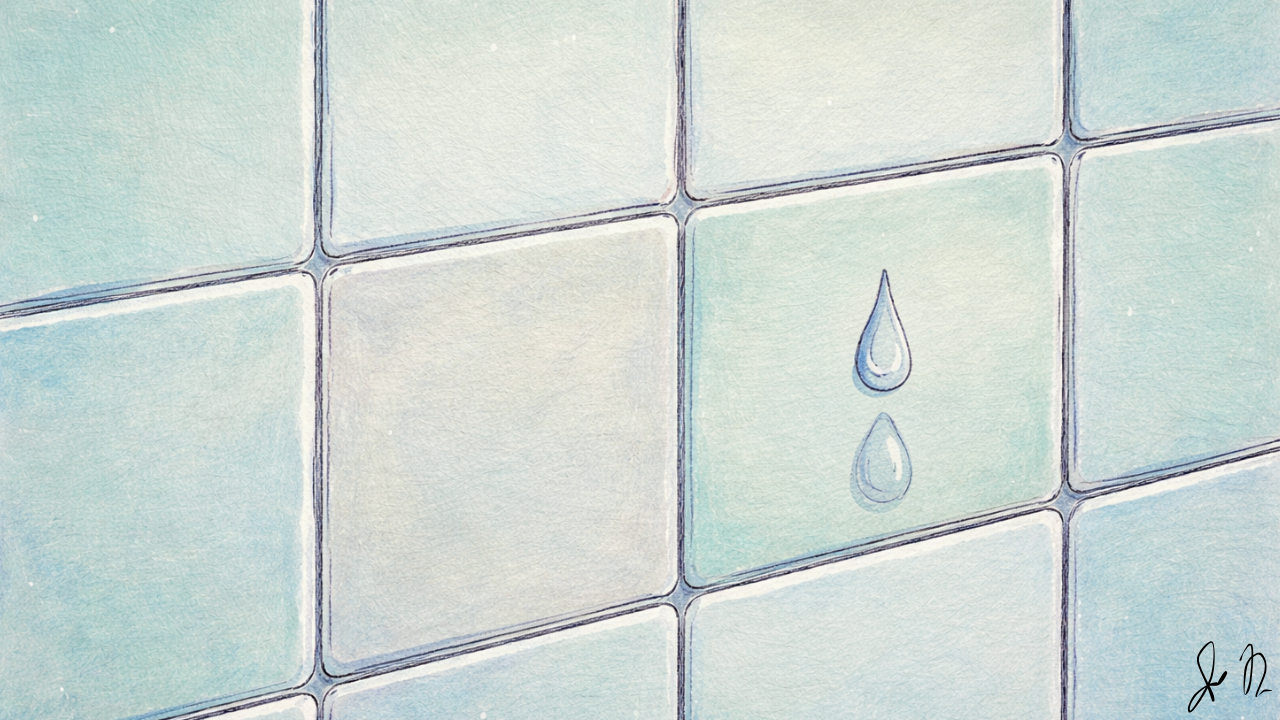
The first thing I saw was the blinding blue of tiles through and against my pupils. Blurry, my sight had been. And my neck, stiff as a board, ached at the insult of turning it. My body was upright, held against something else that was just without the limits of my sight. And said limits of sight pestered me so, for try as I did, I couldn’t see past what was just in front of me. Nothing but the blue tile. Nine to twelve of the geometric boxes lined up against the wall. And upon them I saw water drops racing down to a bottom I couldn’t see.
“Put your leg up, honey,” came the disembodied voice. Highly intoned, as though radiating affection.
My head banged from within with resounding thuds against thuds. Or throbs? I didn’t know what thuds were. I didn’t know what sounds were. They just were. Sounds. A person talking at me. My legs and feet were drained of any and all sense of strength, noodley they were. Bones were supposed to hold me up but why did they fail me so? I could feel the wet drip off of my mouth and fall down below what I could see, into the abyss below me. And to me, all that was me, was what I could see. Just a floating head that could think, and hear and see. Around all I could see was an ominous darkness hindering my field of view. A profound fading dim just at the corner of my sight. White or grey or black, it faded into what was behind it. A perilous vignette it was. Occasionally streaked with the clear of wetness.
One moment I was there, and the next I was sat. I have feet. There is a window, and there are figures before me. People, I think they are, like me. I’m a person.
“Sweetie, open your mouth,” came the command from the disembodied entity, and in a moment, a spoon flew into my open mouth with white stuff on it.
And I close after its entry, instinctively. I chew. My tongue was heavy, stuck to the floor of my mouth. It would not lift. It tasted bland. My eyes watered. A wet line, I felt, beside my nose, all the way down to my chin. A tear? The faces about me seemed familiar. One was of a softer yet older texture. She was shorter than me. Her hair was tied into a bun behind her head. The other had a harder face, his build was stocky, and his hair was short and close to his scalp.
“Last night, he jerked in his sleep.”
“At about what time?”
Suddenly, I was in water. The surface tension swapped and swatted at my chest. My sight, still occluded by the dim. And all about me were faces, attached to bodies. They played. They were younger. More of them close to my height. I am a child. I was a child. We were in a water park. Then I see them: the large colored contraptions ascending and disappearing into the sky. Or wherever the place above my sight led up to. I couldn’t look up. I couldn’t turn my neck. The waterslides coiled this way and that all about that place, it was as though they would wring my neck if I didn’t fixate my gaze upon them. One slight glance away and they would become snakes, ginormous as they were.
There was a girl I was swimming with. She liked me, I think. She was no taller than my shoulders and her voice, even in that short instant, was filled with this casual mocking tone. But as she said each word to me, there was a glint in her eye. A shine that betrayed her intent. And I could see it, I could see her. This, the fading dim did not occlude. She was in full view of me. And she spoke to me a few times, but no sound exited her lips. Nothing but inferences I feel, like it was a dream. Like it wasn’t real.
Once more, there was tile before me. This time the wall was of checkered patterns of dark and light green tiles. As of a heavier tint than grass. So, my torment was of a greener scale. I recognized those tiles. These were the tiles of the bathroom I had grown up washed in. My mother was before me. I was naked. In her hand, she held a washcloth, and in the other there was a bar of soap. She was washing me. The walls span. That light. That goddam light. It was fixed to the wall above the door ahead of me. Its rays blaring as if straight into my optic nerve. I could feel the light piercing my brain and radiating… radiating. Or was that something else?
“Okay sweetie, let me go get the towel,” she said as she disappeared from my sight.
What was that?! It was happening again. Mother! Mother! What is happening? A strange overwhelming sense had consolidated my limbs in an instant. I fell harder than a sack of potatoes, hitting the tile with all my weightily force. I heard the sound, like a crack to porcelain. Ow! My head throbbed. No, it screeched. And I opened my mouth and pushed out the air and sound with all my might. A hand reached out for me from above.
“Oh sweetie! Oh sweetie! I’m sorry, I’m so sorry!” My mother said as she embraced me, wrapping the towel around my broken body.
Was my body broken? Or just my mind? They stared from the door. Their looks of pity and of associated torment, deceptively pasted upon their faces. I counted three sets of eyes. Looking out at me. Judging my frailty. It was their fault. Or was it mine?
“I hate this! Someone kill me!”
“I can’t do this anymo…”
It had been a week since I fell. My movements, which were hardly any, were constrained to just a twitching of my brows and the casual floppy futile jerky motions of my limbs. My neck felt as though I was shackled by chains. Like a slave to this thing that had overridden my body. A thing that I answered to for weeks on end. It still kept my sight, and just as much along with it, it took too my wakefulness. For I would slumber for ceaseless hours, only to awake to the same debilitated nightmare. In a matter of days, or weeks, I’m not sure, when it returned to me the faculties of my limbs, just barely of course, I began to pray. To something I still could not see.
“End this torment please.”
“My body and head ache.”
“Is this death, is this what comes after?”
But I had fallen and felt the pain. I knew this to be of the living. It had made sure to know that it tormented me within the confines of life. Keeping me just without the edge of death, but still within the well of despair. I would have taken to the knife, but my body, my limbs, were too weak to make the cut. And each day dissolved into the next as fast as the previous evaporated from my mind. There was no yesterday, no tomorrow. Not even a today. There was a now. A current state of turmoil on my end succeeding itself in repetitive consecutive days to no end. And for a moment, I imagined the festive season passed me by. Was that Christmas? It hardly mattered. The only holiday I would celebrate belonged to it. And its holiday was my torture.
Suddenly I was awake. It was pitch black, the air around me. Nightfall again?
I can’t breathe.
I can’t breathe.
My back was on the bed, and my sight was transfixed to the wooden frame of my brother’s bunk atop me. But I was not in my withered, diseased body. I was floating above it. Watching myself gargle on my own stomach contents returning back up probably out of the dissatisfaction of having been digested by such a pathetic body. With haste, my brother descended from his bed, grabbed a bucket and forced my face into it, spilling whatever was in my mouth out. And he slapped me between my shoulder blades. I coughed, and I returned to my body, gasping, heaving.
I can’t die, can I? It won’t let me.
My baby brother frolicked before me with his friends. Playing with his toy cars, driving them up and down along the pavement. I envied him. Envied his agency taken for granted. It did not want him. It had me. And kept me for itself. My head still throbbed. And the wardens. Ooh, the wardens tormented my days by forcing me to walk among the normal and sane.
“Walk until here, just try, I’ll catch you,” they would say. But as I stepped, the ground would give way and become the sky. I could see the sky now. It was blue whenever I saw it. But it lived somewhere in there. Somewhere everywhere.
It taunted me with the perfection I wouldn’t enjoy. I was the imperfect thing. The tainted object. And why couldn’t I see?! Then I was on our living room couch. As though whisked away across time and space. Beside me sat a beautiful girl. Her complexion was dark, and her lips were fuller than any I had ever seen. But her face was unfamiliar, and try as I may have, I would not remember it with each passing succeeding moment. Not among the ones that resided within that home. She was kind and treated me delicately. When came time for my scheduled evening walks, she gladly escorted me round, her arm around mine.
“She just scares me.”
“Oh, come on, mom is pretty cool. She wouldn’t mind,” I heard myself say. It allowed me to speak now. It allowed me to think. But still drank from my bones and muscles like a vampire, like a tick.
I woke up from my parents’ bed this time. It was bright out. Maybe about midday. The television was loud against my ears. As I walked into the living room, there was just my sister. Her tote bag placed on the table as she unpacked whatever was inside. In the kitchen, something fried upon the cooker. I was steadily standing, erect against gravity. I gave it no mind at all. I spoke to her.
“What time is it? What date is it today?”
And my sister replied, with a quizzical stare on her face, “Are you okay? I think you need to go back to sleep.”
No, please. Don’t give me back to it.
Editor's Notes:
When we read “The Silence Between My Thoughts,” what struck us immediately was how closely the writing matches the experience it describes. The piece centers on a severe neurological episode—likely prolonged seizure activity—and instead of explaining that experience from the outside, the author lets the form of the story recreate it for us.
Notice how time works. Scenes do not unfold in a steady, chronological way. Moments appear abruptly. Transitions are missing. The narrator’s sense of self comes together slowly, almost experimentally. At first glance, this might feel fragmented. But if you stay with it, you begin to see that the fragmentation is intentional. The structure is doing the same work the subject is doing. It places us inside a mind struggling to connect one thought to the next.
Look closely at the opening pages. Consciousness arrives step by step: tile, water, light, sound. The body registers the world before the mind can name it. Only later does identity emerge. By the time the narrator writes, “There was no yesterday, no tomorrow. Not even a today,” we have already experienced that disorientation ourselves. To be clear, the technique is not decorative. It helps us feel what the narrator feels.
The image of the “perilous vignette”—the darkening at the edges of vision—is especially important. On a medical level, it reflects what can happen at the onset of a seizure. On a symbolic level, it becomes a way of understanding the entire illness. Life narrows. Vision is partial. The world is present but incomplete. The silent girl at the water park deepens this idea. She is visible, but the connection to her never fully forms. The body can see; the mind cannot reach.
It also matters that the illness is called simply “it.” The story never pauses to provide a clinical label. That choice keeps us in the narrator’s perspective. The threat feels intimate and constant. It behaves almost like a living thing. Something that feeds, that remains attached. When the narrator says, “It did not want him. It had me,” we understand that the illness has become a presence with its own terrible logic.
There are moments where the sensory detail softens—particularly in the scene with the girl on the couch, whose presence feels less vivid than the physical surroundings. But the ending regains its clarity. “No, please. Don’t give me back to it.” By that point, even sleep has become frightening. Something that should offer relief now threatens a return to suffering.
Stories like this are sometimes mistaken for unfinished drafts because they do not move in a straight line. In our view, the opposite is true. The fragmentation is purposeful. The author understands that to write about a mind coming apart, the writing itself must shift. That alignment between form and experience—and the emotional honesty that runs through it—is why we chose to publish this piece.

Dylan Siunwa is a Kenyan writer working in poetry and literary fiction. His work explores memory, interiority, loss, and moments where the ordinary brushes against the unseen. He draws on personal history and cultural context to examine vulnerability, belief, and the body as a site of meaning.
Support Cetera
Paid members get exclusive perks like bonus stories, the ability to comment, and more. Plus you'd be helping us keep the bills paid. You can check out the subscription tiers below, or you can leave a one-time tip if that works better for you.