Woe to You Building Tombs
Michaela has built a quiet life around a terrible secret. Now she’s inviting someone inside.

Michaela pressed the release, her boot lid lifted with a soft sigh, and she knew that the man was going to find it. She had watched his hands, capable and methodical, as he’d crouched by her rear wheel, loosening the lug nuts before jacking up the car, when he’d said, “Let’s get that spare,” and moved to the boot. Wedged in there was a dark green book. Looking back, Michaela was annoyed with herself: This is a world where one careless moment can undo you, but here I was letting this man root around in my car. But she also knew that this irritation only masked a deeper sensation she had been experiencing recently. It would have been so easy, so safe, to have just taken it out and burnt it or tossed it in the sea, rather than wait for someone to find it (“Play with fire,” Emma, her daughter, said) and see what would happen, feel the ground tilt beneath her feet.
“You get off on the idea of being found out. That’s called psychological masochism.” Emma wanted her to name what was getting harder to ignore. After the incident, after Michaela slammed the spare tyre compartment shut four months ago, too frightened to take a closer look, too ashamed to touch it, something had developed in the pit of her stomach every time she drove the Mercedes. The same tremble she got when she went into the shed, which she now did several times a week. Michaela would tell herself she was looking for something (garden shears, plant pots, the box of Christmas decorations) but really she went to look at the trolley, sitting there beneath a collapsed deckchair and a cracked laundry basket, the tinsel still tied to the handle, crushed and lifeless. She felt guilty, but also something else, something she didn’t want to specify. When she touched the cold metal, saw the paint streak still there despite the rust creeping in, she was strangely, disturbingly, alive.
“OK,” she said. “I’m an adrenaline junkie.”
Michaela and Emma had talked about the ‘thrill of proximity’: keeping the trolley and the book was a way for Michaela to see how close she could get to the edge without falling. Emma disagreed and wanted to dispose of them. That would solve it, although Emma would never say that out loud. Sometimes Michaela couldn’t tell if Emma was speaking as her daughter or as a doctor, if she was offering advice or issuing warnings, if (as she sometimes suspected) Emma was waiting for her to fail so they could both stop pretending. Of course, Michaela could have just asked, if she’d truly wanted to know.
During their daily calls, Michaela usually sat on the cream linen sofa positioned to face the French doors. Emma liked that, she’d said once, she could imagine her mother looking at the garden, at the shed.
“You don’t like me forgetting about it?” It seemed a strange thing for Emma to want.
“Forgetting is dangerous,” Emma had said.
“What do you think about? When we talk?”
Emma had paused. “The timeline. The variables. The risks.”
“Do you ever think we’ll be okay?”
“No.”
“Is it raining in London, too?”
“No.”
Michaela shifted the phone to her other ear (they never video called; the absence of eye contact allowed them to be more frank with each other). As she resumed her story, the grass outside was glistening with rain.
The moment the man had reached into the spare tyre well, his hand disappearing into the dark cavity, something in Michaela had gone very taut and very alert. The book had emerged in his hand, its plastic cover split along the spine, pages swollen from damp, and in that suspended second before he could focus on what he was holding, she’d felt it: that hot, illicit gratification she’d been trying not to name.
Before the discovery, Michaela had been dropping her gym bag onto the back seats when she’d seen the rear tyre: flat, the rubber sagging against the tarmac. She stood in the car park, Friday lunchtime, the lot almost empty, and swore quietly.
“Need a hand?”
She’d turned. A man was walking towards her, gym bag over his shoulder, reading glasses on a chain around his neck. Late fifties, solid build, greying hair. He was smiling.
“I’ve got a flat,” she’d said.
“I can see that. You have a spare?”
“Yes, but I’ve never changed one.”
“Well,” he’d said, setting down his bag, “today’s your lucky day.”
Michaela could have called roadside assistance, but she wanted to see what would happen.
When the man held up the book and asked if it was hers, she reached out – hand firm, voice firm, everything collected apart from the electric current running under her skin – and took it from him, feeling the weight of it, the wrongness of it, the magnificent dangerous audacity of having kept it. “Must’ve fallen in there when my daughter and I went to the beach. I’ve been looking for it.”
He glanced at it: “Library book. Bit overdue, I’d say.”
“Just a bit,” she laughed, “thank you.”
She looked directly into his face, expecting suspicion, doubt, a flicker of recognition, but she only saw mild curiosity and helpfulness, a man doing a good deed. She smiled her most grateful smile.
He fitted the spare tyre, lowered the car and tightened the nuts in a star pattern. When he was done, he wiped his hands on a cloth from his own boot. “All set.”
“Thank you so much. I’m Michaela,” she said, clutching the book to her chest.
“Dan.” They shook hands.
“Mom, you didn’t befriend him, did you?”
“I think it was the book that made me do it.”
“You know what the thought of being found out does to you,” Emma said. “But do you ever think of what it does to me? Is this because of Dad?”
Michaela closed her eyes and squeezed the bridge of her nose. She wasn’t stupid: Emma’s guilt was a living thing between them, but so was their closeness. That April night welded them together in a way Peter’s death nineteen months ago hadn’t managed, because she and Emma were co-conspirators now, partners in something unspeakable. She would get rid of the evidence and go back to things that had once grounded her: gardening, classical music, practising her German. Bringing Peter into this was not fair.
“I think about you all the time, love.”
“Maybe this is your way of punishing yourself?”
Michaela sighed. Emma often found a way to bring up Peter’s death. He was a heart surgeon, meticulous about cardiac health, and he’d woken her at 3:27 AM with his hand on her shoulder, his voice steady despite the pain showing on his face. “Call an ambulance,” he’d said, “I’m having a heart attack.”
She’d fumbled for her phone in the dark, dialled, spoken to the operator with a calmness that surprised her, then helped her husband down the stairs to wait by the door. The paramedics arrived within eight minutes (she’d timed it, watching the kitchen clock) and within twenty they were at the hospital where Peter had performed hundreds of surgeries, where everyone knew and respected him, moved with practised efficiency to save one of their own.
When they let her see him afterward, he was pale but alive, tubes and monitors surrounding him like a familiar choir. “Go home,” he’d whispered that evening, “get some rest. I’ll be here tomorrow.” She’d hesitated, wanted, should’ve, stayed. But he’d insisted with the gentle authority he used with anxious patients; she needed a shower, clean clothes, maybe an hour of sleep. Emma kept calling from London all day. Michaela had assured her there was no need to rush back, that she’d see her father at the weekend when she could change her shifts and catch a flight to Dublin. “He’s stable, he’s going to be fine.”
She had been towelling her hair after washing the antiseptic hospital smell off herself when her phone rang. Peter’s colleague, Dr. Zeleny, her voice careful and professional. Complications. Arrhythmia. They’d done everything they could. She needed to come back now. The aching had lodged itself in her chest that night. She should have camped in that blue vinyl chair beside his bed, she should’ve held his hand. Peter had died alone surrounded by machines that couldn’t save him. When Emma arrived twelve hours too late to say goodbye, she’d said: “You should have told me to come. I would’ve come.”
“I know,” Michaela had whispered, “I’m so sorry.”
Emma had hugged her then, “How are you feeling, Mom?”
How was she feeling? How? She hadn’t been there when Peter needed her. She was conditioning her hair while her love’s heart beat for the final time. “Like I’m breaking.”
“Mom,” Emma said into the phone, “you need to stop doing this.”
“Doing what, Em?”
“Punishing yourself for Dad’s death to justify what we did with the trolley. They’re not the same.”
“Aren’t they?”
“No. With Dad, you made a reasonable choice that had an unpredictable outcome. With Bagatha, we made a choice that was wrong. That’s the difference.”
Michaela closed her eyes again. “I know.” The rain was falling harder now, drumming against the glass.
Dan’s grip was warm and solid. “You come here often, I’ve seen you around.”
“Three times a week, usually. You?”
“Same. Creature of habit. I even park in the same spot every time.” He gestured to a space two rows over. “Makes it easy to find the car.”
They talked for a few minutes. He told her he was an officer with the National Economic Crime Bureau. Divorced, two grown kids. She told him she was a pharmacist, widowed almost two years ago, one daughter in London. Before they parted, he asked for her number, and she gave it to him.
She drove home with the book on the passenger seat, took it inside and, standing in the hallway, turned it over to read the title. Holding it, Michaela was struck by the precision of the due date stamped on the inside. Bagatha had expected to walk through the automatic doors, shake the rain from her coat and hand it across the counter. A receipt served as a bookmark, placed halfway through a chapter. Michaela took the book up the stairs and put it in her bedside drawer, the piece of paper still marking the place, waiting for the reader to come back.
“A police officer, Mom?”
“Fraud investigations, he’s not involved in…”
“Still, Mom!”
“He doesn’t know anything, we met at the gym, he helped me with a flat tyre. He’s nice, kind.”
“And?”
“It’s been nearly two years since your Dad died, I’m allowed to…”
“I know. I’m sorry, Mom. I want you to be happy, I do. Just… be careful. Don’t get caught, get rid of it.”
“I am being careful. Trust me.”
Michaela and Dan sat by the window in Nonno’s Cucina. She’d suggested it because the arancini was excellent and it was near the pharmacy where she’d worked for eighteen years. Dan wore his reading glasses on a chain around his neck; his eyes were very deep blue. “This is nice,” he said.
“Yes. The food is delicious here.”
“The whole evening.” He took a sip of wine.
Michaela smiled. “Was it strange, what I said earlier? About the case?”
“No, she was well-known around town. The guys in the office still mention it at times.”
“Yes. People looked out for her. I remember the vigil. It was very moving.” Her fingers turned the stem of her wineglass.
“Did you know her?”
“By sight. I gave her a scarf once, in winter.” She remembered the way the woman had wound it twice around her neck – efficient, practical. That was the sad truth of it. She had been a fixture. A migratory creature who’d stayed. Children used to wave at her. Shopkeepers had kept aside bruised fruit for her. She’d moved along the high street with that trolley as though pushing a pram with an invisible child, the metal rattling at every kerb. Plastic bags fluttered from its sides like tired bunting. It was her wardrobe, her pantry, her bedside locker. At Christmas someone tied tinsel to the handle. Everyone called her Bagatha, though never to her face. She had a real name; Michaela had heard it at the vigil, but it’d slipped through her like rain through a sieve.
Dan took another sip. “The trolley is the key, apparently. Paint transfer, if they find it, they can match it to the car.”
“Have they checked all the local cars?” The boldness of the question caused a million little stabs to dance across Michaela’s skin, making the back of her neck break out in sweat.
“As many as they could without warrants. But there are limits to what they can do without probable cause. And it may not have been anyone local at all.”
About two weeks after the accident, a guard had knocked on Michaela’s front door. He was young, earnest, with a notebook and a tablet, doing routine follow-up. Had she noticed anything unusual that night? Michaela, just back from work, hair pulled back, her face showing the kind of tired that comes from working with sick people, had told him she’d been asleep. She looked exactly like what she was: a respectable professional, a widow, a woman with nothing to hide.
“We’re also checking vehicles in the area,” he’d said. “Any damage to yours recently?”
Her heart kicked hard. “Actually, yes. Someone clipped me in the Tesco car park the week before last. Didn’t leave a note.”
“Would you mind showing me?”
She’d walked him to the Mercedes, clean and expensive. The scratch on the dented bumper was visible: a thin line across the copper-red paint.
He’d crouched, looked at it, made a note. “Did you report it?”
“No, didn’t seem worth the hassle for something so minor.”
He’d nodded and stood. “What colour is this, ma’am?”
“It’s custom,” Michaela had said. “We chose it together, my daughter and I. Bit of an indulgence.”
He’d smiled. “It’s nice. Is your daughter home, maybe she noticed something?”
“She’s completing her medical residency in London, I’m sorry.”
“Well, if you think of anything, here’s my card.”
She had taken it, thanked him, walked back into the house and closed the door behind her. She leaned her back against it—she was the most alive she had been in years.
Michaela met Dan’s eyes across the table. “I suppose some people get away with things.”
“More than you’d think. In fraud we catch maybe one in ten. The rest are too careful, or too lucky, or we just don’t have the evidence.”
In the past two hours, Michaela had gone from the excitement of a long-overdue romantic date into the even sharper excitement of her knowing something he didn’t. A part of her didn’t want to lie to Dan, wanted to say, Actually, there is something I need to tell you, but she restrained herself. “That must be frustrating.”
“It is. One thing I’ve learnt, you have no idea what people are really like. You can try to get close to them, but at the end of the day, they’re unknowable.”
“She was just trying to survive,” Michaela said, irritated by Dan not digging deeper, even though that was exactly what she was trying to prevent.
“Indeed.” He topped up their glasses and rested his blue eyes back at her. “But you understand what I’m saying, don’t you? About people hiding who they really are?”
“I do,” she said slowly. “But you learn to live with it.”
“I’d rather just trust people.”
“You can’t.”
He held her gaze and smiled. “That’s cynical.”
“Or realistic,” Michaela beamed back, her heart hammering.
A metal trolley one metre long. Wire basket construction with vertical and horizontal bars forming a grid pattern, four wheels, the front pair capable of rotating 360 degrees, a handlebar at the rear, approximately waist height with a scrap of Christmas tinsel tied to it. Brand logo stamped on the handle. Chrome finish, showing wear and scrapes in places. Rust spots have appeared on the mangled lower bars and rear left wheel axle. Manufactured in 2014 at a factory in Guangdong, China. Shipped as part of a bulk order to a B&Q branch in a retail park on the outskirts of town, then used by customers for six years, removed from the car park behind the store in July 2020 by Bagatha. Now in the shed at the bottom of Michaela’s garden. Emma had brought it in the boot of the Mercedes and they’d moved it together.
It was waiting beneath a collapsed deckchair, a cracked laundry basket and a box of Christmas ornaments. But it was not inert; it hummed in the back of Michaela’s mind. When she heard sirens, her insides tightened. When a colleague mentioned the case, heat crawled up her neck. When neighbours speculated about what might have happened to it, she excused herself from the conversation. She’d go into the shed, breathe in the smell of damp wood and grass clippings, lift the deckchair and see the metal handle, the tinsel flattened and dull.
The night Bagatha died, it was raining; a thin, needling rain that slicked the roads and made halos of the streetlights. The guards said she was struck sometime after midnight, no witnesses, no cameras on that bend of road. Her belongings were scattered in a radius around her body, as if she had briefly become the centre of a small explosion. A blanket, two mismatched shoes, a tin of beans burst open like a blunt confession. But the trolley was gone.
In the morning, Michaela took the car through the wash on the bypass, paying extra for the undercarriage clean, watching the brushes thrash and foam against the windscreen. The dent and scratch along the front bumper were still there if you crouched and looked, but she told herself it could have happened anywhere: a stray bollard, a careless parking job. Michaela pulled into the self-service bay and vacuumed the boot herself, working quickly. The vacuum roared and sucked, and she didn’t look too closely at what might be there. When she opened the spare tyre well, she saw something dark wedged there (a book, she had thought) and she left it there. When she got home, she listened to the radio while making coffee. “Gardaí are appealing for information,” the presenter had said. “The shopping cart used by the victim has not been recovered.” Michaela turned it off. She stood in her kitchen, hands pressed flat against the counter, when Emma came down, looking like it was her who had died in the night.
“It’s on the news,” Emma said.
“I know. Do you want coffee? Just made it.”
“Mom, I can’t…”
Michaela grabbed her by the arms. “Yes, you can. You go back to London today, as planned, you report for your shift. You see your colleagues and friends. You live your life.”
“How?”
“The same way I’m going to go to work and do my rounds and come home. We keep going.”
Emma was crying. Michaela hugged her tight.
“I’m sorry,” Emma whispered.
“I know, darling. I know.”
The first time they slept together was at her house, following a jazz concert, then wine and conversation that flowed easy and warm. When he kissed her, she wasn’t surprised and kissed him back. He was at the same time hungry for her and tender, attentive. He was different from Peter, and it’d been too long since she’d been touched this way; she remembered what it was like to be wanted again. Afterward, when she returned from the bathroom, he was lying in her bed, relaxed, one arm behind his head. He smiled at her.
“Come here.” She slid back under the covers and he pulled her close. “This was nice,” he said. “I like you, Michaela.”
“I like you, too.”
“How was it, lying there with a cop?” Emma asked.
Michaela turned her face away from the French window into the sofa, as if Emma could see her cheeks heating up. She wanted to hide the emotions she’d had about sex with Dan, his warmth against her side, the trolley in the shed thirty metres away, the book in the drawer thirty centimetres away. She’d kept the woman’s death close, like a secret lover. These items weren’t just evidence. They were proof of what she was capable of. Proof that she chose, and chose, and kept choosing.
“Do you have tissues?”
“In the drawer.”
He reached over to her bedside table and opened it, reached inside and paused. She watched him pull the book out. “Oh,” he said. “The book from your car. You still have it.”
Her pulse spiked. She sat up slightly, reaching for it. “I wanted to finish reading it first.”
He handed it to her. “Any good?”
“It’s fine. I’ll return it when I’m done.”
“Must be pretty overdue by now.”
“Probably.” She put it back in the drawer, passed him a packet of tissues and closed it. “I’ll pay the fine.”
He pulled her back down, kissed her shoulder, settled into the pillows and hugged her close. “I’m glad I met you,” he murmured.
“Me, too.”
“I should go soon, early start tomorrow.”
“Stay a bit longer.”
Within minutes, Dan’s breathing deepened, evened out, he was asleep. Michaela lay beside him, awake. What was he dreaming about: his kids, maybe, work, or her, maybe the book, the case, paint transfer and missing trolleys. She should feel guilty. She did feel guilty. But she was also full in a way she hadn’t been in years. The secret hummed in her blood, dark and vital.
She thought about Bagatha: what had she been thinking about on that last walk, pushing her trolley along the wet road in the dark? Emma had told her everything. She had been at a friend’s place near the college. Just a few drinks, she’d said, insisting on that detail, as if quantity could soften the consequence.
“Mom,” she’d whispered, sitting on the side of Michaela’s bed. “It was so dark. She was just… there.”
The rain. The bend. The headlights briefly catching a shape that did not move fast enough. The impact was dull, softer than she would have expected. The car skidded, fishtailed, the trolley went flying, metal rattled against tarmac. Emma had stopped immediately and run back. The woman lay on her side, one arm flung out, fingers curled, her coat dark and soaking wet. Emma had dropped to her knees, reached out and then pulled her hand back. She’d known immediately: the stillness was absolute, “The world went very quiet, Mom.” The trolley had tipped onto its side, one wheel still spinning. The paint from the car had scored along the metal bars, a bright, unmistakable streak. A custom mix they’d chosen together. Something “a bit different”, Emma had said at the dealership, laughing. Not red, not quite copper: a colour with ambition. She’d seen it there, incriminating and obscene in the headlight against the grey of the road. “I panicked,” she’d whispered, her hair wet, her fingers clawed into her own sleeves. “I thought they’d test it and they’d know. They’d know it was yours.” She’d said she had looked around. No cars. No lit windows. She’d lifted the trolley: heavier than she’d expected. She had to fold the back seats down and her hands were shaking and wet with the rain so much she could barely get it into the boot. Some of the woman’s things had fallen back out onto the road. Emma had left them there.
She had driven home, parked crookedly, come inside and scrubbed her hands until the skin along her knuckles split. She’d woken Michaela, who listened and held her. She did not shout. She did not ask why. She did not tell her to go back. Instead, she got up and got dressed.
They’d moved the trolley, in the dark, through the side gate and down the length of the garden. It had rattled over the paving stones. Michaela remembered thinking that the noise would wake the neighbours, that curtains would twitch, that someone would step out and ask, “What are you doing with a metal trolley at three in the morning?” No one did. Inside the shed, they’d laid it on its side while Emma kept muttering, “I didn’t mean to. I didn’t mean to.”
The police knocked on doors for weeks, as the cameras on the road hadn’t caught anything useful. They’d asked about unusual noises, about vehicles seen in the area. They’d mentioned the missing trolley every time, as though it were a person of interest. Michaela had stood on her doorstep and shaken her head in all the right places, said how terrible it was, how tragic. And it was.
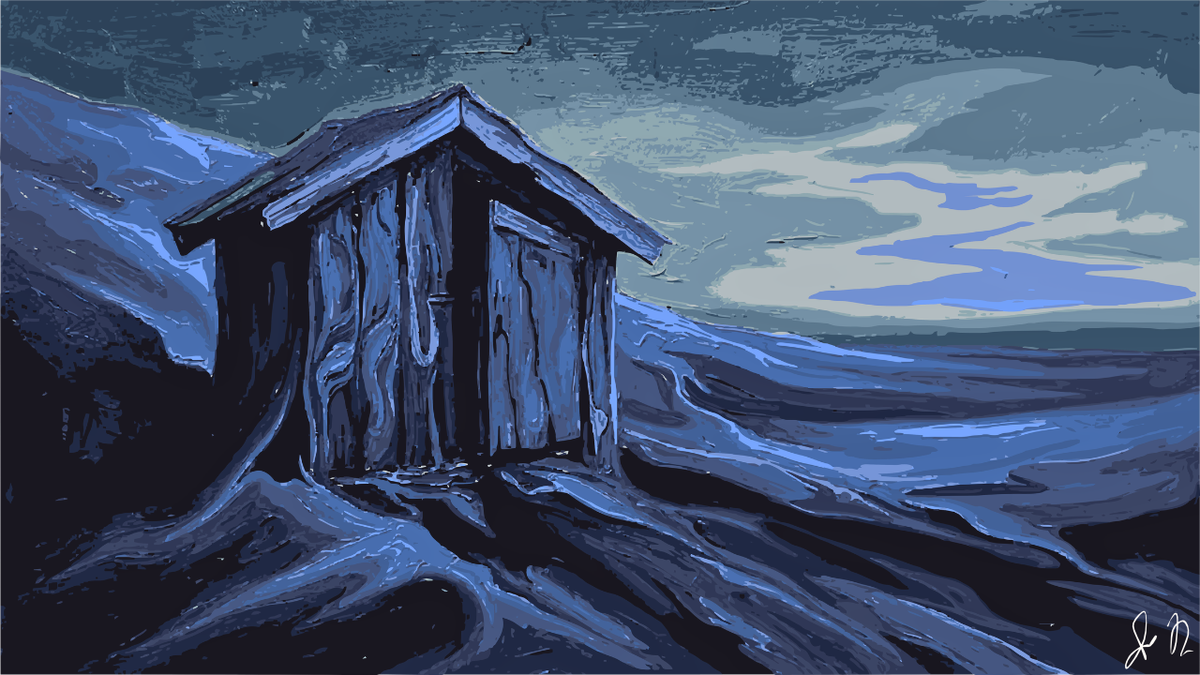
If you came into the garden, you would not notice the shed. You would see the apple tree that never fruited properly, the rotary line leaning slightly to one side, the terracotta pots stacked like chipped teeth along the wall. The shed sat at the end, green paint blistering, door swollen in damp weather, ordinary and entirely unremarkable. Michaela chose to protect Emma. One stupid decision and her daughter’s life would calcify around it, unleashing a storm of horrors: a court case, a record, the shame, the words “criminal” and “killer” attached to her forever like an incurable disease.
“It was an accident, Emma. The rain. The dark. The bend.”
Dan stayed at her house often. They cooked dinner together, talked about their days, watched TV from the sofa. He told her about fraud cases: “People who lie about insurance claims, about business expenses, about identities.” They tentatively talked about the future, maybe meeting Emma when she was back from London on a break, maybe a long weekend together away.
One evening, when he was in her kitchen making pasta with too much garlic as they both liked it, she was opening wine when he mentioned, “You know, in fraud, everyone lies. You get good at spotting it.”
Michaela focused on the corkscrew. “Oh?”
“Little things. People over-explain or avoid eye contact. People whose stories don’t quite match up.”
She met his eyes, forced herself to hold his gaze. “What do you look for?”
“Inconsistencies mostly. Someone says one thing, then contradicts it later.”
“Like the library book,” she said (couldn’t help herself).
He looked at her, startled, then grinned. “What about it?”
“I told you I’d return it. I haven’t.”
“Well, that’s hardly fraud. Just forgetfulness… I suppose we all have our secrets,” he said, turning back to the pasta.
I don’t know, she was aware of telling herself, getting the wine glasses out of the press, I don’t know if he is oblivious or playing with me; I can’t read him. Does he know? Has he always known? Is he waiting to see what I’ll do? I’ll say Hey, I noticed there is a name on the bookmark receipt, isn’t that the name of the dead bag lady? And he’ll say, That? That’s not her name at all, Michaela, you must have got it wrong. It must be your book. And maybe that is correct, maybe her name I heard at the vigil was not her name at all, just a stand-in name for someone who didn’t really have a proper name after all. Maybe it was me who got the book out of the library.
“And did you? Ask him about the name?” Emma asked.
“I didn’t get a chance. We ate dinner, it was… delicious.”
“And what about later, after dinner? Or the next day?”
“In bed, he… fell asleep quickly. He left before I was up. I haven’t talked to him since.”
Michaela was aware of Emma waiting on the other side of the line. She very much wanted to say what Emma wanted to hear, something like You’re right, I’ll get rid of it all; or I’ll burn the book, dump the trolley, scrub my life clean; or I’ve joined the German conversation group again; I got tickets to the Proms. She wouldn’t, though. She couldn’t.
They sat in silence. Michaela had wanted, for so long, not to be alone. Some solitudes, she understood now, are necessary and others are chosen. And the worst are the ones you build yourself, brick by careful brick, until you can’t tell the difference between shelter and tomb.

Marketa Dowling (she/ her) is a Czech-Irish writer and theatre and film professional. Her work has been published in Irish Country Magazine, Midnight Ireland Journal, the 2026 Scottish Arts Trust’s Edinburgh Anthology Series, The Honest Ulsterman, Flare Magazine, Thin Skin, Moonlit Getaway, The Belfast Review, and Mslexia. She writes and lives in the West of Ireland.
Editor’s Note:
Thank you for reading Marketa Dowling’s “Woe to You Building Tombs.”
When we think of guilt, we don’t often think of it as a mechanism for growing close with someone. But guilt is an instinct that urges us to revisit circumstances and rehearse our mistakes. To preserve objects that might otherwise disappear. Such rituals can resemble devotion, and devotion consequently brings us into proximity with the subject of our desire. It is, in a way, a form of attachment.
In Dowling’s story, Michaela’s attachment to the evidence of a fatal accident grows increasingly difficult to distinguish from her desire to be discovered. A battered trolley, an overdue library book. These and more connect her to a dead woman, to her daughter. Better yet, to a version of herself capable of terrible choices. It leaves the reader wondering, of course, why? Why develop a romance with a police officer, why indulge this intimacy with danger? That is for the reader to consider.—Jon Negroni
Support Cetera
Paid members get exclusive perks like bonus stories, the ability to comment, and more. Plus you'd be helping us keep the bills paid. You can check out the subscription tiers below, or you can leave a one-time tip if that works better for you.