Xeno’s Dilemma
They found something in the woods. They can’t stop returning to it.

Now that she’s pressing her fingertips to the middle of her sweater, I’m pretty sure that today I’ll take her to the pod, and I want to tell you about this, all of it—how we ended up at this point and where we might go from here.
For a while though, she only rubs at the gray wool, as though massaging her chest, and my certainty wanes. Maybe this is all she’ll do, then lower her hand. But no, her fingers arch, nails digging in, like she’s trying to tear through the yarn and excavate something from her heart. She knows she shouldn’t be scratching, knows it’s only going to make the itching worse, but of course it’s satisfying, and few things are these days while her mind still struggles to go on without the constant stimulation of the city we’ve been so enmeshed in and enamored with.
Much of life here must seem small, slow, and subdued.
She keeps her eyes—drowsy, bored, or both—on her steel-cut oats, keeping me and the part of the table with my breakfast out of even her peripheral vision. No doubt she expects me to tell her to stop like I always do. But this time, I say, “Let’s go for a walk,” like I’m suggesting just a short outing because I don’t want her to object, even though she never does.
She loves the forest here, especially on warm days like this one. Today though, I’m asking her to go there not for the forest itself but to see something extraordinary, even if she finds it unsettling. Whatever effect the pod has on her, the walk will at least serve as some respite. She never scratches in the forest, the leafy landscape an elixir for her latest ailment and for so many of ours before this one, an elixir I made the mistake of denying us for too long.
During the years we lived in Helicity, I knew that I needed to spend more time with her and that both of us needed to spend more time in nature, in soundscapes with birds singing, wind jostling leaves, and water flowing over rocks. Still, those needs always seemed like they could be taken care of later, always seemed paltry in the heady dazzle of a society ever ebulliently striving to better itself.
We were avid members of the aspirational class, our minds enlivened by and devoted to technological possibilities and scientific progress, our senses saturated with and electrified by the urban bustle that made us alternately spectators and partakers in the spirited discourse of our civic-minded citizenry and the fervent commerce of shopping arcades. I was working at the forefront of cognitech research, and she was flourishing at school, enthralled by the minds-on pedagogy of her teachers, ravenous for the encouragement they cheerily bestowed.
Then, after lunch one late-summer day, I walked to the park down the street from the lab and sat in the shade of a tree. Aglow in sunlight, its serrated leaves captivated me, the sight timeless and nostalgic, reminiscent of a scene from childhood.
But which scene? An afternoon reading on the riverbank near my elementary school or one of our family picnics by the lake? Was this an alder or a birch?
I considered the foliage and the trunk with its mottled bark, a combination of familiar features I couldn’t unify with a name. Hoping to nudge awake the dormant knowledge of flora and fauna you instilled in me, I spent the next week eating sandwich lunches in parks near the lab, only to find that I couldn’t tell which plants were invasive and which were native. Couldn’t recognize birds by their songs or even plumage in some cases. Like I’d gone from fluent to a student failing quizzes in a language I’d picked up as a child.
Would you have been disappointed by this the way I was?
In the days that followed, I felt as though the world had lost a dimension, been reduced to a single plane of immediate fervor—the urban greenery of pollinator corridors and rain gardens like little brushstrokes of soft shades offering the illusion of depth on a canvas crowded with frenetic hues ostentatiously constituting the subject of the painting.
Of course, something similar had happened to her too. I finally noticed that she wasn’t staring at flowers and moss like she used to, wasn’t talking about clouds as mice scurrying east or a dragon devouring cauliflower—the sky imaginatively inert to her, clouds just features of the atmosphere, masses of water vapor. And it was clear we had to leave the engrossing metropolis of concrete terraces, glass pavilions, aerial gardens, and complex transit systems, this most civilized of cities where ambitious idealism is expected and paradigm-shifting achievement is prized above all else. So I did what I could to wrap up my R&D projects while figuring out how to lead a new life. Eventually, I took the offer to mentor inquisitive youth in this remote northwest town and bought the little tree farm we’ve been slowly repurposing.
It would be so easy to let
moment
after moment
slip by, but
one day you might ask
in a voice I can’t imagine you having
what these days were like, what you were like.
So let’s make moments matter
and make them last in our minds,
practice an awareness
that makes us more human.
And isn’t becoming ever more human
the essence of being truly human?
And isn’t that what it takes to know the world,
especially in these times?
Entering the trailhead at the end of our road, we follow the narrow path that goes all the way through the forest to the distant ravine. Soon we’re among lofty maples, enfolded in the singing of wrens and warblers. As always, she alternates between walking beside me and behind me, her gaze going everywhere.
Once we’re a couple miles out, I finally tell her, “There’s something I want to show you, and we have to go off the trail to see it.”
“OK,” is all she says, even though we’ve never ventured away from any trail on our hikes together.
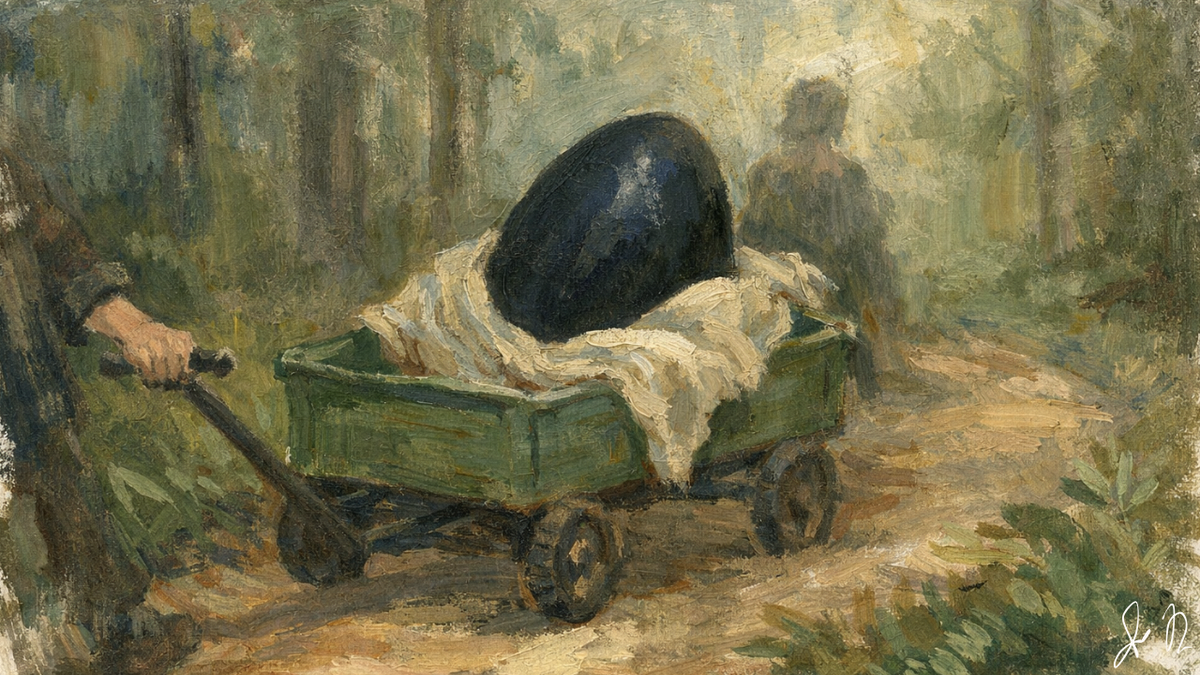
Carefully we make our way through the profusion of ferns, fringecups, and fairybells until we get to it: the pod, the black egg-shaped object that comes up to the middle of her chest.
“This?” she asks, probably wondering if it’s a piece of junk or a strange rock.
“Yeah. Look at this side.”
I wave her over to the part I’m standing next to, the part that looks obviously technological with exposed tubing, the part that has a crystalline window with curvy symbols etched around its edge. The moment she comes around, her eyes widen.
“Is it real?” she murmurs, her gaze transfixed upon the creature inside.
Her question is like an echo of my first reaction. I was sure the pod had to be a work of sci-fi-inspired installation art meant to be mysterious and thought-provoking. But the more I looked at the creature, the more alien this whole thing became. With six lanky limbs resembling tentacles that each end in a splay of six extensions more like feathers than fingers. The ruddy body is oddly oblong and intricately scaly in ways that seemingly no one with a terrestrial mind could have dreamed up—much of the skin tightly tiled with little beads that have a fine brain-coral texture.
Atop a head shaped somewhat like a seahorse’s are four antennae or eyestalks. They’re suspended in some sort of fluid, and the creature undulates as though sluggishly swimming in place.
“As far as I can tell, it’s real,” I answer.
“How did you find it?”
“I saw it from the trail before the understory leafed out.”
“Why didn’t you tell me?”
“This thing could be dangerous. There’s no way for us to tell what radiation it might be giving off or what pathogens it might harbor.” Or what the creature will do if it comes out.
“So it’s some kind of stasis chamber?”
“Or maybe an escape pod.”
“And you haven’t told anyone about this?”
“No.” Who is there to tell?
“But does the… animal…inside need help?”
“Maybe, but I don’t know who can help it.”
“What about scientists?”
“I doubt there’s an exobiologist within a hundred miles. And even if there were, I don’t know if they’d try to help it so much as study it. Also, if someone takes it away, that might make things harder for its fellow creatures to rescue it.”
“So you think it’s an escape pod from a spaceship that ran into trouble?”
“That seems plausible. What do you think?”
“Maybe it was sent from its home planet as a way to show other civilizations that there’s life in the universe. Like a living message in a bottle.”
“Wow, that never occurred to me. I figured this creature was either a crew member of a spaceship or one of the passengers. Or part of the cargo, if the spaceship was carrying animals to settle another planet.”
“I guess it could be any of those things.”
“Or something else entirely.”
“Like an experiment that got lost.”
“Or abandoned.”
Then, done with conjectures, we’re silent as she watches the creature.
“Does it always move this slowly?”
“Yeah. It’s like this every time I’ve come here.”
“Do you think it can see us?”
“If it can, it hasn’t responded in any obvious way.”
“So maybe it is in some kind of stasis or torpor.”
“Or its senses work differently from ours.”
“Hm, yeah.”
Then we’re silent again, and I can tell she’s deep in thought.
“So we just leave it here?” she finally says.
“That’s probably best.”
“OK.”
I worry your inner voice is too quiet,
the voice that tells you what you need to do
subdued
by the sonic doppelgänger
that tells you what you should do
ever as insistently as the adult voices
that have been the constant chorus
of your childhood, their echoes
having ricocheted around your thoughts
long enough to sound like you,
reshaped by the acoustics of your mental ecology
to take on the timbre of that tender wilderness
they have been relentlessly pruning
Tell me what the quiet one says,
and learn to ignore the one that always wants
your mind’s ear all to itself
The scratching stops. As though a switch has been flipped, turning off the itching that has so ceaselessly afflicted her. Still, I continue to put ointment on her chest, rubbing it over the swath of once-smooth skin now crisscrossed with scabs and welts, injuries that then glisten with an unctuous sheen reminding me of the times you’d rub tiger balm on my belly when I had an upset stomach.
Every day, she walks to the pod after school, even if that means walking in the rain. There are only three days when she doesn’t and is instead housebound with a cold, tucked in bed reading astrobiology books borrowed from the town’s little library, the kind of books that have become her evening pastime once she’s finished her homework.
She knows she can’t learn enough from them to help the creature, knows she has a long way to go before she can fully grasp what she’s reading, knows this material is all so speculative. Then of course there’s the pod and the creature, technologically and biologically inscrutable without scientific equipment—probably indecipherable even with the most advanced scientific equipment, unless opened. But she has to try, needs to learn everything that could help her understand the creature.
She’s restless during our weekly trips to the grocery store, ahead of me in every aisle, eager to grab what we need and get back to her books. On weekends, she never wants to go out for brunch or a movie but does attend the occasional birthday party of a friend from school—with indifference.
While we do chores together, she tells me about what she’s read, her way of digesting the information, reminding me of those evenings in Helicity when she’d chirp on about school as I handed her plates to put in the dishwasher.
This all feels familiar. Didn’t you indulge me through a period of preferring the pursuit of knowledge to being a person in the human world?
In the evenings, she watches the sunset with me in the backyard, sometimes posing questions about the creature as the clouds glow with gradually deepening hues of magenta. Is it descended from a predator species or is it an herbivore? Or does its planet even have herbivores? Are its appendages capable of making the technology needed for a spaceship? If it was on a spaceship—which seems more likely—a generation ship or a hibernation ship?
“Do you see the night sky differently now?” she asks when we’ve lingered in our lawn chairs long enough to see the sky slowly fill with stars.
“Yeah. It doesn’t feel as empty. We know there’s life elsewhere. We’re not alone. Humans may never come into contact with aliens again, but just knowing they exist comforts me.”
“Me too. It’s like the universe is telling us, ‘You’ve barely seen any of my wonders.’ Like it’s let us in on a secret it’s been keeping for a long time.”
I wait for her to say the other half of this thought, its logical next part: and now we’re keeping this secret.
Her sentiments shift how I see the students I meet with, raising the question of what they would do with the secret she now holds. Ever idealistic, Miri would no doubt want the world to know about the creature, so certain that humanity would be transformed by the new reality of extraterrestrial intelligence. While discussing thought patterning with Bosarc, I get the impression that he would want humanity to reap the knowledge held by the pod, the potential technological and even medical advances outweighing the likely harm to the creature.
If I were their age, I would probably ask you to do what could still be asked of me: get someone to come take a look. I’d bring you to the pod and trust you to find the right someone. It’s been a long time since I was that version of myself, the psychological distance between now and then spanned by so many iterations of myself. Across all of them, I’ve always wanted to tell you everything, have always felt a need to make what I know known to you, the one person who has always known me. But you don’t need to know all those things.
I can’t imagine
bringing it up,
but if you ask me what I did before
you were born,
I’ll tell you about my work
as a neuroceutical engineer
about how I made drugs
that made the mind sharper,
made the brain remember better, dream bigger, learn faster, think deeper.
Then maybe you’ll ask
what I liked most about that work,
and I’ll tell you that I liked seeing
what the mind is
capable of with a little help.
And I still do, but I better appreciate help
that isn’t the chemical kind.
Soon, the weather warms, school is out for the summer, and she gets into a new routine. After breakfast, she puts on her hiking shoes and shoulders her backpack. It no longer holds homework and notebooks and lunch but instead has her sketchbook, snacks and water. I see her off at the front door, and sometimes I go to the window at the top of the stairs and watch her walk to the trailhead.
While she’s out, I meet with students in the farm’s old gazebo until it’s time to make a simple lunch that I’ll eat with her before meeting with more students in the afternoon. If she’s late getting back, I put the solitude to use composing the stories I want to tell her but am not yet ready to.
The times I join her, I watch her become instantly lighter when we get to the pod, no longer weighed down by worries, relieved that it’s still there, that the creature is still moving in its languid slow-motion way with long limbs swaying listlessly. I’m impressed that with all her visits to the pod, she hasn’t left a trail of trampled vegetation. She must walk a different way to the pod each time.
All teachers harbor
secrets.
Their favorites, their fantasies, their insecurities.
The one I keep from everyone—
even you—
is simple:
I’m preparing students for a future
I don’t believe in anymore.
Though I want to share everything
I keep this from you
because it’s a secret that should never
concern you.
Before I know it, we’re heading to the pod in the middle of July, and she’s asking me, “Do you think there are other pods here on Earth?”
“There could be,” I answer. “But if there are, they either haven’t been found yet or are also being kept secret by the people who found them.”
“Maybe this pod is the only one here. If it is an escape pod, others from the ship might have scattered in different directions.”
“Right. And even if other pods came to Earth, they could have ended up in really remote places, like the Arctic or even the ocean.”
“Even debris that broke off from this pod during its descent could be hundreds of miles away. I’ve searched all through the woods and haven’t found anything else. Not a single scrap of wreckage.”
Of course. I should have known she’d comb this area for things related to the pod.
“Do you think the creature is lonely?” she asks.
“I would be if I were on my own so far from home.”
“But isn’t that what it’s like being here?”
“Don’t we have each other?”
“Yeah, but I mean, we’re on our own, far from home.”
“I guess so,” I answer even as my mind balks at her words.
Since coming here, she’s never called Helicity home. Then I get it. She means your house, the place we’d always visit no matter what city we were living in. My childhood home and her idealized one—that old A-frame in the forest which taught her to love forests, that abundance of oaks and birches in your one-thoroughfare town where we come alive in ways we never do amid tall buildings and traffic, that cozy municipality in a region where most of our family is, all those aunts and uncles and cousins who take us to farms with delicious berries and to prairies full of wildflowers, rustic places where the two of us tell them about city life and travel abroad, our alternating accounts dovetailing as though describing two parts of the same life—me the half doing the adult things, her the half doing the childhood things, together doing the together things.
Maybe on some level that’s how we are in her mind, two pieces of a single whole. That would make sense. Our lives have been entwined since before she can remember.
I am trying to learn
the kind of patience I hope to teach you
—waiting without expectation,
the ability to let time pass
without anticipation,
to do what you can
while the things you can’t do anything about
run their course—
an ability
like a long glossy feather you can always stroke,
a talisman against the illusion of terrible permanence, a reminder that it’s possible to
glide with ease above vast landscapes.
I need that patience now,
and you will all too soon.
And I wish I had learned it
earlier but I had no teacher
—except the world,
and I didn’t understand the lessons, until now,
that the world teaches me
through you, getting me to learn
by doing more than ever.
Though the creature’s mind—if the concept of mind is even applicable—probably works very differently from the human mind, I sometimes imagine the creature having thoughts like hers, full of curiosity, yearning for discovery—qualities befitting a starfarer. Then I wonder what she would want if she were in the creature’s situation. Would she want the possibility of help if it came with the risk of harm?
Then I have to remind myself that she has long since given her answer, albeit tacitly. Asking her would simply be a path to knowing how her mind arrived at this answer. And though I’d like to know the logic underlying it, there’s no need to deconstruct the decision. What I must do now is abide by that answer, the way you so often did when I’d made up my mind about something important to me. After choosing to relocate us here, I don’t want to impinge on her decisions if I don’t have to. Whether out of necessity or vanity, I’ve already made so many decisions for her.
Framed by my car’s windshield,
the woman walking toward the entrance of the hormonium
must be the soporifin donor who makes your sleep possible.
She has a look of calm alertness
the way you do after a restful nap.
In the waiting area,
with you nestled against me,
I sit a couple chairs down from her.
“Thank you for donating,” I find myself saying. “My baby would hardly ever sleep if it weren’t for donations. My body is holding on to what little soporifin my brain makes to get enough sleep to be functional.”
She smiles and says, “Funny how these things are. My brain makes way too much. I have to extract it or else I’d be sleeping over twelve hours a night. I’m glad it can go to good use.”
August begins with the summer’s hottest days, and after a week of unrelenting heat, she comes into the kitchen while I’m making lunch and says, “The creature isn’t moving as much. Do you think it’s the heat?”
“Could be,” I answer, though I doubt it. If the pod can handle the vacuum of space and direct solar radiation, what difference could thirty degrees up or down really make?
“Or maybe it moves less sometimes,” I offer. “Or it’s going into a more dormant state.”
“Can we move it into the barn, just in case?”
“We can try.”
Her eyes widen for a moment. She was probably expecting me to object.
“But the pod could be heavy,” I add.
“So long as we can get it on to the wagon, moving it won’t be too hard.”
“Do you think the pod will fit?”
“It’ll just make it. I measured.”
Of course she did.
After I meet with Konami, we head out into the torrid air. The walk to the pod is somber as I follow behind her with the green wagon in tow. The last time I pulled it, she was my passenger, half her size now, sitting with knees tucked to her chest, staring up at the fall foliage in a little park enclosed by imposing buildings. Over and over, I followed the circuit of the park’s short walking path, trying to give her something akin to an autumn afternoon in the woods.
As we near the pod, I brace myself for the worst—the creature catatonic in some odd position, like a fish floating in an aquarium tank. Relief rushes through me when I see that the creature looks just as it did the last time I was here, in its semi-upright position with limbs outstretched like the twigs of a sapling.
Though I’m sure that by now she’s touched the pod many times, I ask her to stay back while I try to lift the pod. Crouching down, I push on the back of it, the glossy black material even smoother than I expected. The pod tilts easily, not nearly as heavy as I’d assumed, and I quickly get my hands underneath it so the bottom, which is surprisingly flat, rests on my fingers and palms. Leaning the top of the pod against my torso, I raise it high enough off the ground to place it in the wagon. She wraps an old blanket around it for cushioning, in case it topples or tumbles out.
Taking turns pulling the wagon, we make our way home slowly, taking care not to jostle the pod out of the wagon, cautiously rolling over the tree roots we can’t maneuver around, one of us always in back, keeping an eye on the pod.
With the pod sitting in the coolest corner of the old barn, she spends much of the day there. Beside it, she leaves her sketchbook and books the library has gotten from larger libraries in cities far away.
Maybe now that it’s so close, I have dreams about the creature. In the ones I can remember, it’s always out of the pod, wandering or exploring our house. That never alarms me. Sometimes, I’m glad to see it, happy that she no longer has to worry about it. Once, I hear her calling the creature Xeno.
Then I wonder why she hasn’t given the creature a name. Between meetings with students, a couple possibilities come to mind. She’s always wanted to know the names of animals, plants, objects, feelings and ideas, to use those words as soon as possible, as though the name of a thing and its nature are bound together, and now, without knowing the creature’s nature, choosing a name is impossible. Or she simply doesn’t want to become more attached to the creature.
I add dysnomia to the collection
of concepts you might use when you’re older
because even though it’s not helpful
the way tenacity and gaslighting can be,
it doesn’t take up much space and it’ll be good to have,
in case you ever end up feeling
that your name doesn’t fit,
or you meet someone who feels that way,
then you’ll know what that’s called
and know it’s OK, it happens sometimes—
we can’t all have names that suit us.
I simply chose one I hoped you would like
when I knew nothing about the person you would become,
deciding on aspirational sounds
you might grow into.
Now, I’d call you Avirene,
but I don’t want to make you
self- conscious about your name.
Though I hope one day you’ll tell me
how you feel about your name.
And if you can’t
because you don’t want to or I’m not around,
I’ve made sure that there’s this part of dysnomia:
you can give yourself any name you want
because you should have one that you love.
Though the days are getting noticeably shorter, we make our way through them ever more slowly, a gentle lassitude accumulating under the sunlight thick like sap that could harden and gradually lock us into a golden timelessness.
The less the creature moves, the more time she spends with it. I say nothing about the possibilities she must have considered and may be afraid of. The pod’s power supply running out. Its store of nutrients dwindling. The creature nearing the end of its lifecycle. The creature succumbing to the effects of too much or too little gravity. The pod no longer functioning, due to a part failure or self-shutdown protocol, becoming a relic, a high-tech specimen jar.
I keep waiting for something amazing to happen. For a rescue party of the creature’s comrades to arrive. For her to tell me she can see the creature’s thoughts with her mind’s eye. For the creature to come out of the pod. For any change in the creature’s appearance that suggests the pod isn’t a stasis chamber but a chrysalis, a technological means for the creature to take its final form. But everything remains ordinary, keeping us in our own stasis.
And I start to think that there’s a poetic quality to the creature’s fate, the way it came so far from such an advanced civilization and now lives out its remaining days in the company of a kind and curious girl, making her kinder and more curious, helping her consider this unfathomably vast world and her place in it.
You once told me that nature can be ruthless, though not without reason, and I’d like to think that something similar can be said of destiny—strange, though not without meaning.
Life speaks in questions
I’ve forgotten how to hear, even
as it speaks with a voice that comes from you.
Fortunately, the best way to hear is to listen.
The end of August is full of thick fog that makes the mornings and evenings damp and chilly. Still, she spends hours in the barn, a sweater or jacket keeping her warm while she reads or sketches. Seldom do we talk about the creature now that it hardly moves, the limbs only sporadically wafting as though in a protracted twitch.
On our walks through the woods or in the yard watching the sunset, she brings up mostly practical matters: the supplies she needs for the new school year, the birthday card that should be sent out soon, the tofu about to expire on the middle shelf of the fridge. Though now and then, she brings my attention to the sublime—most recently a lullaby composed for glass harmonica.
I worry that she’ll start scratching again and ravage her skin. But even after she goes back to school, I never see her raise a hand to her chest. She seems ever wide-eyed, entirely awake, as if the days are full of promise, the way I remember you when I was her age.
“Look over there,” she says, pointing.
So you look across the ravine.
“In your dreams tonight, there will be
a bridge
that goes from this side
to that side,” she tells you.
“Make sure you cross it.”
You want to ask what she found
when she crossed it,
but her words carry a firm finality.
She has no more to say on the matter
—until after you dream about the bridge.
Editor’s Notes:
What struck me first about “Xeno’s Dilemma” is that it understands something a lot of speculative fiction doesn’t. Wonder is rarely loud. It doesn’t always show up with sirens and spectacle and a huge explanatory apparatus. Sometimes it’s quiet. It’s in the woods, it’s in the form of a sealed black pod half-hidden among ferns, and what matters is not just the object itself but the emotional pressure it exerts on the people who find it.
That, to me, is the story’s great achievement. It takes a premise that could so easily tilt toward plot mechanics—What is the creature? Where did it come from? Should the authorities be called?—and instead locates the deepest drama somewhere more intimate and more difficult, putting this in conversation with the work of Claire Denis for instance. Because this sci-fi tale is really a story about care. About the moral burden of witnessing the impossible. About the strange ways a child’s curiosity can restore a dimension of the world that adulthood has flattened into utility, progress, productivity. It is also, crucially, about the kinds of secrets love keeps.
I admired the way the story avoids easy binaries. The pod is not simply salvation or danger, miracle or threat. The city they have left behind is not rendered as villainous, just spiritually overdeveloped in one direction. Even the narrator’s protectiveness is allowed to be both generous and compromised. That tonal balance is hard to pull off. The story manages it by being patient with everyone in it, including the reader.
And then there‘s the prose, which is doing something quite lovely. The braided structure of narrative and lyric address gives the piece an unusual pulse. Those passages to the absent “you” deepen the emotional field, gradually revealing that this quirky alien stasis story is actually about inheritance, parenthood, memory, and the desperate, tender wish to leave behind some usable record of one’s love. The speculative frame expands the story, and the intimacy grounds it.
We eagerly accepted “Xeno’s Dilemma” as a submission because it feels like the kind of story we want to champion. It’s formally attentive and emotionally intelligent. It’s unafraid of quietness. It trusts observation. It trusts ambiguity. It understands that the most haunting science fiction often isn’t about the future at all, not really. But about the present moment viewed from a slight and revelatory angle. By the time this story ended, I felt what the best stories make me feel. That the world had become both stranger and more understandable, and that those two sensations might, in the end, be the same thing.—Jon Negroni
Soramimi Hanarejima is the author of A Psychography of Modest Intimacies. Soramimi’s recent work is forthcoming in West Branch, The Worcester Review, and Straylight.
Support Cetera
Paid members get exclusive perks like bonus stories, the ability to comment, and more. Plus you'd be helping us keep the bills paid. You can check out the subscription tiers below, or you can leave a one-time tip if that works better for you.