Doors that Open on Leap Days
Every four years, on February 29, the bar is open.

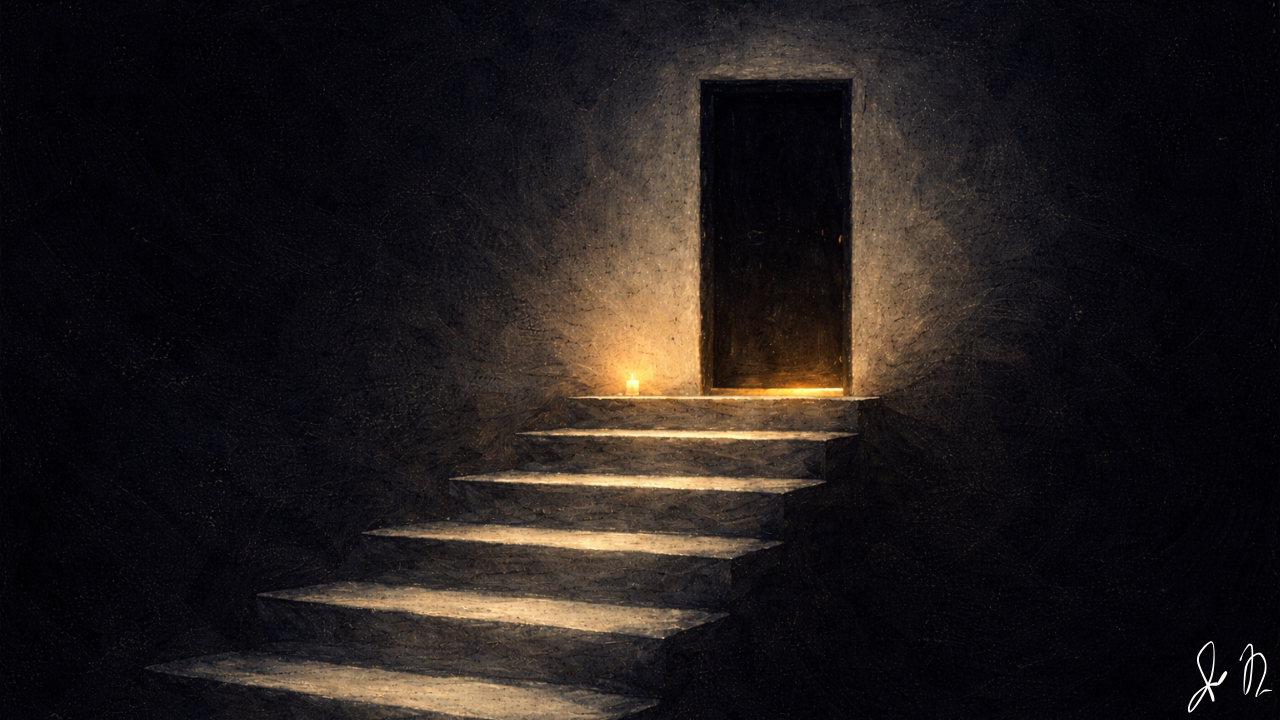
The bar had no sign. Everybody who needed to find it already knew the staircase—six steps down from the alley behind 127th, past the dumpster that smelled like someone’s abuela had been frying plátanos on the fire escape above, past the mural of Sylvia Rivera that wept in the rain because the artist used house paint instead of acrylic, and then the door, heavy as sin, black as the first hour of any good night.
February 29, 2008
Inez was twenty-one. She wore her mother’s silk blouse tucked into thrift-store trousers, and she had spent twenty minutes in the bathroom of the 2 train achieving a collar that looked effortless. She descended those six steps on a dare from her roommate, who had already disappeared into the dark interior and would not resurface until 3 a.m., radiant, lip gloss obliterated, smelling like someone else’s perfume. Inez went alone through the door.
Inside, she found wood paneling that fondly remembered the seventies. A ceiling so low the taller women stooped like cathedral visitors. Votives on every surface, red and white, their light catching the condensation on glasses so the whole room seemed to breathe in flickering morse. The jukebox in the corner was older than anyone present and played everything six seconds too slow, which meant every song became a ballad whether it intended to be a ballad or not.
She ordered a rum and Coke because she panicked when it came her turn. The bartender, a woman in her sixties with cropped silver hair and a scar that ran from her left ear to her jaw like a river on a map, poured without comment and set the glass down with a gentleness that made Inez want to cry. She didn’t know why. Maybe later she would understand.
She saw a woman on the stage. Except there was no stage, only a corner where the floor rose three inches—a platform for declarations, the bartender called it—and a woman stood on that three-inch elevation like it was Everest’s summit, singing into a microphone that fed into an amp so old its distortion had become its own element.
The woman sang something slow. Inez tried to figure out the song, but then she realized the song didn't matter. What mattered was how the woman's throat moved, visible from across the room. The way she closed her eyes on certain syllables and opened them on others, so her gaze arrived and departed like a passing rainstorm. The way her left hand floated at her side, conducting nothing, reaching for no one in particular, and how Inez felt, from twelve feet away, reached for.
Afterward, the woman came to the bar and stood close enough that Inez could smell her jasmine and the salt on her skin after performing under a hot light. The woman ordered whiskey and turned and said, “You’re holding that glass like you dropped it already.”
Inez laughed. It came out louder than she intended, almost a bark, and she covered her mouth, and the woman reached over and moved her hand away. “Don’t do that,” she said. “I'm June. I want to see what you look like when you tell me your name, next.”
They talked for two hours. First about Toni Morrison, which somehow transitioned to a fashion show of their bad tattoos, until finally they settled on a ten-minute rant about the indignity of growing up queer in a neighborhood that loved them on every axis except the one that kept them up at night. June had grown up eight blocks from where they stood. Inez had come from the Bronx on scholarship money and the furious belief that being an architect would keep a roof over her head. That architecture itself could be its own form of community. That the right building could hold people the way the right arms could.
“That’s the dumbest thing I’ve ever heard,” June said.
“Which part is wrong?”
“Buildings don’t ‘hold’ anyone. People hold each other. Buildings are just another bunch of doors and walls and shit.”
Near closing, when the votives had burned to puddles and the jukebox had cycled back to the beginning, June said, “Come back.”
“When?”
“Next impossible day. You know when that is?”
“Leap Day.”
“Uh huh. Four years. Think you can remember where the stairs are?”
“I remember everything,” Inez said, which was the kind of thing she would only ever say at twenty-one and mean it.
They kissed in the stairwell. Six steps between the underground and the street, and they stopped on the fourth, which put them at the same height, mouths level, the cold February air descending from above and the residual warmth of the bar ascending from below, so they stood at the exact seam and pressed their lips together and tasted rum and whiskey and the jasmine that would follow Inez into sleep for years.
February 29, 2012
The building was gone. Inez had checked, twice, in the years between. Once accidentally, walking through the neighborhood after a site visit, and once deliberately, on a Friday in October when missing June had become a chronic illness. The address was a fence around a lot. The mural had been sandblasted. The dumpster remained.
She did not expect the door, though.
But there it was: black, heavy, at the bottom of six steps that should not have existed, carved into ground that was, by every permit and survey she had studied in her first year at the architecture firm, poured concrete over compacted gravel over sixty years of Harlem’s refusal to be just one thing.
She descended. She was twenty-five, now. She wore a blazer she had bought with her first real paycheck and shoes that cost more than her last three pairs combined, and she was aware, descending, of how precisely these clothes announced what she had become and what she had left.
Inside was the same. Exactly the same. The wood paneling, the votives, the low ceiling, the jukebox playing everything at funeral tempo. The bartender with the scar, who looked no older, who set down a rum and Coke without being asked.
June was at the corner platform, not singing this time. She sat on its edge with a beer, watching the door without looking at it. She wore a yellow dress the color of something that should not exist in February. Her hair was longer. Her eyes were harder. She had a new tattoo on her inner forearm. An address, Inez realized, the bar’s address.
“You came,” June said.
“You’re here.”
“I’m always here.”
That sentence did too much work, and they both knew it. June had not left the neighborhood. Had not left the orbit of what the bar had been. Had organized the vigil after the fire—yes, there had been a fire, Inez knew about the fire, everyone knew about the fire though nobody agreed on its cause—and had started collecting. Oral histories. Photographs. Flyers announcing open-mic nights and drag shows and AA meetings and birthday parties for women who were now dead of age or violence or the slower violence of being forgotten.
Inez was the one who left. First to Columbia, then to the firm. Had put on the blazer. Had learned the language of setback requirements and floor-area ratios and community impact studies, which was another way of saying she had learned how to describe displacement in terminology that made it sound almost natural.
“How’s the big girl job?” June asked.
“It’s, um, fine. I’m doing well.”
“I didn’t ask how you were doing.”
“They’re really the same thing.”
“No,” June said. “They really are not.”
They drank. They talked around what they wanted to say. They did not talk about the two months they had been together after that first night. The two months of June’s apartment, June’s bed, June’s cooking, June’s voice in the morning saying get up, cariño, the light is doing something unbelievable on the fire escape. And they did not talk about how Inez had ended it by not ending it, by simply becoming less available, less reachable, less present, until absence was indistinguishable from departure.
“You quit smoking,” Inez said, because she noticed the absence of the cigarette June used to hold in between songs.
“I quit a lot of bad habits.” June looked at her. The hardness in her eyes rearranged itself, briefly, into something that Inez recognized as the unique pain of being seen by someone who once had permission to look. “You always did love buildings more once they stopped having people in them.”
Inez opened her mouth. Nothing came.
The jukebox cycled. The votives burned. At some point the room seemed to thin at its edges, the walls going soft the way a dream does when close to waking, and June stood and said, “I should go.”
“I just got here.”
“Yeah. You sure did.”
She left. Inez sat at the bar and finished her drink and listened to the room disassemble itself around her. By the time she walked out and climbed the six steps, the door was a wall. The staircase was sidewalk. Even the dumpster looked like it had been there for centuries.
February 29, 2016
The bar was quieter this time. Fewer votives. The jukebox played but the sound came from farther away, as if the music had retreated deeper into the room’s memory and Inez had to lean in to catch it. The bartender was there, still ageless, still scarred, but she moved slower, poured slower, and when she set down Inez’s glass she held her gaze for a moment that said: don’t rush it. Savor.
Inez was twenty-nine. She had been promoted twice. Her name appeared on a rendering for a mixed-use development twelve blocks from where she sat, a building that the firm’s website described as honoring the cultural legacy of the neighborhood and that was, in fact, a glass-and-steel reliquary for money, its lobby decorated with blown-up photographs of the streets it had replaced, including—and Inez had seen this, had stood in the lobby on the day of the unveiling and felt her organs twitch in response—a photograph of the mural of Sylvia Rivera, framed and mounted as decor in a building whose construction had necessitated the mural’s destruction.
June was already in the bar, which Inez expected. But she didn't expect to see a folder in June's hands.
“Sit down,” June said, withholding any other form of greeting.
“I’m already sitting.”
“Then stay sitting.”
June opened the folder. Inside was a copy of the community impact study for the development. Inez’s firm’s letterhead. Language Inez recognized because she had helped write it. Phrases like contextually sensitive massing and activated streetscape and heritage-informed materiality, which meant, translated from the dialect of polished erasure: we will take the neighborhood’s memory and return it as a product worth selling.
“I didn’t design that building,” Inez said.
“You wrote the words.”
“I wrote a study. That’s what junior architects do.”
“And the firm? The one that took the development contract after the fire? The one that hired you six months later?”
Inez said nothing.
“Did you know?” June asked. “When they hired you. Did you know they were connected?”
“It’s not that simple—”
“It is exactly as simple as I am making it. You walked into a room where people were planning to eat this neighborhood alive, and you picked up a fucking fork, Inez.”
The room dimmed. A votive went out and did not relight. On the jukebox, the song—the same song, always the same song, the one June had been singing the night they met—skipped and caught and skipped again, and for a moment the silence between the skips was total and yet half the size of a breath.
“I was just starting out,” Inez said. “I was broke. I had loans. I had my mother calling every week asking when I was going to have a real job. I didn’t have the luxury of—”
“Of what? Integrity? That a luxury now?”
“Of your certainty.” Inez’s voice cracked on the word and she let it crack. “You always knew what the right thing was. I never had that. I just had the work. I still do. I'm still trying to do something worth taking up space.”
June closed the folder. Her face did something Inez had never seen. It softened and hardened at the same time, compassion and fury somehow coexisting. Though fury probably had the edge.
“Inez. This place was here for you. And you helped them take it.”
It was a sentence that had more in common with gravity than grammar. Inez looked at the bartender for help, but she immediately looked at the wall. On the wall, a photograph Inez had never noticed: two women dancing, blurred with motion, their faces turned toward each other so you could not identify them, only feel them, only know that in the instant the photograph was taken they were the entire argument for the existence of the world.
“I know,” Inez said, shifting back to June. “I knew. I could have said something. I could’ve leaked the documents or at least refused the job, but I didn’t and I can't change that.”
“And how’s that working?”
“Well, I’m sitting in a ghost bar talking to the woman I used to love, who now hates me. How do you think?”
June stood. She picked up the folder. She looked at Inez with just the smallest atom of tenderness still in her gaze.
“You can’t even apologize,” she said. “You can’t even do that right.”
She climbed the six steps. The door closed. The bartender poured Inez another drink, unbidden, and when Inez reached for it, her hand was shaking, and the bartender covered it with her own. Warm, dry, scarred. She held it until the shaking stopped.
“Last call’s coming,” the bartender said. "You best take advantage of it."
February 29, 2020
She almost didn’t come. Three times in the previous four years she had walked to the alley in non-Leap months. March, September, January. Each time, she found nothing, and each time the nothing felt more permanent, more like an answer unto itself. The staircase was a sidewalk. The door was a brick wall. The neighborhood was practically a brochure.
But she came. She descended the six steps, which were shallower now, as if the passage between worlds was silting up, and she pushed through the door, which gave with a resistance that felt like exhaustion, and entered a room that was barely there.
Half the votives were dark. The wood paneling had the translucence of old film. The jukebox played, but the sound came from everywhere and nowhere, like she was playing music on her phone in an empty apartment.
The bartender was absent for the first time.
June sat at the bar with a glass she was not drinking. Her yellow dress was the same yellow dress, or its descendant, maybe. She looked up when Inez entered, and her face held nothing. Not even anger.
“I wasn’t sure you’d come,” June said.
“I wasn’t sure I should.”
Inez set a folder on the bar. The symmetry was deliberate, and she knew June would recognize it, and she did not care about the theatricality.
Inside the folder was a formal complaint filed with the city’s Landmarks Preservation Commission, naming Inez’s firm, documenting the connections between the fire investigation and the development contract, and requesting landmark status for the remaining structures on the block. Including the alley. Her signature on every page. Her professional license number beside it, which meant the complaint was not anonymous, which meant the firm would know. They would know she was a traitor to the people who had made her successful.
There was more. A cashier’s check made out to June’s archive, drawn from Inez’s savings. The exact amount of every bonus she had received from the firm since the development project was completed.
“This is my restitution,” Inez said. “But don't confuse it for charity. The difference matters.”
Finally, at the bottom of the folder, a resignation letter. Dated tomorrow.
June looked at the documents carefully, completely, without rushing to interpretation. She turned each page. She read the complaint. She held the check up to the weak votive light and then set it down.
“You’ll lose everything,” she said.
“I already have. They’ll contest the complaint anyway and say I’m disgruntled.”
“Are you?”
“I’m a lot of things. Disgruntled is the least of them.”
The room flickered. The walls thinned. Through them, briefly, Inez could see the alley. Could see both worlds at once, the bar and its absence. She could see both versions of a person she loved. Who they were and who they might've been. The private and the public. The possible and the actual, held in a single frame that the eye can’t sustain.
“This won’t bring the bar back,” June said.
“I know.”
“It won’t undo the displacement. The people are gone. Mrs. Okafor who ran the fish shop. The drag mothers. The women who used to sit on those stools and laugh like they invented the concept.”
“I know.”
“So what does any of this shit do?”
Inez gave the room one final glance, starting with the votives, still sputtering with the dedication of small, stubborn, mortal things. Then at the jukebox, which had stopped playing and now hummed a single sustained note.
“It...makes me someone who can stand in the same room as you,” Inez said. “That’s all I really want.”
June went quiet. The room did, too. Then June closed the folder and slid it back across the bar and said, “Come help me remember it properly.”
She stood and held out her hand. Inez took it. June’s hand was warm and dry and calloused from the guitar she had started playing after she stopped singing in public.
They climbed the six steps. The door closed behind them with the sound a book makes when it’s finished. The alley was dark and cold and smelled like the dumpster. But in the walls, the jasmine lingered.
Author's Notes:
I've been tinkering with the concept of this story for several years now, actually since 2024 when our last "leap day" took place. But it took me some time to get it (hopefully) right.
The four-section leap day structure isn't just me trying to be all clever and weird. It's the story's central claim. By compressing a 12-year relationship into four meetings, I'm forcing each scene to carry enormous narrative weight while simultaneously making a philosophical point: that some reckonings can only happen in extraordinary time. Ordinary calendars can't hold this kind of accounting. The bar itself literalizes this, too. It only exists when the calendar admits it exists.
So in that way, the bar is doing double duty. It's both a real queer Harlem space and an explicitly deteriorating archive. Each visit, it loses substance, and the decay tracks Inez's complicity with almost mathematical precision. The bar doesn't disappear because of external forces. It fades in proportion to what Inez has cost it.
That said, I didn't want to make Inez simply a villain or a victim of circumstance. The 2016 section is the crux of this, when she defends herself to June. This was the hardest section to figure out because it was also important to avoid having June simply demolish the argument. What we get instead is June declining to accept the argument as complete. I think that's more damning than a counterargument would be.
I was also worried that June would easily become a moral idol, always right, always rooted. So I tried to make sure the story quietly complicates her. The tattoo of the bar's address, never leaving the neighborhood's orbit, the oral history project, and so on. These suggest someone who has also made a choice, and whose choice has costs. I don't think she's any freer than Inez. She's just made a different transaction with the world.
As for the ending... "Come help me remember it properly" was the hardest line of dialogue for me to crack, and our editor Natalia Emmons really put me through a rigorous process in getting it exactly right. The line couldn't imply forgiveness, nor reconciliation in any clean sense. Instead it has to be an invitation into a practice. Into a memory as ongoing collective labor rather than a fixed archive. And crucially, they goup the six steps rather than back into the bar. Whatever comes next won't happen underground, in extraordinary time. It will happen in ordinary daylight, which is a harder place to be.

Jon Negroni is a Puerto Rican author based in the San Francisco Bay Area. He’s published two books, as well as short stories for IHRAM Press, The Fairy Tale Magazine, and more.
Support Cetera
Paid members get exclusive perks like bonus stories, the ability to comment, and more. Plus you'd be helping us keep the bills paid. You can check out the subscription tiers below, or you can leave a one-time tip if that works better for you.