Goddess Class
A data analyst’s uncanny social instincts earn her an invitation to a billionaire’s mysterious island retreat.

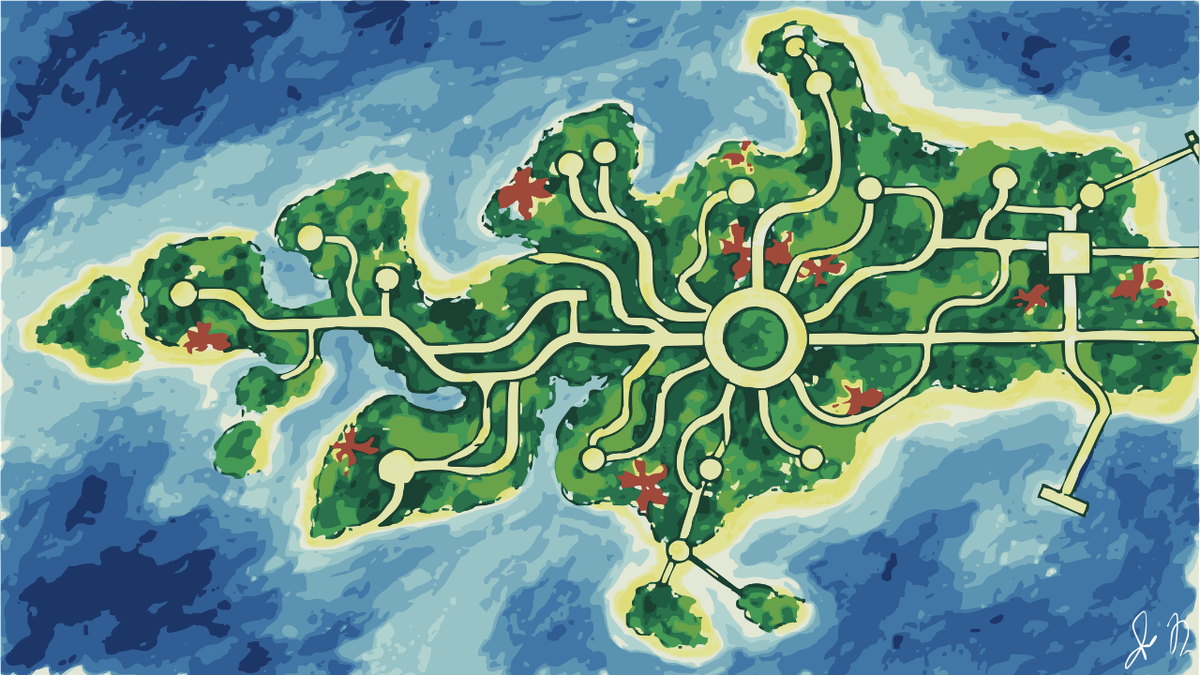
One summer day in 2048, Heinrich Oliver sat down at my lunch table and introduced himself, as if I didn’t know the name of my company’s world-famous owner.
“Hi, I’m Heinrich. And you are?”
“I’m Emily. Your name is Heinrich? Really?” I think I giggled, but this was from anxiety. I was scared even though I had fantasized for years about this happening. I might not have been the first woman who tried to flirt with Heinrich Oliver by making fun of his first name. If so, the other women must have discovered he did not flirt back. So what did he want?
We were in the air-conditioned courtyard of the Invivion campus. The cold air wafting away into Austin’s baking scrubland didn’t matter because the units were solar-powered. So they said.
Across from me Heinrich’s knees were splayed. I stared at his left cheek as he looked past me. His skin was tanned, processed-looking, like artificial leather.
Finally he said, “I was named for my maternal grandfather, Heinrich Krumbach. The prominent computer scientist.”
I already knew this. I also knew that his grandfather was not a well-known computer scientist to anyone outside the Oliver family. I rested my chin in my hand and smiled at him while Heinrich continued to look beyond me.
“What do you do here?” he asked at last.
I breathed in some refrigerated air. “I’m a data analyst in Special Projects.”
His eyebrows rose in interest. “What special project are you working on?”
“Right now we’re planning for the Strategic Planning symposium in October.”
This appeared to bore him. Just as I thought he would get up and leave, Heinrich looked into my eyes and said gravely, “Emily, I’m getting some friends together on Saturday. Would you like to come?”
My heart thudded and I thought of a deflated soccer ball. Heinrich was kicking it, joylessly, persistently. Why?
“Sure, that sounds fun!” I said weakly.
He peered at my name tag and said, “Emily Peterson in Special Projects. I’ll send the coordinates to your device.” He slapped the top of his thighs briskly and left.
The party location arrived on my device seconds after Heinrich left—a warehouse west of Killeen. I thought it might be a private nightclub. The party started at six pm, which seemed early.
After spending Saturday considering myself in the mirror, I settled on clothes and makeup I might wear to an upscale hotel bar. As I drove out of Austin I thought about Kevin, how I was following in his footsteps. I always thought about Kevin. I was still in love with him a year after our three-week relationship. The last time I saw Kevin he was going to a party with Heinrich Oliver, and now, miraculously, I had been invited to one of these parties. I never thought something bad had happened to Kevin. I knew he had been whisked away to some secret, glamorous place to start a new life.
Driving north on I-35 I replayed my favorite scenes from our brief affair. I had intrigued him with uncanny guesses about his childhood: knowing he had a connection to a motel outside Indianapolis, sensing somehow that his father’s last name was Flynn. I just knew from the way Kevin looked and acted. He thought I was spooky, exciting, even.
I was nothing like Kevin. Kevin was charming. He knew how to make other men like him. He was a computer scientist, not an analyst. To find Kevin I needed to appeal to Heinrich. Average-looking women can attract even the most important people, I told myself. Attraction is the great equalizer. I put my faith in these ideas because I wanted to believe I had a chance in this world, something to make me the equal—worthy—of Kevin. I never considered what would happen if Heinrich actually wanted me. How could I have Kevin then?
When I pulled into the cracked cement parking area I was thinking about how I looked in my eleven-year-old Mazda Inago. I was relieved but puzzled that many of the cars were not nicer than mine.
Inside the warehouse men and women were sitting at tables in assigned seats. This and the fluorescent lights made me think of a low-budget wedding reception. No one was particularly attractive, least of all the women, and I saw that I was overdressed. I found my place card, sat down, and checked the time: 6:03.
I pick up on social cues; it’s how I’ve managed to stay employed at Invivion. So after glancing around I put my device away. Staring at screens was a no-no, some inner voice told me. Then I wondered: Why hadn’t I known how to dress?
At that moment a woman I recognized as the Vice President for Corporate Excellence rose from the long table at the end of the room.
“Good evening, friends. Thanks for joining us tonight in Bell County. You’re wondering why you’re here. You’re here tonight because you have a special talent. A gift we want to nurture. Nurture and harness to improve the world.”
Had they noticed my social sensitivity? My heart began to thud again when Heinrich appeared from behind a stack of shrink-wrapped pallets. He took the microphone from the woman, then stood still, scanning the room. Not as a performer does to connect with an audience, but as a seafarer looks over a vast ocean. When our eyes met, his gaze slid over me without recognition.
At last he smiled and said, “I want you to imagine a future where integrated AI doesn’t just know who won the internet today, or who had the snarkiest online comebacks.”
We all knew to laugh politely at this. When the tittering subsided, he said, “We’re doing something infinitely more important. Using your gift for interpersonal dynamics, you are going to be the progenitors of the future internet. The creators of something so transformative that our children will not recognize the world we live in now. You, friends, are going to train the Algorithm.”
For the first time in my career, someone was acknowledging my value. I was flooded with gratitude and hope. Who had selected me? What if it was Kevin?
There were a hundred and twenty of us in the warehouse. When I found out we were going immediately to Little Cayman Island, I worried about my apartment and my cat, Diego Rivera.
Women wearing stylish wrap dresses streamed in, ten of them, one per table. Ours was named Solange. She had shimmery brown skin, frizzy orange hair, and orange-brown eyes. When Solange came near me I told her that I wanted to go to Little Cayman but I could not leave Diego Rivera.
Solange smiled and said, “Yes, we know Diego. What a big fat cutie. He’s going to a resort, just like you. Movers are putting your things in storage. It’s climate controlled; our guys are professionals. They do corporate moves all the time. It will be fine. I promise.”
There were two charter buses waiting outside in the dusk. Solange made me sit with my group, the Jades. The other groups were also named after semiprecious stones. Was this stupid? I told myself to reserve judgment.
The buses drove down empty country roads through the last of the twilight. Then we came to an airstrip, which are common enough in rural Texas. What was unusual was the size of the plane waiting there. I felt giddy, unreal. I hadn’t had to plan any of this, it was just happening, my new life. Maybe a new life was all I wanted. Maybe I wanted nothing from Heinrich Oliver.
I leaned across the aisle to Solange. “What about my parents? I need to tell them where I’m going.”
“We told them. Everything is taken care of.”
“But my parents aren’t going to be satisfied with that.”
Now Solange looked at me with a hint of authority, though her voice was warm and smooth. “This comes up all the time with corporate moves. Your parents are not worried. I promise.”
I looked around, afraid. But the cabin door was closed, and the engine had begun its subsonic thrumming. Solange gave me her sunniest smile, and then we were accelerating.
When I awoke the next morning a light breeze was probing the thin curtains. Memories of the night before, golf carts swimming through sultry black air, came back, indistinct. I got up and parted the muslin panels. The searing light wiped away my mental haze like a refreshed web page. Before me lay a shallow sea, turquoise, surreal.
I turned to the nightstand for my device. It was 7:53 am. No cell service. I looked around the room. Like the view outside, it was beautiful, not quite real. There was a tap on the door and Solange entered.
“You look great this morning, Emily. Refreshed. There’s breakfast on the veranda. Your clothes are in the closet, okay?” She turned and left.
I was wearing the gauzy nightgown I’d found on the bed the night before. Now I opened the closet. There were three wrap dresses, just like Solange’s. As much as I envied Solange’s beauty and poise, I could tell she was a servant of some kind. She controlled me but her social status was below mine.
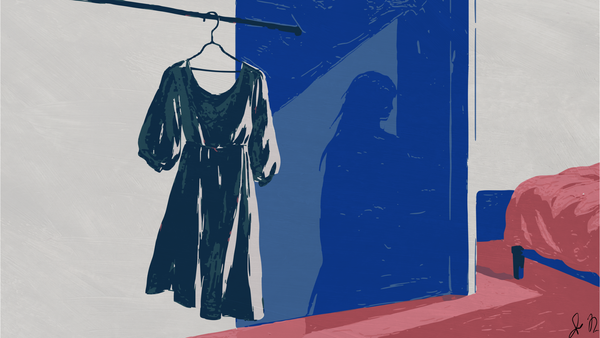
I pulled a dress off its hanger, looking for clues. It was made of a nubby, rust-colored linen and raw silk blend that surely cost hundreds of dollars per yard. This was not a servant’s livery, I told myself as I tied the sash around my waist. Because I was not a servant.
I made my way down a boardwalk toward the sound of voices on a veranda. Below the veranda was a tropical garden of astonishing richness and color. I felt an urge to run down the steps and stand among the strange, lush plants, to bathe in their green light. Instead I went to the buffet. What food! The food of the wealthy and slender. I had seen images of these foods all my life. I ate a slice of radish adorned with brown paste and bright seeds. It tasted like virtue and rarity. Food exists to train self-control, it said. Status comes from self-denial. If I did not want to be a servant I needed to remember this.
“Sit down, everyone.” Solange’s voice was playful but unopposable, like a nursery-school teacher. She pointed to a studiously whimsical flower arrangement that marked the Jades’ table.
When we were seated, a thin woman with white hair and a long, sleeveless white wrap dress appeared. Everyone stopped eating as she glided to the center of the veranda. “Good morning,” she said. “I’m Richilde Hess. Your guide. Welcome to Little Cayman.”
Richilde smiled and met our eyes gracefully, promising to get to know us. Or perhaps her smile was to show that she already knew, at a glance, our special qualities. I had seen this kind of person before. She was a grande dame. And I was heartened that Heinrich Oliver knew the value of a woman like Richilde. It gave me another way to matter to him.
Richilde seated herself on a chaise longue, brought one knee under her chin, and grinned like an impish yogi. She was perfect, serene. I was seized with the desire to please this woman, to meet her high standards. To be a goddess like her.
She stretched out a gaunt arm and said, “First we detox. No electricity. While you are detoxing you will get to know your teammates. Your facilitators will show you to your workspaces.”
“Follow me, Jades!” Solange’s voice rang out. She led us along another wooden walkway. As we clomped along, the garden gave way to mangrove thicket. Ahead were palm-thatched bungalows, each with a sign. We passed Agate, Tourmaline, and Carnelian before we came to Jade.
Solange sat us down inside a bungalow decorated with woven grass mats that I knew cost a fortune and said, “Now we are going to talk about… Power!” She said “Power!” the way my mom would have announced, “Ice cream!”
Turning to me she said, “Emily, why do people have power?”
I shrugged. “They inherit it? They have a lot of money? They’re intimidating?” I looked around and added, “They employ a lot of people?”
Solange nodded. “Adam, what are some other reasons people have power?”
“Leadership? Charisma? Intelligence?”
“Darcy, can you add to that?” Solange asked cheerfully.
Darcy answered, “What about knowledge? Knowledge is power, right?”
Adam interrupted. “You can’t define power without talking about power structures. There are two kinds, horizontal and vertical. Horizontal power is wielded by people who are equals. Vertical is a hierarchy.”
“People Power!” A woman laughed and waved a fist. When no one smiled she looked at her lap.
“Those are all good answers,” Solange said. “I’m going to leave now so you can get acquainted.”
When she was gone no one spoke for several seconds. Then Adam said, “What the fuck is this place?”
“We need to know if they’re watching us,” a woman said.
“If they are, they lied about there being no electricity,” someone answered.
Darcy asked, “What would happen if we went exploring?”
Adam opened the door and everyone followed him outside. Solange had vanished. I looked over the side of the walkway and saw tangled mangrove roots. No one could walk down there even with waders and a machete. We had a binary choice: continue down the walkway to where the sea must lie, or back to the veranda.
Adam chose the sea. We heard the voices of other teams as we passed more bungalows. Then the walkway turned into a pier jutting into the sea. It was mid-morning, sticky and hot, late August. I wished I had brought a hat. Did I own a hat anymore? Then I saw a boat with an outboard motor lashed to the pier.
Adam said, “Should we grab it?”
I looked out to sea; there were no other islands, no boat traffic. We would probably die or get picked up by the resort’s staff if we tried to escape this way. When no one said anything Adam shrugged. Without discussion, we turned back. We were a herd. Somehow our bodies had synchronized yet we acted as though communication was impossible, not worth the effort.
Halfway to the veranda we noticed another walkway. We veered onto it without speaking. The garden became less tended, but gradually, as if the gardeners would not admit they did not control all things.
Without warning a tower appeared behind a clump of trees. Coming toward us was a figure dressed in white. Someone gasped. We all knew we had transgressed.
She walked to meet us with an amused smile. “You’re the explorers, then, Jades. Good for you. Let’s go back to the veranda, shall we? It’s nearly lunch time.”
Richilde eased to the head of our pack. Turning to me she said, “And what do you make of the place? I’ve been watching you troop around.”
“It’s beautiful. So refined.” I couldn’t find better words. My eyes implored her to feel the depth of my appreciation, my sophistication.
Richilde frowned, then fell behind to speak to someone else. Embarrassment flared inside me. When we got back to the veranda I ate slices of flower-encrusted zucchini until I calmed down.
After lunch Solange surprised me by telling me I did not need to go back to my group. I could spend the rest of the day by myself. In fact, I could spend the rest of the week relaxing. The other Jades were told to go back to the bungalow.
I had done something wrong. I went to my room and pulled the covers over me. I stared up at the ceiling, feeling, for the first time, how trapped I was. Kevin. The thought of him returned like a welcome burden, like ballast.
I was not on this island to impress people like Richilde, I was here to find Kevin. I got out of bed and returned to the veranda with all the dignity I could summon. And yet once on the veranda I was afraid to leave it. I was sure if I went exploring I would lose the little freedom I had.
I passed the next six days in a state of dreamy, floating unease, waiting for the thing that would happen at the end of the week. I ate my exquisite, tiny meals and watched my body slowly shrink, become dense. Strange to say, as anxious as I was, I was delighted to be surrounded by rare, desirable things. I had wanted to know luxury my whole life; it would take more than a few days to see its emptiness.
In that strange interlude I often watched Richilde idling on the veranda. I was curious why she spent time there. In her place I would have guarded my mystique in my tower, showing myself only when I had an audience, devotees. Richilde ignored me, though now I know she was watching me, too. Once I saw her serene mask slip to reveal fear and anger. Our eyes met and I experienced a rush of satisfaction.
I saw the Jades on the veranda at mealtimes. They were not bonding. They were driving each other mad, feeding dread that would surely derail them when we reached the test. The other nine groups had connected; their laughter was giddy. They were afraid but they had each other.
On the morning of the seventh day, Solange entered my room while I was still asleep. “Good morning, Emily. Ready to go to the Compound?” Her sing-song was that of a nurse who had come to prep me for surgery.
I played along, refused to be disoriented. “Yep!”
“Good. Get dressed and meet me outside.”
We were the only ones on the veranda. For the first time since I arrived, the sky was overcast. I heard the first heavy raindrops percuss the large-leaved plants, then the dim rumbling sound of the plane. It flew above me, loud and low, before merging with the clouds.
Solange handed me an umbrella. For once she was not smiling; I glimpsed the scared and bitter person who lived inside the nurse, the preschool teacher. I followed her through the rain, up the path to Richilde’s tower. I looked up as we passed; it was much larger than I thought, with dozens of windows. I saw a young woman at a window high above, regarding me thoughtfully. She did not wave.
There was a golf cart below the tower. The walkway swelled to form a place for it to turn around, like a snake that had swallowed an animal. Solange sat in the driver’s seat and motioned me to sit beside her. She was angry about something. I wished I knew how to tell her I was on her side, whatever side that was.
The rain drummed on the plastic roof of the golf cart. Through the downpour the island was gray, featureless scrub. It took a long time to reach a building that looked like my workplace in Austin—sharp angles, metal and glass. Solange pulled into a covered entrance, and, stepping out, I reached for my luggage before I remembered I had none.
“Good luck,” Solange said.
“Thanks, Solange. Thanks for looking after me.” She nodded curtly and drove away.
When I stepped through the sliding glass doors I let out a little gasp. Kevin was standing there.
Before I could speak he said, “I knew you’d make it. Want to get something to eat?”
He gave me a quick shoulder hug and tears threatened behind my eyelids. He led me down a glassed-in walkway to a cafeteria where the smells were heavy and unapologetic. A plump man smiled and pointed to the day’s offerings. Conch curry. Shrimp gumbo. Lobster roll. I took one of each and Kevin laughed. “You must be starving after Richilde.”
We sat across from each other at a table overlooking a sculpture garden. The rain was lifting; shafts of sunlight striped the dark grass yellow-green. When I thought my voice would not break I said, “You’ve been here since… you left.”
“Yeah. I went to the Killeen facility, then Richilde, then here. Same as you.”
“Were you also the only one who made it through?”
Kevin paused mid-bite. “There are different places people go. We both ended up here.”
I searched his face. His auburn curls had receded slightly. His delicate pink skin had turned yellow and waxy in the hot climate. I remembered worrying that Texas would do that to him; instead it was this place. He was a man now, the boy was all scrubbed off. What kind of man?
He looked at me steadily and said, “The Algorithm is amazing. You’re going to love being part of such a cool project.” When he cleared his throat I thought he was going to bring up us. But he said nothing. I felt dizzy. The Kevin of now and the Kevin of memory had not reintegrated. I didn’t know him anymore, and I didn’t believe he’d ever really known me. I wished I could be alone for a while.
Finally Kevin said, “I owe you a lot, Emily. You’re pretty cool.”
I said, “Yeah, that was something, wasn’t it?”
Kevin blinked or possibly winced. Maybe he was trying to reintegrate the different versions of me, too.
I said, “So, where are the other places people end up?”
“Most of them go to Nashville. We have an Algorithmic starter community there.”
I thought about this. “The ones who bonded, right? What happened to my group? The Jades?”
Kevin laughed. “Yeah, you had the weirdo group. I don’t know what happened to them.”
When we finished eating Kevin took me to the labs. There was no special equipment, just lots of screens, tables, and conference rooms. Heinrich himself was there, along with seven or eight young men.
Heinrich said, “Welcome, Emily.” He did not shake my hand or introduce me to the men who orbited him like an electron cloud. Kevin was at home here, joking, competing. He looked young again.
Soon Heinrich slipped away and Kevin called to me. “Come see the Algorithmic Village.”
The others made room for me in front of a screen. I watched people interacting—cashiers and customers, people talking in parks, people at work. After each conversation, text appeared under each person. Things like: Credit Earned +3 Status, -2 Power.
This was delightful, freeing, acknowledgement of a reality I had always tracked. There was recent footage, too, from the bungalows and the veranda. It was easy to search. The readings from the Jades were nothing but zeros. “People who refuse to participate are going to starve when the Algorithm takes over,” one of the boys said.
After a while the boys drifted away, and Kevin with them. When I was alone I found the video of Richilde and me on the veranda. Though we never acknowledged one another, the Algorithm knew we were competing. I watched intently at the spot where Richilde’s face had dropped its mask to show fear. At that moment my posture was proud, brave, exultant, for that was when I had sensed she was not a goddess. Her animal mind had submitted to mine, but my thinking brain had only registered that she was a fraud. And with that my status and power credits reached a tidy sum.
As the afternoon lengthened I grew bored watching other people compete. I left the monitors and stretched out on a sofa overlooking the sea. I watched the sun slip into the water.
I awoke at a touch on my shoulder. Heinrich was standing over me. I sat up quickly and brushed hair out of my face.
“Emily. Will you join me in my office?”
I looked around. The boys were gone. My stomach rumbled and I saw it was night outside. I stood and straightened my wrap dress.
I did not expect the equestrian theme of Heinrich’s office: photographs of sleek horses, green fields, serious people wearing funny pants. Heinrich leaned on the edge of his desk and motioned me to take a seat. His face was almost bashful.
“Look, Emily, with your high readings for status sensitivity, you meet the criteria for oocyte donation. The modern harvesting technique is relatively painless, and quite safe. In addition, you would become eligible for a job transfer.”
“You want my eggs? Why?”
Heinrich’s buttocks shifted on the desk. “We would use them to create gametes.”
“I don’t like this,” I blurted.
He sighed, then retreated behind his desk where he paced back and forth. “You know, I could’ve had someone else have this conversation with you. I’m here because I know what I’m asking of you.”
I wondered if he wanted me to acknowledge that he was doing something that made him uncomfortable, to praise him. I said, “Oh. Whose sperm would fertilize the eggs?”
He looked up, surprised. “Mine, of course. You wouldn’t need to gestate them. We have special people to do that.”
“Do I have a choice?”
Perhaps an old reflex made him say, “Yes, yes you do. If you don’t want to participate you can return to your old job. You’d need to sign a nondisclosure agreement, of course.”
I could hear the lie. “Is that what happened to my group, the Jades? The ones who wouldn’t participate?”
Heinrich’s face contracted, and when he said, “That’s none of your business,” I understood. There was no NDA, no going back to my old life. The Jades had disappeared; it was better for both of us if I did not know what that meant.
I breathed in. “What is the job transfer?”
He brightened. “Richilde needs an assistant. Someone to keep the resort beautiful and elegant. She’s getting old. You will replace her someday.”
Kevin drove me back to the resort in the golf cart that night. The headlights picked out the gray ribbon of the walkway. I thought: The walkway is a circuit board. We can only flow where it conducts us. Around me in the blackness I heard strange birds calling out, commenting on our intrusion.
I could not see Kevin in the dark, only feel his bulk beside me in the vinyl-upholstered seat. Uncomfortable with his silence, I spoke at random.
“Where do you live?”
“Oh. We have our own digs in the Compound.”
“Are they as nice as the resort?”
He considered this. “The resort is about showing off. The Compound is more about showing who’s boss.”
“One is status and the other is power?”
Kevin laughed. “I forgot you were so smart.”
“Do you know what Heinrich is going to do to me?”
It took Kevin a while to respond. “Yeah.”
I breathed in. “Am I going to see you again?”
Kevin took his right hand off the steering wheel and felt around for mine. “No, Emily. Heinrich doesn’t want his children’s biological mothers interacting with men. It would damage them psychologically, knowing their mothers were like that. Don’t worry, he won’t pester you, it’s not like a harem or something. We respect you; we actually call you the goddesses. Because you’re untouchable. We have our own fun in our compound.” He squeezed my hand and let go.
“With girls?”
“Yeah, with girls. They fly in special girls.”
I felt cold. I was a special girl too, but not the kind that cavorted with special boys like Kevin. “Why does Heinrich want you guys around?”
Kevin sighed. “He has a tendency to be gloomy, and we cheer him up. Add energy.”
Something in his tone made me ask, “Does he like the girls they fly in? Or boys?”
“You would ask that, wouldn’t you? I think he’s more into the boys. Do not tell anyone I said that.”
“He’s into boys like you?”
“Um, yeah.”
I was overcome by the bleakness in Kevin’s voice. Kevin had already turned dry and yellow in this environment. What would happen to him when his beauty was exhausted?
I decided to tell him one of my secrets. “When you disappeared it reminded me of a painting. The Assumption of Mary. I called your leaving the Assumption of Kevin.”
Kevin snorted. “I know what the Assumption is. Now you know I didn’t go to heaven.” Then he said something unexpected. “I changed my last name. I’m not Kevin Benitez anymore. I’m Kevin Flynn.”
“Why?”
“Because our mothers both had that name and I only knew this because you got me talking about myself. Because you are the only person who ever figured me out.”
I wanted to tell him I wasn’t sure that was true. The only thing I knew about Kevin was that I loved him. Was that enough to know someone? Was it enough for him to love me in return? Please, please let that be enough.
“I will change my last name to Flynn, too.”
“Like a secret marriage or something?” Kevin’s old trustfulness tore at me.
“Yes,” I said softly.
He sat up straight behind the wheel and said, “Miss Flynn, will you marry me?”
I smiled in the darkness. “I do. By the powers invested in me, I now pronounce us husband and wife.”
Kevin leaned over and kissed my cheek. I tried to kiss his cheek but ended up kissing his neck.
We had reached Richilde’s tower. Candles and lamps shone from many windows, like a leaking lighthouse. Kevin turned off the engine and bounced his knee up and down.
“I’m not allowed in the women’s quarters. I guess someone else will take over now.” He gave me another shoulder hug as I got out. He turned the cart around and I watched him drive away.
“I love you, Mr. Flynn,” I said to no one.
I stood still as the two beams of light, never meeting, grew dimmer and dimmer.
This story is one of a series that serve as a prelude to Carmen Clarke's novels. The first novel is called Eusebio's Tale and is available on Amazon.

Carmen Clarke is an infectious disease epidemiologist living in Maryland. Clarke began to write speculative fiction several years ago, no doubt as a way to understand what was happening to our shared reality after exhausting themselves responding to the pandemic.
Editor's Note:
Thank you for reading Carmen Clarke’s “Goddess Class.”
There is a seductive idea buried inside our language about power. That understanding a system gives us some measure of freedom from it. Learn the codes of wealth, beauty, class, corporate life, and social influence, and perhaps you can finally move through the world on your own terms.
In that way, Emily has been learning those codes all her life. She reads status with extraordinary precision. Yet this talent becomes another resource for powerful people to identify, measure, and eventually own. The cruel joke of “Goddess Class” is that seeing the hierarchy clearly can make someone exceptionally useful to it.
Clarke pushes that idea into especially uncomfortable territory with the word “goddess.” Emily is elevated through language at the moment her choices become increasingly constrained. Prestige becomes one of the technologies of control. A beautiful name for the place someone else has chosen for you.
Perhaps that is why status can exert such a powerful hold on us. It teaches us to experience our assigned place as an achievement unto itself.—Jon Negroni
Support Cetera
Paid members get exclusive perks like bonus stories, the ability to comment, and more. Plus you'd be helping us keep the bills paid. You can check out the subscription tiers below, or you can leave a one-time tip if that works better for you.