Shipworms in the Wood
A mother has spent her life with a lump in her throat. Then she finds one growing in her daughter.

Content warning: This story contains depictions of postpartum distress, bullying, and physical harm to a child.
The newborn’s skin is untouched silk next to the rough cotton of the hospital gown, draped unevenly down my right side, exposing my shoulder, my neck, my engorged breast. A drip of golden milk appears, and her face turns toward it, and I’m amazed how someone so new can already be captivated by its lure, can already rely so heavily on instincts.
A rooting reflex: her pink tulip mouth opens and quivers as it searches for something that she knows is there but can’t locate. She writhes and stretches in discomfort, and the crown of her head dips beyond the crux of my elbow. I move the nipple, now a flowing spigot of honey-colored drops, closer to her, but still, she can’t make contact. Tears fall from both our eyes, fusing with the milk, moistening her dark hair, soft as fuzz.
And even through the frustration, through the confusion, I am relieved to see her exposed neck is flat. I move my finger to it and press gently. There is nothing that pushes against my finger.
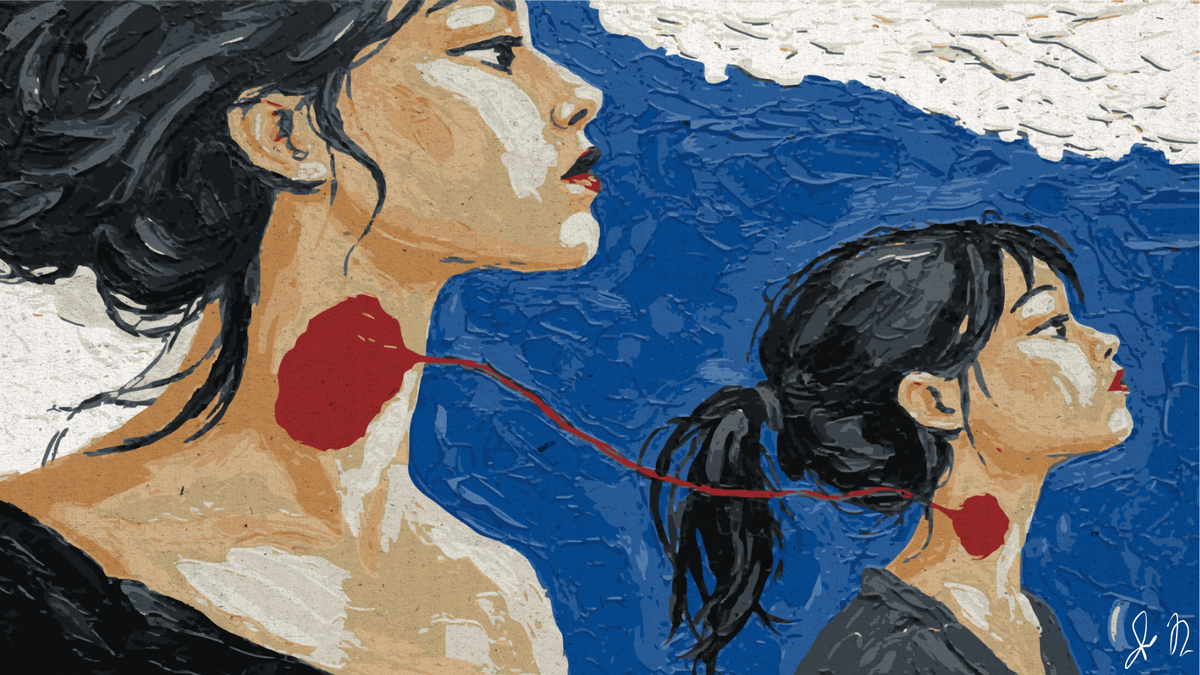
I swallow against the lump in my own throat, cradled by the lines that I wear like a necklace stack. It settled there years ago and never left. It is invasive. Making a home in the soft tissue and collecting to survive. Like shipworms burrowing into soft, paper-like wood.
I imagine the lump is a porous sponge, unevenly round, holes like random patterns. Swallowed, but never suppressed.
She doesn’t want me. She is rejecting me. My lump swells, rivaling my breasts in size. And like this lump that needs me to survive, so does this baby. I ask the nurse to look at my neck instead of pulling at the netting that is hugging my pelvis, soaking up the blood, tugging at the raw stitches. She presses her thumbs into it, as though expressing a blemish. She asks if I ate something that I couldn’t swallow. She asks about my thyroid. She asks why I am so concerned about my neck when my real concern should be drinking water or getting my baby to latch.
The baby does latch, eventually. Days later, her mouth makes a connection with its food source. My nipples are raw. Blood streaks the milk, a marbled red-pink. The pediatrician is worried about her weight. She tells me to supplement with formula, but I can’t fathom it.
“No,” I tell her.
The doctor tells me to take off my shirt and feed her. Feed her while she watches. As if underperforming for an audience, the baby bumps her head against me. Red-cheeked, anger erupting with each bump. She is once again lost in the maze of this body. The doctor shakes her head. Her disappointment is palpable.
“Her stomach,” she says. “Your diet. It’s making her sick. No spice. No acidic foods. Especially no coffee.” No coffee? A means of survival. For weeks, plain chicken breast is cooked, broiled, roasted, grilled, and poached.
I indulge in a meal of flavorless rubber each night, no juices to lubricate the meat as it attempts to pass the lump. But eventually it is swallowed. Eventually, I sustain her.
In first grade, Fiona is called to the front of her classroom.
The rusted caps on the chair’s legs scrape against the green speckled tile as she stands. Her shaking legs kick the chair out with the backs of her knees. She carries the paperback in her hands, and when she arrives at the front, and sees the wide peering eyes staring at her, she raises it level with her face. Even the clamping of her thumbs on the antique brown pages can’t hold it steady.
She stumbles over her words. Lips quiver as she attempts to align her voice with the words on the page. Her eyes ping-pong between lines.
Her teacher paces the length of the room and makes a face as though swallowing spoiled milk.
“Thank you, Fiona. You can take your seat.”
Fiona walks to her desk and sets her book down.
“Stupid,” a girl across the table whispers. “You can’t read.”
Fiona’s tears fall heavy onto the opened pages, droplets swelling into circles that swallow and warp the print.
That night, before bedtime, we settle in to read. I pick her book up off the nightstand and hand it to her. Fiona throws it across the room. “No! I’m never reading! Never again!”
Instead, we lie in the dark. Our eyes follow Fiona’s nightlight; a myriad of colors dance wildly across the ceiling. She is gripped by sleep while I lie awake, watching her. The soft sheen of moonlight beams through her window and pronounces a faint lump in her throat. My breath is held in my own throat as I cup my forefinger and thumb around it and pinch the soft skin. It’s delicate, like the white of a hard-boiled egg. It has arrived.
When Fiona is ten, we are lined up outside the bus for sleepaway camp forty minutes north of our home. A familiar woman stands near us. I’ve seen her many times at school. I side-eye her as she adjusts her daughter’s bag. The girl’s eyes roll with agitation as she stares into the screen of her phone. At her feet, a large storage bin with the girl’s name, Shea, stenciled on the side.
“Excuse me,” I ask the woman. She drops her daughter’s backpack, and it falls heavy on the girl’s back. “Can I ask why you have a storage bin?”
The woman looks down at the duffle bag at my feet.
“Oh.” She frowns. “This must be your first time.”
She looks down at Fiona. “Is this? Your first time at camp?”
Fiona nods.
“Well.” Her tongue massages her front tooth, which slightly overlaps the one next to it. She looks around as though trying to find a solution. Perhaps someone with an extra bin. “It’s not on the packing list, but us veterans know that it’s a good idea to pack their things in the storage bins. In case of rain. The cabins can flood this time of year.”
“Flood?”
Fiona’s fingers reach up and grip the straps of her backpack. The woman sees it too. “Nothing to worry about, sweetie. Just rainwater.”
The woman extends her hand toward me. “Dina.” Her teeth push the D out like a melody when she says her name.
“Rachel,” I say.
“And this is Shea.” Dina snaps. “Shea!”
Shea looks up from her phone and her eyes graze Fiona. Fiona appears so elementary, so baby-like in her playful patterned matching top and shorts, next to Shea’s tank and revealed bra strap, her cut-off jean shorts with uneven frays.
Dina introduces the girls to each other and all four of us dance around the awkwardness of two mothers meeting for the first time, two girls that have no common ground, until the bus driver honks the horn.
“Everyone on!” the driver yells.
I straighten and pull Fiona close to me. Her arms wrap around my waist, her hands join at my back. I kiss the top of her head, offering a piece of myself to her, to keep with her.
Fiona’s face is buried in my stomach, and I reach down to loosen her grip. Her face is upright, toward me, but I can only look past it, to her throat. “It’s going to be okay.” I attempt to swallow, but it’s all so dry. “And at least you know Shea?”
Dina meanwhile is speaking to Shea, her voice dimmed behind her teeth, behind her crooked tooth. She tongues at it again, as she watches Shea comply.
Shea slugs over to Fiona. “Are you ready? I can sit with you on the bus.” Her eyes are wide and magnetized toward her mother.
The girls walk to the bus and toward a group of girls who are waving at Shea. The same clothes, the same builds, bra straps peeking in an array of colors.
We wave goodbye.
“Hey, why don’t we get together for a drink this week?” Dina asks. “To help pass the time while our girls are gone.”
I hesitate, trying to remember the last time I had a drink. Time to myself. A friend to talk to.
“C’mon,” she nudges the air with her elbow. “How about Thursday?”
With equal parts reluctance and excitement, we schedule a happy hour for Thursday. Later that evening, I hear the drumming of rain on the window. I think about the ocean of plastic bins that surrounded us as we waited for the bus. I see her canvas duffle, floating, sweeping across the planked floor of the cabin. The water rising up around her as she sits knees to chest on her bed, hugging her legs.
Shea and the girls with the short shorts mock her as her belongings are pulled from the bag. Her stuffed bear, a bracelet making kit, her bone white training bras with no padding, a photo of us I tucked inside, hoping that when she unpacked her things she would find it, and with it, find comfort.
I walk outside to the backyard. My bare feet sink into the waterlogged grass. I throw my head back and open my mouth, bare my throat to the sky. Beg the rain to soothe the pulsing that won’t allow me to sit still, won’t allow for quiet, for rest.
The rain is steady for the week, and I dodge puddles, slipping on the sole of my sandals as I enter the bar to meet with Dina. After three glasses of white wine each, my phone displays the number of the camp. I can feel the lump swell, as it takes hold of my words. I hand the phone to Dina, and it’s only through my eyes that she can understand what I’m trying to say. She answers.
“Hello?”
She nods her head. “This is Dina Hargrove. My daughter Shea is there too. I’m just answering for…”
“Her neck?” she asks. Her neck? My fingers reach up to my own neck. I can feel movement. Dina lowers the phone from her ear and leans it toward me. “They need to talk to you.”
Dina drives to camp. Her impairment isn’t as severe as mine. The white wine headache builds behind my eyes, the immense pressure threatens to pop my eyes out of my head. I can feel the acidity in my throat rise, and I silently wish for it to burn the lump. I imagine opening my mouth and releasing the ashes. Getting rid of it for good. But instead, it contracts from the reflux.
When we arrive at camp, the director walks us to the infirmary. Fiona is sitting on the bed, holding a compress to her neck.
“We think it’s poison ivy,” the nurse says. She helps lift a paper cup with water to Fiona’s lips.
I sit next to Fiona on the bed and put my arm around her. I ask her to lower the compress so I can see. Clusters of blisters have formed on her neck, and up around her ears. But it’s not the rash or the tiny blisters that I focus on. It’s the mothership, the swollen lump in the middle.
“What are you going to do about this?” I point to the lump.
The nurse moves her head close to where I am pointing.
“The rash and blisters should go away with the calamine lotion.”
“Not the rash. Her throat! The lump. It’s larger than when I dropped her off.”
The nurse looks confused. Her confusion makes its way to Dina, and they share a worried look.
“Lump?” the nurse asks. She removes her glasses from her shirt pocket and holds the lenses in front of her eyes.
“How did this happen?” Dina asks. “Why is the rash only on her throat and neck?”
“We were wondering the same thing, but Fiona wouldn’t tell us,” the director interjects.
“Why don’t you take Fiona and gather her things?” Dina suggests. “I can drive you back home tonight.”
The director walks Fiona and me to the bunk, and the floor is wet, just as Dina said it would be. We pack her things into the duffle bag, heavy from submergence. The other girls, including Shea, sit at a wooden table in the center of the room and watch.
I reach for the corner of her sheet at the top of the bed, and Fiona yells. “No, mom!” She pulls my arm back. “Don’t touch the pillow or sheets.”
“Why?” I ask. “What’s going on?”
My eyes drift toward the middle of the room where the girls sneer quietly. Shea is among them, her hand lifted to her mouth to conceal her laughter.
I open my mouth, but Fiona squeezes my arm as she holds it. She shakes her head as though to say, “Please, Mom, don’t.”
I ask the counselor for a garbage bag, avoiding the areas infused with the oil and residue from the poison ivy, and shove everything inside.
The ride home with Dina is silent after she asks if Shea has been nice to Fiona. She nods, and trickles of tears run down and fuse with the raised rashes along her neck. Dina sweeps her tongue over her teeth, and the tip of it massages the crooked tooth at the center of her smile.
By the time Fiona reaches high school, the lump has grown. It made itself known, quivering when she cries, sitting calmly on the surface of her skin while she sleeps.
It’s present during her volleyball games, when she pulls at her uniform, desperate for slack. The slick spandex adhering to her like an additional layer of skin, spotlighting her imperfections that were so perfect to me.
It’s there at the homecoming dance, when she walks in heels for the first time, and her ankle buckles, bringing her weight down with it.
The day finally arrives when her class is notified if they are chosen for the National Honor Society. I wait impatiently outside for her at the end of the school day. When the bell rings, I reach up and massage my neck, recalling the late nights of studying. The notecards and the quizzing at the dining room table. All the preparation for this day.
Her class runs out. Shea is among them, her asymmetrical smile that is so much like her mother’s is wide, and she’s waving her letter in the air. Many letters are in the air. A parade of letters, with Fiona, the finale float, empty-handed, at the rear. She drags herself to the passenger side of the car and lunges her body into the seat like dead weight.
Fiona buries her face in her hands and cries so hard that it is devoid of sound. She begins gasping, as if she is unable to breathe. The gasping grows louder and more intense, pressing into my ears like a siren. The lump.
I run to the passenger side and pull her from the car, my hands compressed around her throat. My thumbs dig into her skin with desperation, carving crescent nail indentations into the surface. The lump dimples under the pressure of my fingers. Its texture shifts, stretching and fighting for its survival. If I could only find it, I can remove it. Before it consumes her.
“Mom! Please!”
She puts her hands over mine, bone kneading bone.
“Rachel! Stop!” I hear from behind before I feel the strength of someone pulling my hands off Fiona’s neck.
It’s Dina. Dina, who I waved to, smiled at in passing, but haven’t spoken to since the time she drove me to camp years ago. I throw my arms up and Dina is forced to release me.
“Did I get it?”
I circle frantically in place, as if there is a chance the lump had fallen out of her neck and onto the pavement. I look up to see the faces of the crowd that stand near the car. The mothers and students gathered here. Staring, judging, whispering. One mother holds her cell phone high in the air, her thumb at the ready on her keyboard, her wide eyes a quiet threat.
“I…I…” I lift my arm and use my sleeve to wipe the hot tears from my face. A combination of tears and sweat pastes strands of my disheveled hair onto my skin.
Fiona stands away from me, her hands around her neck.
“Show’s over!” Dina yells. She shoos at them as if chasing bees from a lemonade pitcher.
I walk to Fiona, and she lurches away from me. “I’m sorry. I was scared. Scared that you couldn’t breathe.”
“Fiona, honey,” Dina says. “Sit in the car. Your mother will be right there.”
Fiona gets inside and closes the door.
Dina pulls a bottle of water from her bag and unscrews the plastic cap. “Take a drink.”
She guides the opening of the bottle to my mouth. I wince as the water is absorbed into the spongy lump, and I feel it expand. It is larger than it’s ever been.
“Just drink slowly. Do your best to swallow.”
The tip of Dina’s tongue massages her crooked tooth.
“We’ve all been there, Rachel. All of us.”
I massage my throat, making a pathway for the water.
Her tongue recedes back into her mouth and settles. “All of us.”

Erin Dawkins (she/her) is a Michigan-based writer. Her work has been published in Flash Fiction Magazine, Sky Island Journal, and The Orange Rose, among others. Her fiction has been nominated for The Best of the Net, and her novel-in-progress was a finalist for the Unleash Press' 2026 WIP Prize. Read more at https://www.erindawkins.com/.
Author's Note:
"Shipworms in the Wood" was born in two parts. First, I have Hashimoto’s Thyroiditis, which is a chronic autoimmune disorder in which my body attacks the thyroid gland, which is essential for the body to function properly. For a long time, I had a large goiter in my neck, and I frequently underwent radioactive scans and biopsies to monitor the nodules that develop on the gland. A few years ago, I was waiting for a scan and I wrote a rough draft of this story.
The practice of sitting quietly while my body underwent this crazy process of attacking itself made me think of the neck lump as a visceral image and naturally spilled onto the page.
My earliest influence as a writer is author Shirley Jackson, because her later work exposes the lovely and dark sides of motherhood and undercurrents of domesticity, so I frequently draw her influence into my fiction. The second part of this story came from watching my daughter grow and navigate her own struggles. I realized how much in motherhood you reflect back on your own experience through adolescence and teenage years. It's hard on everyone involved!
I submitted this story to Cetera Magazine in January as a flash piece, and the editors were kind enough to highlight the strengths, and encouraged me to revisit it and lengthen the story. It took about seven months for revisions and naturally I was thrilled when I received the news that it would be published. I am so grateful for Jon and Natalia at Cetera Magazine for their support in refining this story and sharing it with the world.
Support Cetera
Paid members get exclusive perks like bonus stories, the ability to comment, and more. Plus you'd be helping us keep the bills paid. You can check out the subscription tiers below, or you can leave a one-time tip if that works better for you.