Nasturtiums
As a child, she ate flowers from her great-aunt’s garden. Decades later, she learns who they were planted for.

My great-aunt Reyna died when I was seven. She’d been living on the same block in San Antonio where she was born. I didn’t know her well. I knew that she grew things in her yard, that she wrote in notebooks that my grandmother didn’t read, and that the women at her funeral didn’t cry the way the women at other funerals cried.
My grandmother, her sister, was the one who told me when it happened. She sat me down at the kitchen table and said that Tía Reyna had died during the night, that her heart had been weak for some years, and that we would be going to San Antonio for the services. She said this calmly and then got up and turned the stove on. I didn’t ask questions. I was seven and I didn’t know what questions to ask.
The funeral was held in a church on a side street near the highway. The flowers at the altar were yellow and white and had no smell I could detect. Tía Reyna’s coffin was plain dark wood with brass handles. I stood between my grandmother and my mother and looked at the coffin for most of the service. I kept trying to remember Tía Reyna’s yard, which I had seen only once, the summer before. We drove past it on the way to the church. Some people had already started pulling things up. There were fresh dirt patches along the fence where the plants used to be. I didn’t understand, then, why anyone would pull up a garden before a funeral.
After Tía Reyna died, my grandmother rarely talked about her. If her name came up, my grandmother would agree that yes, Reyna had been very dedicated to her garden, and yes, she had kept a lot of notebooks, and yes, it was a shame there had never been children. Then she would find something to do with her hands. She had a way of ending conversations by becoming busy.
What I knew about Tía Reyna I assembled from fragments. She had never married, though she had been engaged once, to a man no one talked about. She had worked for forty-five years as a school secretary. She had taught herself to read in three languages. She had been, as my grandmother put it, very particular about certain things. This last phrase was used to explain a great deal. Why she lived alone. Why she did not attend family gatherings after a certain year. Why she and my grandmother had not spoken for some time before she died.
I asked my grandmother once what they had argued about. She said they had disagreed about how to remember someone. She did not say who.
A few days after the funeral, my grandmother took me to the house on Bowie Street to help sort through what remained. It was a small house, pale green, with a covered porch and a yard that had been cleared down to bare dirt. I remember standing at the front gate and feeling that the yard looked wrong, too open, like a face with something missing.
Inside the house everything was orderly. The kitchen was clean. The bedroom had a narrow bed, neatly made, and a nightstand with a glass of water that was still there, half-full.
The notebooks were in the back room, which Tía Reyna had used as a study. There were more than fifty of them, stacked on two shelves above a wooden desk. Each was the same: black cardboard cover, college-ruled pages, the name and a date written on the spine in blue ink. The names were all women’s names. I pulled one from the shelf. The spine said: Jovita Idár, 1885. Inside, in my great-aunt’s small, even handwriting, were pages of notes. Dates, places, short summaries. A list of her articles. A note: She once stood in the doorway when the Texas Rangers came to shut down the newspaper. They had to return later.
I put the notebook back and stood there for a moment. My grandmother was in the kitchen. I could hear her opening and closing cabinets.
I pulled another notebook. The spine said: Sylvia Mendez, 1936. Another: Antonia Pantoja, 1922. Another, thinner one: María de Jesús Dosal. At the bottom of this entry, in slightly different ink, as if added later, Tía Reyna had written: There is no record of where she is buried. Someone knows. No one has said.
I didn’t even think to call my grandmother in to show her. It felt like something I was not supposed to be looking at.
But the part I think about most happened the previous summer, when I had been six. My parents had taken me to San Antonio to visit the family, and for one afternoon, while the adults rested, my grandmother brought me to Tía Reyna’s house. This was the only time I saw the yard when it was still alive.
It was August, and very hot. The yard was not large, maybe fifteen by twenty feet, but it was full in a way I couldn’t take in all at once. Things grew at different heights and in no particular order. There were tomatoes and there were tall plants with red flowers and there were low plants with thick waxy leaves that I didn’t recognize. The smell was sharp and green. It was nothing like a park or a garden I’d seen in a book.
Tía Reyna was waiting for us at the gate. She was a short woman, very straight in how she stood, with white hair cut close to her head and thin hands that were stained faintly green at the fingertips. She wore a yellow housedress and canvas shoes. She shook my hand when we were introduced, seriously, as if I were an adult, too.
My grandmother stayed on the porch with a glass of water and a book while Tía Reyna took me into the yard. She showed me everything. This is yerba santa. This is epazote. She told me the names in Spanish and sometimes in Latin and once or twice in a language I didn’t recognize. She repeated each name, as if it mattered that I remember. I remember only some of them. What I remember more clearly, though, is how she moved through the plants slowly, touching things, lifting a leaf to check the underside, pressing a stem between her fingers and holding them up for me to smell. I only pretended to smell once.
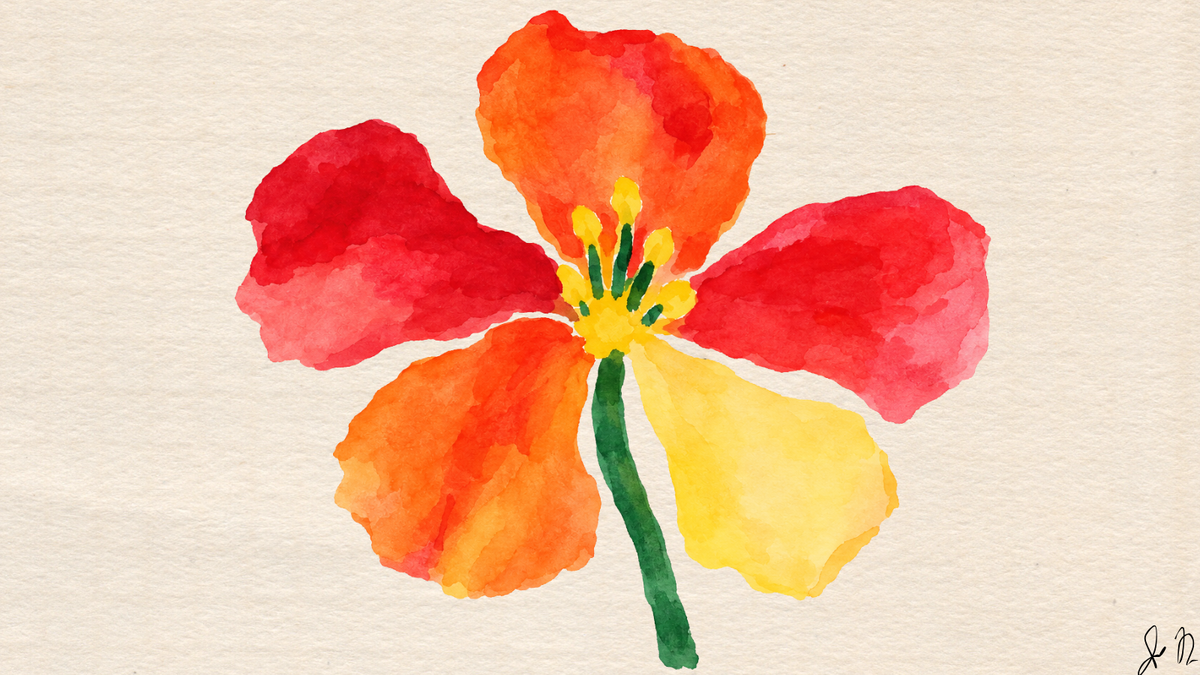
Near the back fence there was a large patch of nasturtiums, orange and yellow, growing in a low dense sprawl.
“You can eat these,” she said.
“The flowers?”
“Yes, and the leaves. Everything.” She picked a small orange flower and held it out to me. I ate it. It was peppery and strange and not unpleasant.
Then she said something I didn’t understand until much later. She crouched down and looked at the nasturtiums for a moment and said, “Every one of these is for someone who didn’t get a plaque.”
I asked what she meant. She looked at me, her brown eyes very steady.
“Nothing,” she said. “Only that some things grow without being asked to.” She stood up and brushed her hands on her dress. “Come. I’ll show you the lemon tree.”
I’m thirty-one now. I teach secondary school in Austin. I’ve kept a small container garden on my balcony for the past four years. Last spring I started growing nasturtiums.
I wasn’t thinking about Tía Reyna when I bought the seeds. Or at least I didn’t think I was thinking about her. But when the first flowers opened, orange and very bright in the early morning, I stood there for a while before going back inside.
I have all of Reyna’s notebooks now. Fifty-six of them. My grandmother gave them to me when I finished my graduate degree. She wrapped them in paper and didn’t say much when she handed them over. She said Reyna would’ve wanted someone to do something with them. I asked what she thought Reyna had wanted, and she went quiet for a moment, then said, “To have them read.”
So, I’ve been reading them for two years. There are women in those notebooks I haven’t been able to find in any other source. Women who organized other women and were never recorded. Women who wrote and whose writing was lost. Women who fought and whose names were given, in the histories I can find, a single sentence or half a sentence or nothing at all. Tía Reyna had found them anyway. I don’t know how. She had no university appointment, no grant, no institutional access. She only had decades of evenings and a library card and a habit of writing letters to people who might know something about someone. She built the archive by herself, in a small green house, and no one knew it was there while it was there.
Sometimes I think about what she said in the yard that afternoon. Every one of these is for someone who didn’t get a plaque. I thought, at six, that she was speaking loosely. Adults talk like that sometimes around children, saying something that sounds like more than it really is.
But now I think she was telling me exactly what she meant. Every nasturtium in that yard had a name behind it. She’d been tending them for years, and the names were in the notebooks waiting on the shelf, and she’d been waiting for someone to come and read them. It didn’t have to be someone specific. Just someone.
But standing on my balcony last spring, watching the nasturtiums open, I understood that I had already been inside it. I had eaten from it. She’d fed it to me before I knew what it was, so that when I finally did understand, I wouldn’t be afraid of it.

Jon Negroni is a Puerto Rican author based in the San Francisco Bay Area. He’s published two books, as well as short stories for IHRAM Press, The Fairy Tale Magazine, and more.
Author's Note:
Thank you for reading “Nasturtiums.” This is a story loosely based on my aunt. I wrote it in response to “Forgotten Flowers,” a monthly prompt from IHRAM Press that they were kind enough to feature a snippet of earlier this year. I'm proud to finally share the full story this week with the readers of Cetera Magazine.
When we think of archives, we usually imagine boxes and catalogues, as well as the institutions that house them and the authorities who must decide what belongs inside. So Reyna’s archive is unusual in that her archive sprouts from evenings at the library, letters sent to strangers, notebooks kept in a back room, and flowers tended in a scorched yard.
Reyna gives the forgotten women she researches two forms of afterlife. First, she writes their names down. Second, she grows something for them. One preserves knowledge. The other requires continual care. After all, a garden survives through watering, pruning, replanting, and (eventually) someone new learning how to tend one of their own.
In that way, Reyna’s true inheritance to our main character is a practice of attention. Long before her great-niece understands what she's received, she's already walked through it. Tasted it. Carried some small part of it away with her into adulthood.
Perhaps this is how certain histories endure. When someone teaches another person to notice.
Support Cetera
Paid members get exclusive perks like bonus stories, the ability to comment, and more. Plus you'd be helping us keep the bills paid. You can check out the subscription tiers below, or you can leave a one-time tip if that works better for you.