Rain Check
Ninety-two days sober, Marge walks into a storm to find out what’s left of her.

She got the permit because the website did not ask her how she was feeling. It asked for her name, her birth date, and the last four digits of a card she had memorized in better times. It asked what trailhead she would use and how many nights she planned to stay. It did not ask if she had been sober for ninety-two days or if her sponsor had just texted her, I’m sorry, something came up. It did not ask if she was afraid of being alone with herself without a bar or a couch or someone else’s voice to keep her from thinking too much.
Her name was Marge. That was short for Margaret, but no one called her that now. She was thirty-seven and had a face that could go flat and hard when she needed it to. It did not invite sympathy. People mistook that for strength. She let them.
She printed the permit at the public library because she did not trust her own printer. The paper came out crooked and she smoothed it with the heel of her hand. The librarian asked if she needed help and Marge said no in the way that closed doors.
She had planned the trip with her sponsor. They were supposed to go together, keep each other honest, make coffee on a small stove and walk until their legs hurt and then walk more. Now it was just her. The text sat on her phone like a small bruise. Rain check. I’m really sorry.
Marge did not reply to it. She folded the permit and slid it into the front pocket of her pack. She packed with care. Not in a nervous way. In a deliberate way. She laid things out on the bed and touched them once before they went in. Stove. Fuel. Socks. Food in weighed portions. A book she did not plan to read. A notebook she would not write in. She did not pack anything that could numb her.
The drive to the forest took most of the morning. The highway fell away into smaller roads and then into roads that did not go anywhere important. The radio cut in and out. She drove with both hands on the wheel and kept her eyes on the line.
When she reached the ranger station, it was closed for lunch. A sign on the door said so in neat block letters. She waited. A wind came down from the trees and made the flags snap. She stood and felt it on her face. It smelled like pine and old water.
The ranger returned and checked her permit. He looked at her pack and at her boots.
“Storm coming in tonight,” he said.
“Oh, I know,” Marge said.
“Trail’s exposed in places.”
“Yup, I know.”
He nodded and handed the paper back. “Sign out when you leave.”
“I will,” she said.
She parked at the trailhead and shouldered the pack. It felt heavier than it had in her apartment. That was good. She liked the way weight made choices simple. You either carried it or you didn’t.
The trail climbed almost immediately. The trees closed in and the light went green. Her breath found a rhythm. Her legs did what they were told. The world narrowed to dirt and roots and the sound of her own movement. It was easier than being in a room.
She walked for hours. She passed no one. She drank water and ate when she should. She did not think about the sponsor or the bar down the street from her apartment or the way a drink used to take the edge off the day. She thought about where to put her feet.
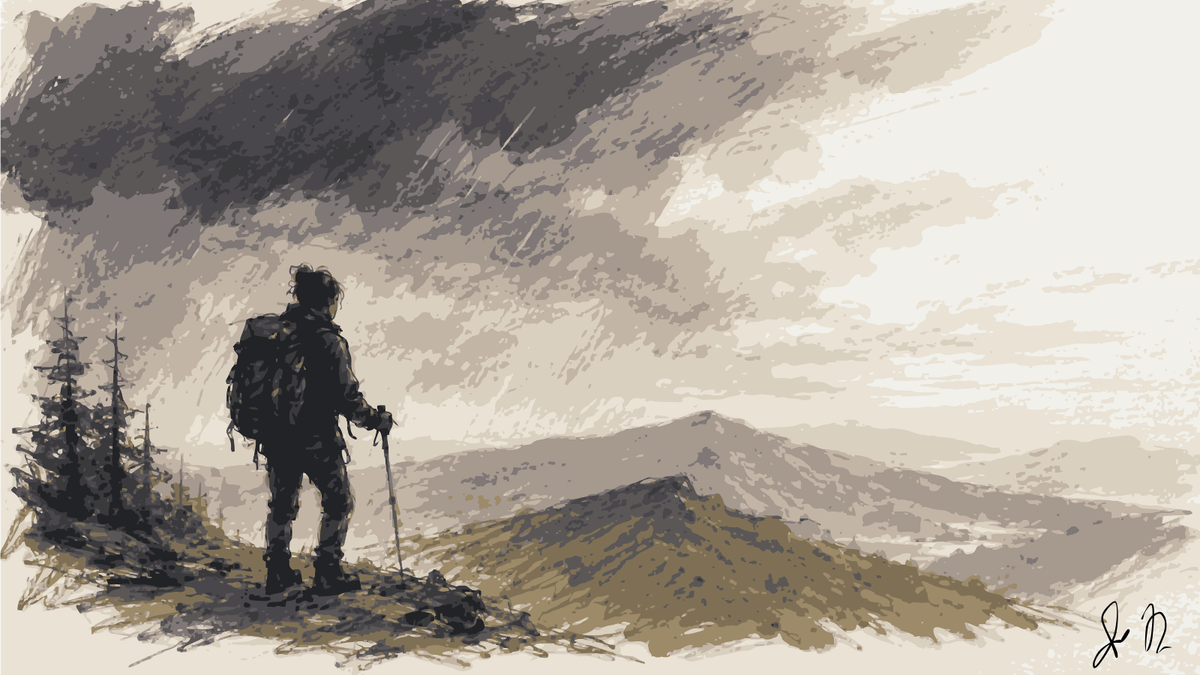
By late afternoon, the sky began to change. The blue went thin. Clouds came in like a lid. She reached the ridge where the trees fell back and the land opened. The view was wide and empty and honest. She could see the line of weather coming. Darker. Heavier.
She could turn back. The thought came clean and clear. She could be in her car before the worst of it hit. She could be in a motel with a television and a shower. She could call someone and tell them.
She walked on.
The wind picked up. The trail grew slick. Rain came in sheets. She pitched her small tent in a stand of stunted trees and fought the stakes into the ground. Her hands shook from the cold. She worked until the tent could stand without her.
The inside of the tent was loud and small. The rain drummed, the fabric breathed. She made soup on the stove and ate it with care. She drank tea that tasted like nothing. She lay on her back and listened.
The storm went on. Time went strange. Her thoughts came and went. She thought about the nights she had woken up not knowing where she was. The mornings that had started with a headache and a promise she did not keep. Next, she thought about the meetings and the folding chairs and the coffee that was always too weak.
She did not crave a drink. That surprised her. She craved something to lean against.
In the morning, the rain had stopped but the clouds had not gone. The world was wet and clean. Her tent sagged, so she packed it slowly. The trail beyond the ridge would be worse now. Mud and wind. She could turn back still.
She checked her map. She had come too far to pretend she hadn’t.
She crossed the ridge with the wind pushing at her like a hand. On the far side, the land dropped away into a valley that held the storm like a bowl. She picked her way down. She slipped once and caught herself and laughed out loud. The sound was strange in the open air.
By the time she reached the bottom, she was tired in a good way. Her muscles ached. Her head was clear. She set up camp again near a stand of tall trees that broke the wind. She cooked and ate. She wrote nothing in the notebook.
That night she slept.
The next morning, the sky was wide and pale. She broke camp and started back. The trail was easier going this way. Downhill. She moved with the quiet competence she had forgotten she owned.
When she reached the trailhead her car was alone. The forest had gone back to itself. She signed out at the station and wrote her name in the book. Her hand was steady.
The drive home was long and bright. She did not turn the radio on. The road unwound.

Emily Brown is a writer and poet based in Toronto. When she is not writing, she can usually be found walking by the lake, buying books she has no shelf space for, or making coffee she forgets to drink.
Editor's Note:
The opening paragraph is this story's best piece of writing and probably one of the stronger openings I've read recently. The permit website as dramatic irony is genuinely elegant, as bureaucracy asks only what it needs, and the gap between what the form requires and what Marge carries is the entire story in miniature. Before we even know her name.
The story is essentially one long metaphor for recovery as solo hiking, carrying weight, making it through a storm. I found the metaphor to be well-chosen and the execution is largely faithful to it. The risk with this kind of story is that the metaphor can feel predetermined — we know from the permit that she'll make it through, and the storm arrives exactly when the emotional logic requires it. Nothing surprises us structurally.
Yet the surprise line is "She craved something to lean against." That's the most precise line in the second half, and it's doing something the surrounding prose isn't. It avoids the easy version of the emotion.
That is why this is such a confident, accomplished piece of quiet realism in the Carver-adjacent register. —Jon Negroni
Support Cetera
Paid members get exclusive perks like bonus stories, the ability to comment, and more. Plus you'd be helping us keep the bills paid. You can check out the subscription tiers below, or you can leave a one-time tip if that works better for you.