The Bones
Her husband walked off one winter night and didn't come back. Months later, a box arrives.
Her husband walked off one night and didn’t come back. She saw him leave, but didn’t think much of it. He’d always walked at night, even since the doctors told him he shouldn’t go out alone. Maybe she should have remembered that, remembered to wait up for him, but she supposed she’d been having some lapses of her own. Anyway, he didn’t like it when she loomed. So she went to sleep at eight, like always. When she woke up the next morning, 3AM on the dot, she called the police.
They asked if she had kids, siblings, anyone that could come over and wait with her. She told them she didn’t. They asked if she wanted an officer to wait with her and she said no thank you. The time would pass faster if she knit, and she didn’t like people to stare at her while she knit. Her husband knew that. So he never did. She never called him on his walks and he never stared at her when she knit.
The police asked if he had any favorite spots and she said that he liked to walk along the heath and sometimes the woods on the other side—but she didn’t think he would do that after dark. They asked her if he had ever wandered off before and she said he hadn’t. Sometimes he asked her things he should know, like where they kept the sugar, or who she was, but nothing like this. Really, he was mostly okay, most of the time. She was sure he was fine.
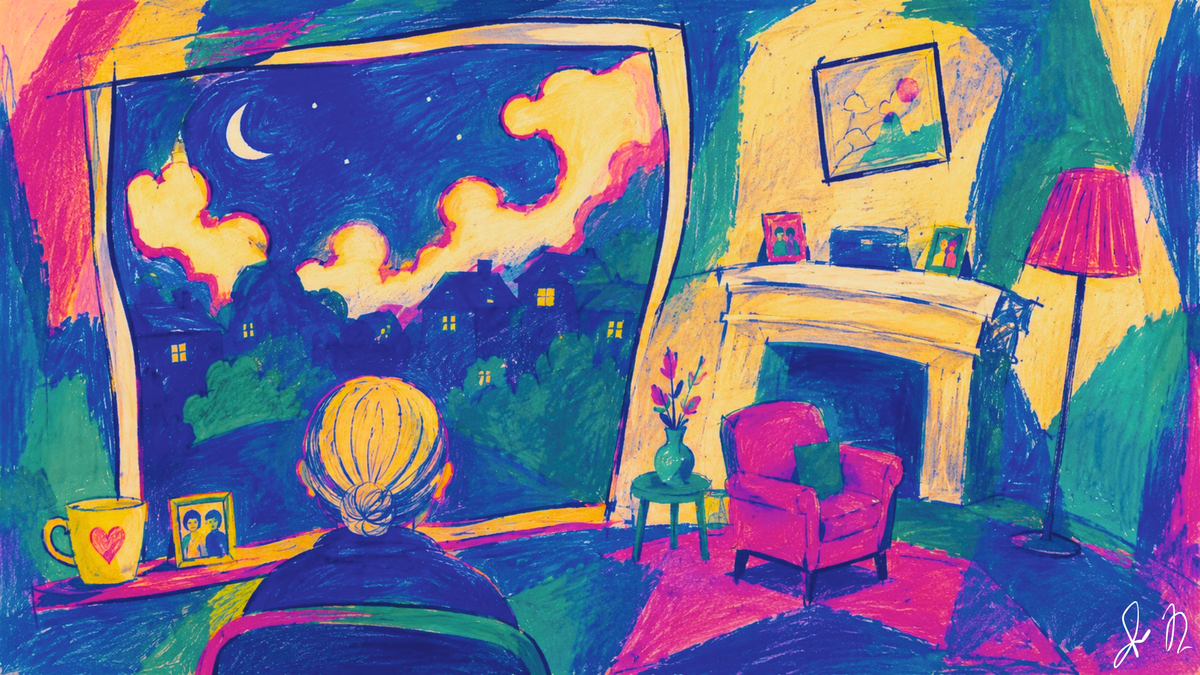
They took her number and left, promised they would call. When they were gone she tried to make a fire in the brick grate, but she couldn’t squeeze her hand tight enough to turn the gas key. So instead, she put a blanket on her knees and another over her shoulders and moved her chair to the middle of the room, away from the windows. She thought she had been knitting something, something for her husband, a red hat for his walks, but she couldn’t find it. So she started something else without knowing what it would become.
It was early winter and she thought it was snowing for the first time, but she couldn’t be sure. It crossed her mind that it would be nice for them to have tea during the first snow of the year. Tea and a fire, that would be nice. So she started to boil water and then went to light the fire, but she couldn’t squeeze her hand tight enough to turn the gas key. She went back to the kitchen and poured the water, two bags in each cup—they both liked it strong. Then she took the cups into the living room. When she got there, she saw that his chair was empty and remembered that he had gone for his walk. So she sat down to work on the hat she was making for him, but the knitted pile of cloth didn’t look like a hat, more like the start of a sweater or a scarf, so she kept knitting like she was working on a sweater or a scarf. She had only knitted a few rows when she remembered that her husband had been gone all night, and now all day.
She called the police to ask if they had found anything. They said they hadn’t. They were still looking. They would put together a search party, but the snow was coming down too hard right now for people to come out. She asked what that meant and the man just repeated that they hadn’t found him. She said okay and picked up her cup to drink some tea, but the cup was empty except for two dry tea bags.
She woke up in her chair later that night and wondered why it was in the middle of the room. She moved it back to the wall then tried to light a fire but couldn’t squeeze her hand hard enough to turn the gas key. The phone rang and she picked it up and they told her that they still hadn’t found him and she asked who. There was a silence on the other line. Then the voice asked if they could send someone to her house. But the way they said it scared her, so she hung up, but of course they sent someone anyway. Again, they asked if she knew where he would have gone and she told them the same thing that she had said last time, but they said they had looked there and hadn’t found him. Again, they asked if she had anyone that could come over. This time, she lied and told them she had a nurse—no, a housekeeper, she didn’t need a nurse—who came over every afternoon. They said that was good, but she didn’t like the way they looked at her. She asked if they could leave and they said yes and they would call when they had an update.
She got into bed and swept her arm over the space next to her. His pillow felt cold in the dark and she realized that she was starting to remember. She wanted to get up and call the police back and ask why they hadn’t found him. To scream and yell like she knew she should’ve done, like she would’ve done if she was younger, but now it felt like that was outside of her. He liked to go to the heath, she thought she should tell them that. The heath and the woods on the other side, but he wouldn’t have gone there at nighttime. And that he sometimes forgot things. That he had gotten lost before.
The next day she woke up and the bedroom was glowing from the light reflecting off the snow outside. She stared at the bathroom door and waited for it to open and for her husband to come back and get in bed with the crossword so they could do it together. They liked knitting and walking by themselves, but they liked doing the crossword together. Then she remembered.
She waited all day for them to call. She wished that she did have a housekeeper, even a nurse, to come over. She saw one of her neighbors come across the street and knock on the door, but she didn’t answer because she didn’t like them and they didn’t get to be nice now just because they felt bad. Another neighbor came later and she ignored them too, not because she hated them, but because she was scared to open the door. To go outside. Then the police called and they said they hadn’t found anything and she said okay and sat in the chair and then moved it back into the middle of the room. Then she waited until she couldn’t remember what she was waiting for. Then she got up to make them dinner.
In the spring they called her and asked what she wanted to do with the body.
“What body?”
There was a pause on the other line.
“Is this Emily?”
“Yes.”
“Didn’t someone—I’m so sorry, I have to—”
She dropped the phone and stared at the counter. The surface was spotless, except for one empty cup of tea with two dry tea bags inside. She heard the little voice, the far-away mouse voice, coming from the phone. Then it stopped and the phone rang again. She picked it up and listened. It was the ice, they said. They found it when the ice thawed. She shook her head yes, her eyes on the teacup. They asked if there was anyone there. She said of course. Her family was there. She listened for a while longer, then hung up. A moment later the phone rang again.
“What do you want to do with the body?”
She didn’t have much money. Or she didn’t know if she had much money. She had been waiting for him to come back and tell her. He had always handled the money. He was good at that sort of thing.
“We have a number, of a place, if you don’t have the—”
“Yes.”
“What’s your address?”
“My address?”
“They’ll need to contact you. To make plans.”
A few seconds later the doorbell rang and a boy was standing on her step with the box. A medium-sized box, a gray box. He was tall, with pimples, and he held the box at a strange angle away from his chest, so it shook in his hands.
“Barnaby and Lemon?” he said.
“No.”
He frowned and looked at the clipboard on top of the box.
“This is the address.”
“They must have given you the wrong address.”
“You’re not Barnaby and Lemon? Are you Emily?”
“Yes.”
“I think this is your box, but maybe I took it to the wrong address. Can I leave it here? While I go back and check? Can I leave it?”
She shook her head yes. Then he got in his black van and drove down the street, through the rows of brown houses and shrubs that all looked the same.
She stared down at the box perched on her stoop. It was a gray box, a medium-sized box, and on top was a piece of paper. Someone had printed her husband’s name on the paper by accident. Which must be an accident, because her husband had disappeared some time ago and hadn’t been at the house to order any packages, so this package couldn’t have been for him. It must have been for Barnaby and Lemon. Maybe Barnaby and Lemon knew her husband.
She didn’t want to take someone else’s package, but she didn’t trust the neighborhood anymore. She didn’t even like to go outside. And now she saw her neighbor opening the door across the street, opening the door of a house that looked just like hers. So she bent down to pick up the box and was surprised to find it was lighter than it looked, and she carried it inside as the neighbor called out and she closed the door behind her. And when she closed the door she saw his empty chair and saw the name on the box and then she dropped the box and it sounded like someone had knocked over a chess set and she stepped back and put her hand over her mouth.
She knew this wasn’t right. And she knew she forgot things. But she didn’t think this was wrong because of something she had forgotten. She thought this was wrong because it was wrong. Because she had lived a quiet life. They had lived a quiet life. And of course bad things had happened to her, happened to everyone, happened to them, but that didn’t mean they hadn’t lived a quiet life. It just wasn’t right that something so strange would happen to her, to them, now. Still, it had happened. So she stepped back toward the box, lifted the lid off the box, and looked. Then she put the box in the closet. But that wasn’t right. So she put it in his chair, but that was far too wrong, so she put it on the mantle. People sometimes kept urns on the mantle.
She waited a few hours but the phone didn’t ring and the boy didn’t come back. She thought she might call them, but she wasn’t sure who to call. So she sat in her chair. It was cold. She went to light a fire, but she couldn’t, because she didn’t want to accidentally burn the box—even though she knew someone should burn the box—so instead she pulled her chair to the middle of the room. And when she woke up in the middle of the night, she wasn’t confused why the chair was in the middle of the room, because she saw the box and remembered.
The boy didn’t come back the next day either. The phone didn’t ring. She remembered that the boy should be back and that the phone should ring because of the box, the box that sat on the mantle. After a while, she liked to look at the box. A few days more and she had to dust it off. She still found empty tea cups and full tea cups and lots of half-knit yarn, but she didn’t mind as much. The box reminded her that she forgot, and forgetting wasn’t so scary if you knew it was happening. It was only scary when it surprised you.
She tried to talk to the box, the way that people talked to gravestones, but that felt too silly. Instead, she would do the crossword next to the box, because she remembered what was inside, even when she forgot everything else. In fact, now that the box was there, she stopped thinking her husband would come in the room any minute. She stopped waiting for him to come out of the bathroom in the morning. No longer did she sit, staring at the door, waiting for him to come in with groceries.
At first, it was good to remember. Not nice, not happy, but good. It had been hard to set down a plate and have nobody come eat it. To open the front door and find stacks of uncollected newspapers. The moment of remembering was bad every time. But it wasn’t long before she found that never forgetting was even worse. It wasn’t long before she started to distrust the box.
Her suspicion started when she was knitting in the middle of the room, and she could feel someone watching her. She put down her needles and looked around the room, but no one was there. She stood up and checked the windows, but no one was outside. She closed the blinds anyway, turning on the lamp in the dark room, but the feeling didn’t go away. She sat down in her chair and tried to knit, but she couldn’t. She put down her needles and looked at the box. She didn’t know why she looked at the box. It couldn’t be the box. Her husband knew she didn’t like to be watched while she knit.
The feeling didn’t go away. She moved the chair to one corner, then another corner, but there was always an itching at the back of her neck. She thought of the boy with pimples, who had made one mistake, then never came back, which was another mistake. And what’s a third mistake to someone who had already made two mistakes?
She laid her hands on the blanket on top of her legs and tried to keep them from shaking. She slowly looked up at the box, the medium-sized box, the gray box, and she thought how her husband never stared at her when she knit. Not once.
She spent less time in the living room. Instead, she lay in bed. She knit in bed, and ate in bed, and slept looking toward the wall, hoping to forget the box. To forget and know, even for a second, that her husband would be there when she rolled back to his side of the mattress. But she couldn’t forget the box and she couldn’t forget that her husband was dead and she started to feel its eyes, even in the bedroom, even when it was far away. She felt the box’s eyes even though her husband had never stared at her while she knit and never would, because he knew she didn’t like it and he wouldn’t do something she didn’t like. Not unless he had a good reason. He wouldn’t hurt her unless he had a good reason.
She left her bedroom and went to the living room. It was dark with the blinds closed, so she lit some candles. Then she took the box down from the mantle and put it in the middle of the room. She took off the lid and looked inside, but even with the candles, she couldn’t really see, not well. But she knew him. She would know him. She was sure.
She went to the bookshelf and took out their old encyclopedias, turning the pages slowly in the candlelight until she found what she wanted. Then she set the book open on the table nearby and one by one, took the bones from the box.
They were cold at first, but they warmed quickly in her hands. She closed her eyes when she picked up each one, sliding her palms over the surface, feeling where they were smooth, where they were chipped, where they felt heavy and where they felt hollow. Sometimes she would touch one to her cheek, her collarbone, to feel. To see if she felt. But she didn’t feel anything.
Sometimes she forgot what she was doing. She would come to with one of the ivory branches in her hand and feel something like shock, but it never lasted long enough to get to her heart, her nerves. It always died in her fingers. Then she would consult the book, find the right place on the floor, and go back to the box. It was hard work, but she made strong cups of tea, two at a time, to get her through. She would pause and look at his cups of tea, going cold next to the encyclopedia as she drank her own. She felt blank. Calm. After a while, she realized that she didn’t feel the eyes on the back of her neck anymore.
It was still dark when she finished. The candles had burned to nubs, but they made enough dim light to see. The flames left wavering black spots on the polished white where the divots and chips sank deep, and they looked like black ash embers dancing off a fire. The more she stared, the more the wobbling light made the long pale branches look like they moved, but she knew that was an illusion. They were still. They were still and they were blank and worse of all they told her nothing. She had been so sure that if she could see him, she would know. And now she could see him, laid out just like the picture in the encyclopedia, and she had no idea.
She didn’t have a meter stick or a measuring tape. She didn’t know if he had been missing any teeth. She knew he had broken an arm, a leg, but she didn’t know how to see that on the bone. So she pushed the table out of the way, the candles with it, opening a space next to him on the floor. It was cold in the room, even in the spring, and when she lay down on her stomach next to him, the dusty wood felt dry and crisp on her skin. She turned her head and lay her cheek against the floor and imagined she was in bed. That she had woken up before him and he hadn’t gone to get the crossword yet. She imagined the way he frowned in his sleep, how it made him look like a little boy. She turned one foot toward him and touched his toes, as cold as they always were in the morning, and she almost laughed. They were as cold as they always were in the morning.
She closed her eyes. She would know when she opened them. If she looked out at the same spot of his neck, if he was just the right amount taller than her, then it must be him. She was sure she would know. But when she opened her eyes, she didn’t. She didn’t know because it was too hard, and she always looked at his eyes, not his neck, so of course she didn’t know if it was the right height.
She felt her chest swell and collapse, swell and collapse. Her heartbeat hammered away in her palms against the floor. She felt something in her eye. But her mind was empty, comfortable and calm against the cold wood of the floor.
After a while, she started to lift her foot, her right foot, over him. She followed with her left leg, settling her knees between the outstretched V of his hips and sockets, then placed her hands on either side of his ribs. She turned her head away, looking at a burning candle nub above the little pond of wax. It was the last candle left.
She didn’t know how long she stayed there until the flame fluttered and died. When it did, she started to lower herself down. She laid her chest onto his chest, not minding the way it poked, the way it hurt. They made little sounds, screeching against the wood as she settled, but went quiet when she lay still. Then she lifted her left leg and moved it onto his, then her right, matching the splayed angles of his own. Her arms were last, and she lined them up on top of his until she could feel the tips of his fingers lightly touching hers.
They felt cold at first, pressed through her dress into her body, but as before, the cold went away quickly. The pain went away quickly too. She kept her head raised slightly above the neck, the jaw, looking to the side, looking away. Then, as her eyes adjusted to the darkness of the room, she laid her head down against the joints of his neck. She closed her eyes. Breathed deep. When she opened them, she could see that a few feet away, underneath the couch, was the red hat she had started to knit him for his walks. She turned her head up toward his, to tell him, to tell him not to forget his new hat when he went for a walk that night.
Then she remembered, because she had forgotten. Lying there in his arms, his body, she had forgotten how he had changed. His legs, his chest, his neck, they had all felt the same. The only thing that was different was his arms, because he hadn’t curled them around her, hadn’t clutched her to him and held her tight. They hadn’t moved at all. But oh, oh, how she wished that they would.
John Cohle is a writer from central Illinois. He completed his undergraduate degree in English and Creative Writing at the University of Iowa. He has worked in restaurants, warehouses, and until recently, consumer financial protection. He is now gainfully unemployed and taking the opportunity to wander the world with his wife.
Editor's Note:
Thank you for reading "The Bones" by John Cohle. Its subject reaches far beyond memory loss. At its heart lies a meditation on recognition. We spend our lives believing love resides in recollection: a shared history, familiar routines, accumulated knowledge. Emily’s world proposes another possibility. As memory loosens its hold, affection migrates elsewhere, settling into ritual. Into posture and even touch. A crossword waits on the table. Tea steeps two bags at a time. A chair slides toward the center of the room. Knitting continues without destination. Each repeated gesture gathers the weight of a vow. The story understands that habit serves as memory’s oldest muscle, preserving devotion long after chronology has dissolved.
Love survives every transformation except indifference. Memory frays. The body changes. Time remakes every life it touches. Yet the human heart continues its search for the familiar shape of another soul. Few stories capture that search with such grace and devastating clarity.—Jon Negroni
Support Cetera
Paid members get exclusive perks like bonus stories, the ability to comment, and more. Plus you'd be helping us keep the bills paid. You can check out the subscription tiers below, or you can leave a one-time tip if that works better for you.