The Empathy Gig
She’s paid to nudge couples closer. This time, the feelings nudge back.

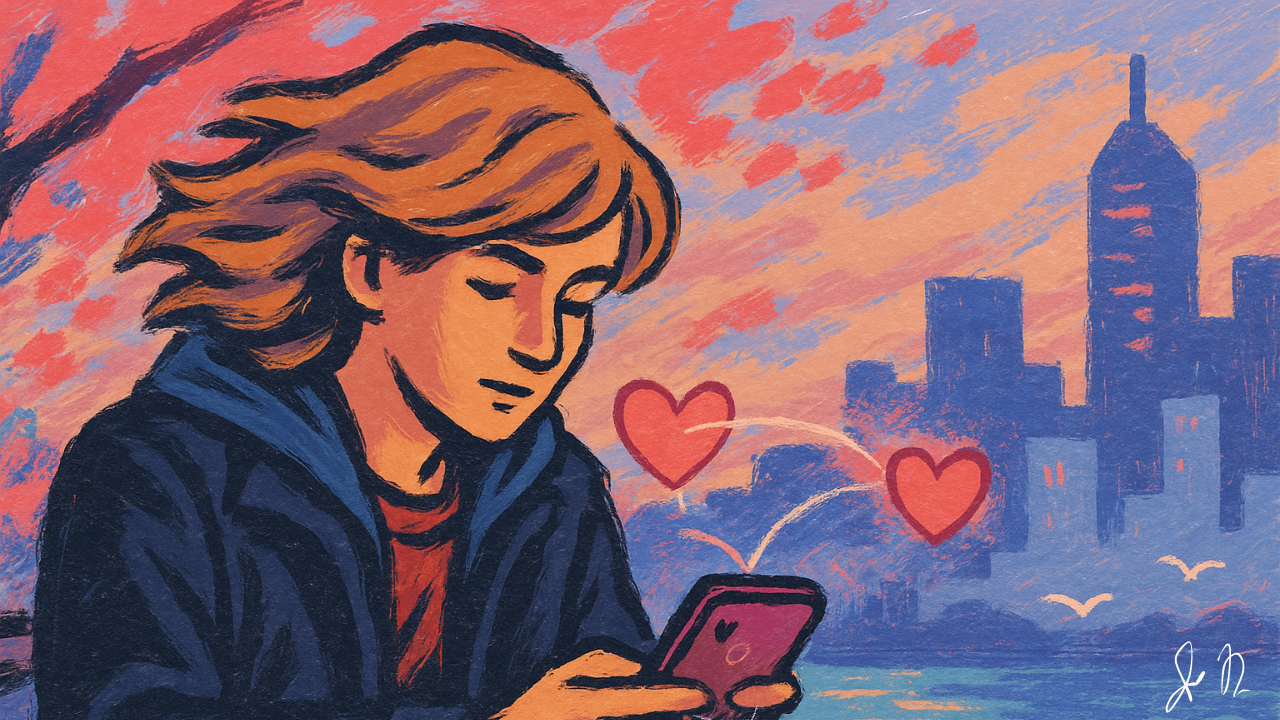
Dating apps didn’t die because people stopped wanting love. They just stopped knowing how to start it. Somewhere around 2027, the whole ecosystem collapsed under its own weight—too many bots, too much optimization, too little willingness to actually show up and be awkward in front of another human being. The kids coming up now? Well, they'd never learned the muscle memory of approaching someone at a bar or fumbling through a coffee shop introduction. They'd been raised on swipe logic, and when the swipes stopped working, they just...froze.
Enter Cupid, Inc.
I pulled up the new assignment on my phone while waiting for my rice cooker to stop being passive-aggressive about its water levels. The notification was the shade of pink the company used for "premium tier" jobs. So, the ones that paid better but also required you to sign more waivers.
New Assignment: Nicole Bryant & Aiden Sharp
Package: Neural Empathy-Lite (Full Telemetry Consent)
Duration: 3 weeks
Compensation: $2,400
Twenty-four hundred dollars. Not bad. That was rent plus the electricity bill I'd been creative about ignoring. That was two fewer tutoring sessions with undergrads who wanted me to basically write their essays while they watched.
That was also two fewer sessions with Jensen.
I set my phone face-down on the counter, which accomplished nothing except making me feel briefly in control.
Here’s the weird thing about Jensen Green. The guy doesn’t even need tutoring. Not really. He was a sophomore econ major who wrote cleaner analysis than half my grad school cohort, and he showed up to our sessions with questions he'd clearly spent hours formulating, questions designed to keep me talking. Last week he'd asked about the rhetorical structure of Federal Reserve press releases, and when I'd gotten animated about Greenspan's strategic ambiguity, he'd just watched me with this expression:
No. Stop.
I picked the phone back up.
The controversy tax theory was simple math. I was twenty-nine. Jensen was nineteen. That was one tax—the age gap, the raised eyebrows, the "oh, interesting" from anyone who found out. Being his tutor was a second tax—the power dynamic, the ethics violation, the part where I was literally being paid to help him succeed and therefore could not also be the person he succeeded with romantically. You could maybe pay one controversy tax and survive the social audit. But two? Give me a break. Two meant becoming a cautionary tale people told at parties.
I could only afford one. And since I couldn't exactly un-become his tutor without losing the income, the math was clear.
My rice cooker beeped its completion. I accepted the Cupid job.
The hardware arrived the next morning in packaging designed to look like a boutique candle company. Discrete, the way all the gig-economy intimacy products were discrete. Inside were two heart-drones the size of tangerines, their surfaces tacky with that same kind of silicone residue that never quite washes off your hands, plus the neural-link headset, which resembled a sleep mask designed by someone who'd only ever heard sleep described to them.
I charged everything while reviewing Nicole and Aiden's intake profiles. Ah, the beautiful couple to be. They'd met at an alumni networking event, exchanged numbers, gone on two dates that were "fine, just fine," and then stalled on the third. Neither wanted to admit the spark wasn't sparking. Neither wanted to give up on the investment. So they'd outsourced the problem to Cupid Inc. To me.
My job was to deploy the drones during their third date—a dinner reservation at some farm-to-table place downtown—and use the empathy link to monitor their emotional micro-fluctuations. If Nicole's interest dipped, I'd nudge her drone to release a pheromone-adjacent mist (legal, technically). If Aiden's anxiety spiked, I'd smooth it with a localized serotonin prompt. Nothing crazy. Basically, I was the dating equivalent of cruise control.
The headset's indicator light blinked pink, ready to sync.
The sync was supposed to feel like nothing. "A slight pressure behind the eyes," the training videos promised, "similar to the onset of a mild headache."
What I got instead was Nicole's entire emotional architecture downloading into my nervous system like someone had poured cold water directly into my spinal column.
I gasped, knocked my knee against my desk, and suddenly knew—knew, the way you know you're hungry or tired—that Nicole was deeply, specifically ashamed of how much she'd thought about Aiden's hands during their last date. Not in a sexual way, exactly. In a more wholesome-yet-still-intimate way. She'd noticed the way he'd held his fork, apparently, and how much care he took cutting his food, and she'd thought: I could watch him do small things forever, and then immediately: what is wrong with me, that's so embarrassing, and then she'd shut the whole feeling down like slamming a window to shut out bees.
I was sitting in my apartment, about four miles away, and I could feel the ghost of that slammed window in my own chest.
"Oh no," I said out loud.
The calibration was wrong. Neural Empathy-Lite was supposed to give me aggregate emotional data. Numbers, graphs, general vibes. Not direct sensory experience…not this.
I checked the settings. Twice. Then again. Everything looked normal. I ran a diagnostic. All systems functional.
But I could feel them. Not just metrics, them. Nicole's suppressed tenderness. And underneath it, starting to bleed through, Aiden's desperate hope that he wouldn't mess this up the way he'd messed up everything else in his life. So dramatic.
The crisis was obvious. I had to disconnect now, report the malfunction, lose the $2,400 and probably get flagged as a liability. Or…I could stay connected, hope the intensity fades, and finish the job and get paid.
My bank account made the decision for me.
I pulled up the drone interface and watched Nicole and Aiden's third date unfold on my tablet screen, the drones hovering unobtrusively near the restaurant's hanging plants while capturing data and dispensing micro-interventions. Nicole laughed at something Aiden said. I felt her genuine amusement arrive in my body like a small, warm animal settling into my lap.
This was fine. This was manageable. I just had to ride it out.
So over the next hour, I learned things about Nicole and Aiden that no one should know about strangers. The specific texture of Aiden's fear of abandonment and how it manifested as over-attentiveness, the way he kept refilling Nicole's water glass before she asked. The shape of Nicole's inner walls, like how she complimented him in ways that deflected intimacy, praised his job instead of his jokes, kept the conversation safe.
And underneath it all, threaded through both of them like a shared secret…the fragile, tentative beginning of something that could actually be real. Something that scared them both so much they couldn't look at it (or the drones) directly.
I was supposed to nudge the drones to help them along. Instead, I just sat there, feeling everything, my own emotional patterns starting to bend under the weight of theirs.
Jensen showed up to our Tuesday session with a new haircut and a copy of Keynes he'd annotated with three different colored highlighters.
Your honor, I adore him.
“Hi Deb, I have questions about liquidity preference," he said, settling into the chair across from my desk, the one students always sat in, the one that kept a professional distance between us, thank you very much.
I had not slept well. I had dreamed about water glasses being refilled by hands I didn't recognize. I was still partially synced to Nicole and Aiden, the connection dimmed but not dissolved, and everything felt slightly too much. The fluorescent lights were too bright and Jensen's presence was too solid, too real.
"Liquidity preference," I repeated, trying to find my footing.
"Yeah, the idea that people hold money not just for transactions but for security." He opened his book to a flagged page. "Keynes says uncertainty makes people want to keep their assets liquid—convertible to cash quickly. But I was thinking about how that applies to, like, emotional investment."
I blinked at him.
"Sorry," he said, though he didn't look sorry. "That's probably not what you meant to cover today."
"No, no, it's—" I rubbed my eyes. The empathy link was doing something strange, layering Aiden's hopefulness onto whatever I was feeling about Jensen's presence, creating an emotional palimpsest I couldn't read clearly. "It's an interesting comparison.”
“Yeah, like people treat their feelings like liquid assets sometimes," Jensen continued, because apparently he'd prepared a whole thesis on this. "They don't want to commit because they're afraid the market will change. They'd rather hold onto the potential energy of uncommitted feeling than risk converting it to something real that might lose value."
I was looking at his annotations. Three colors: blue for questions, green for connections, red for disagreements. The margins were full.
"You didn't need me for this," I said, which was not what I'd meant to say. "You figured this out yourself. You just wanted to talk about it with someone."
Jensen's expression went vulnerable and then quickly controlled. "Is…that a problem?"
Yes, I thought. It's a massive problem that you show up to these sessions with insights that make me want to have actual conversations with you, that you look at me the way Aiden looks at Nicole, that I can feel the specific frequency of your attention and it makes me want to stop being careful.
But that last part wasn't real. That was the empathy link, Aiden's feelings bleeding into mine. Wasn't it?
"These sessions are supposed to help you," I said carefully. "Not just...entertain me."
"What if they're doing both?"
I had to redirect this conversation somehow. I could pull up the syllabus or assigned practice problems or do any of the professional, boundaried things a tutor was supposed to do.
Instead, I heard myself say, "I've been thinking about liquidity too. Not in the Keynesian sense. In the sense that…I’ve been feeling things that aren't mine. And I can't tell anymore what I actually want versus what I've absorbed from other people."
Jensen set down his book. His concern was immediate and genuine. I could tell even without the neural link, just from the way his body shifted toward me.
"Are you okay?"
"I don't know." I laughed, which didn't help. "Sorry. That was weird. I didn't mean to…this isn't your job to worry about."
"I'm not doing it as a job."
He said it simply, the way he said everything. Direct, unguarded, young in a way that made me want to open up my window to bees. Jensen Greene did not have walls. Jensen Greene just said what he meant and trusted other people to handle it.
"I know," I said. "That's kind of the problem."
He nodded slowly, like this confirmed something he'd already suspected. Then, "I'm going to Michigan for grad school. I decided last week."
"Oh." The word came out heavier than I expected. “Oh, that’s…congratulations. That's a good state for…uh, grad school.”
"Econ PhD. Five years, probably six."
"Right."
We sat with that for a moment. The tutoring relationship had always had an expiration date. The end of the semester. The end of his undergraduate career because he was a genius at age 19. But Michigan made it real. Michigan gave it geography.
"I mention it because—" He stopped, recalibrated. "I don't want you to think I'm asking for anything you can't give. I just like being around you. And I thought you should know that has an end point anyway, so maybe that makes it easier."
"Easier to what?"
He shrugged, a small sad motion. "I don't know. Stop pretending you don't like me back?"
The empathy link pulsed a huge dose of Nicole's fear of vulnerability, Aiden's desperate hope flooded in next, and somewhere underneath it all, something that was just mine, something that had been there long before I ever strapped on a neural-sync headset.
"Jensen," I started, and then didn't know how to finish.
He just waited, patient, not pushing.
That weekend, Nicole and Aiden had a fight. I knew about it before they did. The empathy link transmitted their irritations as they accumulated, first with Nicole's frustration at Aiden's constant attentiveness, which was starting to feel like surveillance; then Aiden's growing suspicion that Nicole was pulling away, which made him hold on to her tighter. Classic death spiral. I'd seen it a hundred times in client profiles and Love is Blind.
The difference was, this time I was inside it. I had to feel everything. Their tension arrived in my body as a low-grade nausea that built throughout Saturday afternoon. By evening, I was pacing my apartment, checking my phone for drone diagnostics, watching their emotional readouts spike and crater.
The fight happened at 8:49 p.m. They were at Aiden's apartment, and I couldn't see it (no video feed, just the raw data stream) but I could feel it. Nicole's defensive sarcasm, each verbal jab landing in my solar plexus. Aiden's hurt confusion, which somehow pooled in my throat, making it hard to swallow.
I wasn't supposed to intervene, to be clear. Cupid's official policy was that organic conflict was part of the process. You were supposed to let couples work through it naturally, only smoothing over the rough edges when things threatened to derail completely.
But I was so tired of feeling their pain.
I pulled up the drone controls and started making adjustments. Increased the serotonin buffer on Aiden's unit. Added a mild oxytocin prompt to Nicole's. Tweaked the pheromone release timing to create a sense of comfort, of safety, of this person is home.
It worked. Maybe too well. By 9:30, their fight had dissolved into apologies, into "I'm sorry, I don't know why I was being like that," into a fragile, artificial tenderness that I could feel settling over them like a weighted blanket.
On my end, the relief was immediate and physical. Their manufactured calm became my calm. I stopped pacing. My nausea faded. I could breathe again.
But underneath the relief came the queasy recognition that I had just puppeted two real people through their real emotions. That their reconciliation was my intervention, not their choice. And the link's side effects were getting worse, too. I kept catching fragments that didn't belong to Nicole or Aiden.
Like Jensen's patient attention, the way he'd looked at me when I admitted I couldn't tell my feelings from others'. It was like the system was picking up signal bleed from my own recent emotional history, remixing everything into noise.
I went to sleep that night feeling like god, and not in a good way.
The collapse happened when I least saw it coming. Nicole figured it out first. She was sharp like that, all emotionally defended but perceptive, and somewhere between the artificially smoothed fight and the overly affectionate morning after, she'd started to notice that her feelings weren't tracking. That she'd be irritated one moment and inexplicably tender the next. That her emotions were arriving pre-packaged, ready-made, not quite hers.
The realization apparently hit her while she was eating lunch at her desk. I know because I felt it happen—this cold, creeping horror spreading through her system like ice water through veins.
Something is wrong, she thought-felt. Something is being done to me.
Then she looked up, saw one of the heart-drones hovering near her office's air duct, and understood. Which meant I understood. Her panic arrived in my body like a car crash. It was sudden, total, disorienting, and I grabbed the edge of my desk and held on while her fear and anger and violation poured through the link. I could feel her reaching for her phone, could sense Aiden's confused response when she called him, could feel his own dawning horror as she explained.
And threaded through their shared crisis, I could feel their bond unraveling. Not gradually, the way relationships usually ended, but all at once, as they both realized they couldn't trust any of the feelings they'd built together. Couldn't know which moments had been real and which had been artificially curated.
The ethical thing would have been to disconnect immediately. Let them have their crisis privately, stop experiencing their pain as if it were my own. You know, typical human being type stuff.
But I was afraid. Afraid of the breach penalties, afraid of losing the money, afraid of what I'd feel like when I cut the link and was alone with only my own, un-amplified emotions. So I stayed connected for another forty-five minutes, absorbing their confusion and betrayal, feeling Nicole's rage and Aiden's shame and the specific, devastating grief of trust destroyed.
Then Nicole threw her drone into a trash compactor, and the signal went dead on her end. Aiden's link lasted another hour. I felt him cry—three separate times, in waves—before he found his own drone and dismantled it methodically, like he was performing a dissection.
The silence after was absolute. I sat in my apartment, link severed, and waited to feel something. My own panic, maybe. My own guilt. But there was just...emptiness. A vast, quiet hollow where all those borrowed feelings had been.
I checked my Cupid dashboard. The assignment showed as "Terminated by Client" with a pending review flag. The $2,400 was not going to materialize.
And I couldn't feel upset about it. Couldn't feel much of anything. The empathy link had been a parasite, and now that it was gone, I'd forgotten how to generate emotional content on my own.
Jensen texted me the next day.
Hey. I know we don't have a session this week, but I wanted to check in. You seemed off last time and I've been thinking about it.
I read the message until the words went blurry, waiting for it to produce a feeling. Nothing. Just the realization that this was a kind message from a kind person, landing on emotional bedrock too thick to penetrate.
I typed back:
I'm okay. Just tired.
He replied:
That's not convincing.
I didn’t reply, so he said:
Can I buy you coffee? As a not-tutoring thing.
I decided to say no. The professional distance, the controversy taxes, all the accounting I'd been doing for months? Those reasons hadn't gone away just because I'd spent two weeks drowning in other people's feelings and now couldn't locate my own.
But maybe that was exactly why I needed to say yes. Because refusing would be the safe choice, the emotionally liquid choice, and I was so tired of keeping my assets convertible.
I texted him:
Sure. Saturday?
We met at a coffee shop near campus, though it wasn’t our usual library spot. I didn’t want it to be anywhere that felt like work. Jensen was wearing a sweater I hadn't seen before, soft gray, and when he smiled at me from the ordering line, I felt something small and tentative stir in my chest.
Just a flutter, of course. Nothing like the overwhelming empathy-link floods. But it was mine.
"You look better," he said, settling across from me with his oat milk whatever. "Still not great, but better."
"Thanks for the ringing endorsement."
"I mean it. Last week you seemed like you were somewhere else entirely. Like you were in a completely different from me.”
You have no idea, I almost said. I wrapped my hands around my cup and told him. Not everything, obviously. I didn’t reveal the specific details of Nicole and Aiden, their names, their private anguish. But I did tell Jensen about the gig, the link, the malfunction. The way I'd spent weeks swimming in synthetic emotions until I forgot where they ended and I began.
Jensen listened without interrupting. When I finished, he said, "That sounds awful. And also kind of like what you were describing before about absorbing other people's feelings, not knowing what's actually yours."
“You remember I said all that?”
“Of course. I remember everything you tell me. So what do you actually feel? Like right now, here, without the link?"
I had to focus on something to calm myself down. I started with his new haircut, then I shifted to the way he held his cup with both hands like he was warming them even though the coffee was already lukewarm. Silly, but sort of adorable. And then I started thinking about the way he'd showed up to every tutoring session with questions he'd already answered, just for the excuse to sit across from me and talk.
"I don't know yet," I said. "I think I'm still, uh, recalibrating. Like, my emotional instruments are all off, and I have to relearn what my own feelings actually feel like without the amplification. Does that even make sense?”
He nodded slowly. "For what it's worth, I think you're going to figure it all out. You're the smartest person I know."
"You're nineteen. You don't know that many people."
"I know enough." He grinned, that disarming Disney grin. "And I know that liquidity preference theory has limitations. Holding onto potential energy forever just means you never actually generate any heat."
"Is that a Keynes thing?"
"It's a me thing. Inspired by Keynes."
I laughed without opening my mouth, surprising myself. It felt strange in my throat, slightly rusty, but recognizable. Jensen could be a little bit of a pompous ass, who knew?
"Michigan's going to be lucky to have you," I said.
"I leave in August."
"I know."
We sat with that. The end point he'd mentioned, the built-in expiration date. Somehow it didn't feel like a barrier anymore. Or at least, not the only thing that mattered.
"I should probably stop tutoring you," I said. "For the rest of the semester. It's not—I can't be your tutor and also figure out what I actually feel about you. Those wires are too crossed."
"Yeah." He didn't look surprised, but still he looked like I’d told him Santa wasn’t real. "I figured that might be where this was going."
"I'm not saying…I don't know what I'm saying. I just know I need to stop managing other people's feelings for money. That was a really stupid idea in hindsight. Also, I need to figure some things out about myself. And I can't do either of those things while I'm being paid to sit in a room with you and pretend I don't notice that you like me."
Jensen set down his cup. "I do like you. That's not a secret."
"I know."
"And you like me back."
"I think so. But I don't trust it yet."
He considered this, then nodded. "Okay. So we're not tutoring anymore. And you're figuring out your feelings. What does that actually look like?"
"I have no idea." I finished my coffee, which had gone cold. "Maybe it starts with walking home without checking anyone else's emotional vitals. Just, like, existing in my own body for a while."
"That sounds amazing.”
"God, I hope so."
We walked out together, pausing on the sidewalk where the paths diverged—his toward campus, mine toward my apartment. The afternoon light was doing that Hallmark-movie thing where everything looked slightly gold-tinted and impermanent, and I could feel my own heartbeat, steady and unremarkable and blissfully so.
"See you around?" Jensen said, making it a question.
"Yeah." I almost left it there. The safe ending, the non-committal closure. But then I wondered if Nicole would open up the window to the bees of Aiden Sharp. Aiden's desperate hope would buzz right in, all those borrowed emotions that had never actually taught me how to have my own.
“Hey Jensen?”
He met my gaze and kept it there. I knew what he wanted. But I couldn’t give to him. I could only give him something else.
“I’m glad you kept coming to tutoring. Even when you didn't need it."
He smiled, and it was beyond a grin for once. “Yeah. Me too."
Then he walked toward campus, and I walked toward home, and my heart did that unhelpful tap-tap-tap, like someone knocking on a window.
Asking to be let in.
I didn't have the key yet. But for the first time in a while, I thought I might know where to start looking.
Author's Notes
This story probably makes me seem less hopeful about the future of romance than I actually feel. I like the idea of speculating on a world after dating apps, and how technology will continue to be "hacked" by tech companies eager to make a buck off of loneliness. Hm, maybe I'm not all that hopeful...
From the early stages of crafting this story, I knew I wanted to use "empathy-link technology" as an externalized metaphor for the way we absorb, deflect, and misattribute our feelings in relationships. In fact, my original idea for the story had Deb as a teenage babysitter moonlighting with this gig, which would've been a completely different take on all these ideas.
I'm really glad with where Deb ended up as this sardonic (but not cruel) woman who can be self-aware without being paralyzed by it. I'm probably being indirectly influenced here by Renate Reinsve's performance in Sentimental Value, mixed with her character in The Worst Person in the World. Like those characters, uses wit defensively, which hopefully makes her vulnerability land harder when it arrives.
For the ending, I did consider the more "storybook" final moment, or I guess Hallmark-movie ending as invoked in the actual text. I wondered if this was a story where Deb kisses Jensen or he kisses her, or if one of them declares something they can't take back, etc. But while drafting it, I could tell that it was unnecessary because it's enough that Deb stops deflecting for one moment. The story closes itself on potential energy rather than conversation, and given that the whole thing is about the difference between manufactured feeling and the genuine article, a little restraint in this respect feels thematically correct to me.
If I had to criticize my own work here, I'd definitely focus in more with the Nicole/Aiden material. It admittedly thins out in the middle and they become more functional as the story goes on. This happened because I knew the story couldn't be too drawn out, and I had to make compromises somewhere. And this definitely isn't enough "story" for a novella, let alone a novel. If I could change anything, even after multiple revisions, it would be to find a way to compress enough to find room for a scene inside their actual interaction. Something that would make the end of their relationship hit harder.
One takeaway I'll put here though: this story is an example of the kind of premise-driven speculative fiction I like most. Which is the kind where the technology itself ultimately doesn't matter. The empathy link is a delivery mechanism for questions the story actually cares about, like "How do we know our feelings are ours, not mirrored from something we observed in a show or movie?" And also, "What do we owe people we're paid to help? When does self-protection become self-imprisonment?"
Deb's arc isn't really about the gig economy or neural mumbo jumbo. It's about a woman who's been so busy managing emotional risk (hers and others') that she's forgotten how to just feel something and see what happens. In this case, that's reckoning with the futility of her crush on someone too young for her.

Jon Negroni is a Puerto Rican author based in the San Francisco Bay Area. He’s published two books, as well as short stories for IHRAM Press, The Fairy Tale Magazine, and more.
Support Cetera
Paid members get exclusive perks like bonus stories, the ability to comment, and more. Plus you'd be helping us keep the bills paid. You can check out the subscription tiers below, or you can leave a one-time tip if that works better for you.