The Stranger in Apartment 3A, First Floor
A dead girl haunts her old apartment’s new tenant, only to discover grief can trap the living and the dead alike.
I feel better, Mom.
I gulp and choke on nothing, grasping the rim of the bathtub. My hands slip. The water has drained but I’m frigid. I brush my drenched, heavy hair from my forehead, its icy fingers knotting around my neck. My tongue is too numb to taste anything.
Did you hear me? Can you grab me a towel?
With my ankles entangled in the soaked fabric of my grandmother’s nightgown, I roll over. I trip while I crawl out, my stomach slamming against the tile. I’m dizzy but my fever has lifted. My headache is gone, and I have energy to stand even with trembling knees. I’m off balance. I have to lean against the wall.
Mom slouches on her bare mattress, gathering her parents’ obituary cards, sepia photos of her grandparents, and one of me as a baby, into a neat stack and stuffing them into her wallet, into the pouch where cash is supposed to sit. Her breath stutters, hair matted.
Mom, are you okay?
She crumbles into stifled sobs, wrestling to compose herself. Everything else in the bedroom, including the twin I sleep on in the corner, has vanished.
“I’m ready,” she says with a raspy voice you only get from crying for hours. A rip and tack of tape responds. Her older sister is sealing a cardboard box with DISHES written on the side.
Mom! What’s going on?
I touch her. She flinches, grabbing her shoulder as though she’s been stabbed.
What did I do?
“I’m done,” my aunt says, wiping her hands on her jeans. “Hey, are you in pain?”
Mom shakes her head with fury, weeping. My aunt clasps her sister’s elbow—gently, like testing a mousetrap—and whispers, “Come on. We have to go.” A moment passes, but it feels like forever when my mom refuses to get up. I don’t want her to get up. “We’re late on the move-out inspection.”
“I don’t know if I can do this,” Mom whispers, silent tears streaming down her face.
“I know, honey.”
Quieter still. “She used to sing in the mornings.”
A pause. My aunt nudges her. “It’s not good for you to stay here.”
No, wait.
Mom, limp, leans on her sister, one arm weighted around two shoulders. I follow them.
Wait, please.
I follow them across the kitchen.
Up to the front door slamming in my face. I grab the handle, and I twist it, and I rattle it, and I turn the deadbolt when it flips position, and I listen to her keys click on the other side, but I can’t unlock the door.
I smash the door with my palm. Mom! I stop. Mom? I can’t feel the wooden grooves beneath my fingertips anymore, and when I push, nothing—nothing, a barrier of nothingness—buckles under my force. I no longer feel cold. I no longer feel. I no longer—
Can you hear me? No, my voice has no cadence, more like a breath. No, more like the thought of breath, a memory that can’t catch up to the present moment. Of course I make no sound. I’m time lost, dust left in the corners.
Mom, come back. I’m still here.
When the property manager shows off the apartment, I watch. A small woman in denim overalls trails him inside. The tattoos on her arms—snakes that wrap from bicep to wrist—twine as she nibbles on a finger and hugs an arm across her stomach. On her shoulder is a pleather satchel. On her head, a cap that tucks her pink curls in. Her slouched shoulders and timid frown tell me she wants to hide and never be found.
“It’s… quaint,” she says, scanning the space. A studio with half of a wall to give the bedroom a pretend feeling of privacy. “Lighting is decent.
Quaint, she says. Mom sacrificed electric bills to make sure rent was paid on time.
“If you’re looking for cheap,” the property manager says, all round and tall, “this is your best bet in the city.”
They leave the front door open. My thirty-second chance. I dash for it.
In a blink, I step one foot out into the hall, but instead of pressing down on the stiff coils of the carpet, I land back into the bathtub.
I scream, but they don’t hear me. The property manager recites from memory the square footage. Rent covers water but not other utilities. Trash dump is across the parking lot.
I wail, stalking them as they ignore mismatched paint jobs. She asks about the pet policy. No pets allowed.
I sob. This is home—you can’t take it away from me. Mom is supposed to come back. She won’t realize I’m here if she’s locked out of this place because some snake has decided to nest.
I smash my fists against the kitchen cupboards.
They crack open. The Snake doesn’t jump, but her eyes go wide.
I didn’t know I could do that. Ha. This is my advantage. I smash them again, but the doors widen a smidge. It’s enough to get them staring.
That’s right. I’m here.
“Hm,” the property manager says. He tests the panel then closes it shut. “Must be loose hinges. We can tighten that up when you move in.” He faces the Snake and shrugs a shoulder. “Well, what do you think?”
She swallows, glaring at the cupboards. “You said if I sign today, I get a month free?”
“Yes, ma’am.”
The Snake nods to herself, thinking far away. No, don’t bother signing. I never asked for a roommate, let alone someone who won’t smile when she’s supposed to be polite.
“I can see myself starting a second chance here, you know?”
Ugh.
“Sure. Great place to have a fresh start.” He doesn’t care. “The offer is still there: three months’ rent upfront and I overlook your bad credit and lack of rental history. No cosigner needed.”
She rubs her elbow, where the scales envelop. Glances one more time around the space. First floor, tucked behind a bunch of dumpsters. A far walk away from any park. The view from the one window is the neighbor across the courtyard on the other side. “This place is… nice.”
“Say no more.”
They leave and cross through me, and again, I can’t follow.
She takes over in the morning. The Snake’s wooden easel can barely fit the bedroom—she’s got a twin-sized bed shoved in the corner where mine used to be, tubes of colors stacked on the floor and blank canvases leaning against the opposite wall like office files in a drawer.
I’ve always wanted to draw. I remember… What was it? Coloring pencils, I think. Cheap ones, and a spiral sketch pad for a thirteenth birthday present. I wonder where those are now. I wonder if there is anything I can do. I kick the tube of green, and it rolls down the stack. Nice.
The Snake sweeps it up and nudges it back in place. I hate her.
By night, she’s hung motivational quotes:
Start wherever you are and start small, hangs by the front door. It’s the first sign a visitor will see.
If all you can do is crawl, then start crawling, resides in the nook above the kitchen sink.
One friend who understands your tears is much more valuable than a lot of friends who only know your smile, on the wall opposite the bathroom sink. In the medicine mirror, the letters are backwards.
In my reflection, I’m swamped in water, like I’ve been paused in the middle of rotting. Gray skin, my flesh warped in wrinkles that never dry. If I had known I would die in my grandmother’s nightgown, I would have worn the necklace she gave me. Or was it a bracelet? I can’t remember.
The Snake doesn’t see me as she bumps my shoulder with hers—I’m air with no breeze—and stuffs bottles of prescriptions onto the shelf. The labels read Lamictal, Abilify.
She pops open a bottle of expired Diazepam and dry-swallows one pill.
I want her to know I’m here. I close the medicine cabinet and she stops it halfway. Eyes wide, she inhales, and measures the edges of the cabinet to see if it’s leaning to the side and not actually straight. The knot in her throat bobs.
Oh, you realize now. Let’s see how scared you get. I leave the bathroom and knock hard on the kitchen wall. She rushes to me, groaning.
She turns her back to me—I silently open a cupboard, then slam it.
She gasps.
Get out, get out, get out.
“You friendly?” she asks.
Me? I’m here.
“No?”
Determined, she tips over a flap from a torn box labeled MISC, and pulls out a bracelet of mal de ojo, sage, and a lighter. “This is my home. You don’t belong here.”
Quaint was the word she used earlier. How quaint she thinks I’d be offended by the smoke.
I try the front door. It won’t unlock. The windows, but they don’t slide open. The outside won’t listen to me, even if I shake the glass.
Making her see me takes practice. Not “see” physically. I can’t conjure my own presence and face her. My voice is erased, but there are other ways. Amazing, what can happen with your imagination.
Every morning, I sink my fingers into her breakfast and make it taste like mold.
Every afternoon, when she studies a blank canvas, I wrap my hands around her forehead and give her a migraine, pulsing her images out to the point where she quits choosing a color.
Every night, when she will not leave and someone I’m waiting for won’t come back, I sit on her bed. She shivers in her sheets, even though the AC is off.
I miss the strangest things: the heat of a fever, itchiness behind the eyes. It’s not fair that she gets to taste food. Or paint. Or feel the sunshine on her skin, smell cologne. She wastes it all, boohooing for hours and feeling sorry for herself.
I listen to her tele-therapist say one day that sadness is grief of missed opportunities.
All night, I walk laps around the apartment. Fifty, sometimes a hundred. I find myself saying, over and over, I’m here. I’m here.
I’m here.
I don’t know who I’m saying this to.
Clients visit to shop her finished works. Not that she has much to show right now.
An old woman, well-dressed in a wool sweater, and interested in supporting local artists, introduces herself with a quivering handshake. “Good morning. I’m Clarice.”
Hello. I don’t remember my name anymore.
“Hi, welcome! I’m Arabella, but you can call me Bell.”
I prefer Arabella.
Clarice wants a custom desk portrait of her basset hound for two hundred dollars. Distinguished, please. Arabella’s email is abelladay. Send a photo.
Her clients come to take one, take two, take none. I wiggle open the cabinet drawers when they least expect it, each and every time.
I pick a particularly squeaky one and Clarice clutches the brooch on her neckline.
Arabella pinches her lips in a grimace and says with an insecure joke, “I have a poltergeist.”
“How charming,” Clarice says. Still frowning about me, Clarice continues, “I love your style. It’s soulful.”
Arabella shrugs. It’s her way of giving thanks. She never accepts compliments.
If anything, Arabella tells her therapist that she has lost all her inspiration, and she’s doomed to paint the drudge of bland scenery they hang in motel rooms. Motel porn, she calls it.
But I’m here, Arabella. I’m your anti-muse. You pretend not to listen to me, but I’m in everything you paint.
Anytime I watch you blend color, I mimic your movements like I’m doing it myself. I’m the murderer, but you’re the one killing your work. When I’m sad, you’re sad. I’m angry, and you smack the brush against the canvas in frustration, choosing the wrong colors. Dark colors—raging black stipplings onto the canvas, dreary maroon highlights, until it looks like a funeral procession for Clarice’s most beloved dog. Like a curse. Here lies Snoopy, who’s not really dead but he might as well be.
Clarice isn’t happy and demands her two hundred dollars back, which means Arabella can’t pay rent for the month. It happens sometimes. Customers complain about her floundering professionalism, that she doesn’t fulfill her promises, and they either snatch their money back or they leave her bad reviews.
All I’ve wanted to say about Clarice’s dog is that I’ve always wanted a puppy but never got one.
One morning, Arabella won’t leave her bed to eat.
I remember… I can’t remember.
I do, and I don’t want to. The memories come in waves—when I get distracted, or I see a reminder.
She is crying. One morning, Arabella is there, and on another morning, I am wrapped into my own sheets, missing another day of school, telling someone (Mom) I can’t feel my legs anymore. So many headaches.
Mom promising me we’ll get to the emergency room. Here’s a painkiller, hang in there. Someone (my aunt) has a car, she’ll take us to the public hospital. It’s too far away for the bus. Someone (my uncle) will see about payment plans, will lend us money, we don’t have insurance, honey, just wait a little longer—
Arabella’s tears are familiar. Kind of like Mom, after I said something mean. I might have gone too far. But I don’t know how to stop. You’re stuck with me. I can’t leave.
Arabella’s purse is full of used tissue and expired makeup, and when she wants to look pretty in front of clients, she drops a pinprick of water into her dry mascara and forces it on, then pairs it with a withered-rose shade of lipstick.
She wears makeup for her telehealth appointments, which makes her therapist believe she’s improving, but I know better.
Arabella has left her old life and all her friends behind to start over in a new city.
Her grandmother once told her she was ugly when she smiled.
Ex-boyfriend told her he wasn’t good enough for the girl he wanted, so he got together with Arabella, the safer option, and she can’t do better than him. Arabella cries about this, three months later.
This is her time to work on herself, hence why she is trying to pay for an apartment she can’t afford. No roommates. She can’t go through another arrest, another temptation to steal from someone else. Time to start clean.
She buried her mom, who suffered dementia for four years, before she moved here.
Her dad lives far away, on the other side of the country.
“Do you still have anxiety attacks?” her therapist asks.
“No.” That’s a lie. “I’ve been meditating.” Also a lie.
Therapist leans back in his chair and writes something down off-camera. “How has your mood been?”
Terrible. I make her medications useless.
“Fine.” She’s not convincing. She’s cross-legged on the floor, and her foot trembles. “Much better.”
“How’s your dad?”
Arabella squeezes her elbow and pinches her lips. With a forceful sigh, she says, “He thinks I only call him when I need money.”
Therapist nods. “Do you think that’s true of you today?”
She lowers her face to glare holes in the carpet. “I want to make sure I can support myself before I reply to him.”
“Smart.” Therapist offers a disinterested smile. “Making friends?”
Arabella doesn’t respond. She never leaves except to buy groceries. When art supplies run low, she skips food and rations coffee.
Therapist notices her silence and leans nearer to the camera. “Have you stopped taking your medication?”
“I am still taking them.”
After a pause, Therapist says, “I’d appreciate it if you’re honest with me.”
“I swear.”
Therapist sighs. “Let’s increase it to 10mg and check back in a month and see how you feel.”
A month passes. Arabella is worse, and she can’t hide it.
She informs Therapist that she’s about to be evicted. That maybe it was a mistake to leave her ex. That she should quit art. Everyone told her that she didn’t have what it takes, isn’t that right? She should have believed them.
And when Therapist tells her to hang in there, she hangs up on him for the last time.
Arabella hates bugs. She smashes them with her flip-flops, and squirms when she picks up their carcasses and shoves them into the garbage tin. I hate them too, Arabella. They follow me around. I’m sorry.
She pulls out her stool and I hop to her side. Painting time. My favorite. Arabella streams music on her phone, and starts brushing wide swaths of sterile hospital gray for a base. To her, a park on a cloudy day. To me, something else. I point at the canvas. I tap her shoulder, and Arabella draws something we’re both familiar with.
A syringe.
This is our gift, Arabella. We hear each other.
“How do I make you go away?” Arabella asks me one night, while heating ramen and parsing through the soup with a spoon, picking out the insects. “Like, move on or something?”
Move on to where, Arabella? Where do you think that is?
“Doesn’t it make you sad to stay here?”
I don’t know.
“Let me guess—you were some old guy who died in his sleep.”
I don’t think I was.
She sits at her table-for-one, and twists open her bottle of wine. “Maybe you need an offering.” She lifts the bottle. “Cheers?”
Ha. I was barely old enough to legally drink.
She swallows a gulp then takes another sip. After a moment of silence, as she taps her fingers against the bottle, a clock counting no seconds, she mumbles, “When they kick me out, are you going to follow?”
No, I don’t want you to go. We’re friends. You make me feel like I still exist. That I matter. You listen to me. I speak in your paintings.
She shifts in her chair. “Promise me something, okay? You don’t bother the next person.”
Would you ever want to exist and never talk to someone else?
“It’s not fair.”
None of this is.
Arabella weeps again, and I am not sure how to make her stop. I’ve never seen someone cry this much before.
“I’m going to have to sell everything,” she tells me. “I can’t make this work.”
Yes, you can. I… could be kinder. I should have been. I’m sorry.
She needs to see. I press the back of my hands onto her shoulders and try to make her see. An ambulance. An unconscious teenager. Mom screaming over the phone.
Arabella winces, scrunched up in pain. I’m doing too much, but I can’t stop.
Listen to me.
The understanding dawns slowly, from daze to hypnotism. Arabella blinks, and slides off her chair, dragging her feet to the bedroom. Placing a canvas onto the easel, she squirts globs of colors—black, white, red, purple, blue—onto her palette and starts to brush large, aimless streaks. A sky at dusk.
I want to join. I want to learn the taste of wine. Ice cream. Sunburn on my skin. The roughness of a shoe over my toes. I was supposed to go to college. I haven’t been kissed yet.
See me.
She outlines a silhouette in tan skin, a shoulder, a hand gracefully placed on the neck, the shape of a face and the drapes of curly hair. My face.
Arabella hums, entranced by what she’s doing. Flowers of burgundy and rust on my hair like a crown. A gown like a forest.
I don’t look like this anymore.
She adds eyelashes. My portrait looks down like she’s reading a book, her lips perked in a smile.
“I don’t know where she came from, but she’s beautiful,” Arabella says.
Stop it. I don’t look like this anymore.
“What do you think?”
I don’t know how to answer. What is life but a thousand mistakes you’ve wished to reverse?
I died of a fever. Mom ran me a cold bath to bring the fever down but I slipped into unconsciousness by the time the ambulance arrived. No antibiotics needed. Possibly autoimmune. I don’t remember the mistake that got me sick to begin with, if there was one. I remember the mistake of telling my mom I’m fine, just leave me alone, and then the mistake of telling her too late that my headache lingered. I’m scared. I’m mean.
This portrait of me is too content. Too serene. Healthy. I don’t realize that I’ve pushed my disgust onto Arabella, and her face contorts.
“It’s ugly,” she suddenly says, drunk. She grabs a bottle of water and throws its contents at the paint. My portrait sags, skin bloated and creased, the muddy reflection of a girl bathed in a dirty lake. Her flowers soil, her fingers twist, her smile distorts into deprecation.
Yes. This is what I look like. This is me. I’m here.
In two weeks, half of her belongings are packed. I’ve tried to stall and make her too groggy to dismember her home with me, but all the motivational quotes are gone.
Someone knocks on the door.
A middle-aged woman steps inside and shakes Arabella’s hand. Seeing her arrests me, and if I had a heartbeat, it would die.
Mom. Her hair is more gray than the picture I give myself of her. Eyes the same color. But her smile is different.
“Hi. I’m Maya.”
No, you’re Mom. Old, but real.
Arabella! Tell her I’m here!
I open the cabinet, and Arabella shoves it shut, knuckling it so it stays closed. She’s telling me to back off.
Mom hugs herself as she eyes the move-out boxes, but she says nothing. I reach for her.
Please feel me. Please know that I’m here with you. I never left. I still exist. You can talk to me.
“I’ve seen samples of your work on your social media.”
Arabella clears her throat. She had forsaken social media weeks ago. “I’m sorry to ask but… Why come to me? There’s so many other artists out there.”
Mom purses her lips, looking down at the floor. “I liked your technique.” She’s lying. She came because Arabella has this address listed on her abandoned website. The last gloomy portrait uploaded is of Clarice’s dog.
Mom, Mom, listen!
I push onto her, but the contact makes her rub her arm. Damn it. I rush toward the back and bang on the bedroom wall.
“Sorry,” Arabella says, hiding her face behind her hand. “I have a poltergeist.” No joke this time.
Mom’s jaw slackens. Yes, Mom. I’m here.
Slipping past Arabella, Mom runs to the back.
Arabella gapes, a step behind. “Excuse me?”
Mom stops at the bedroom. Glances at the bathtub before wiping her eyes. “Uh, sorry. It sounded like something crashed.”
That’s when Mom notices my portrait. She gasps. “This…”
Arabella’s shoulders stiffen, and she stammers. “That’s—well…”
Call it an experimentation, Arabella. I tap her on the back of her head. Say it.
“I was just messing around. You know. Experimenting with different styles.” All business and no confidence.
Mom holds it up and studies the strokes warped by water and dried into a nightmare. My face slumps in ripples, my eyes inflated into the flowers that are supposed to hold my hair up.
“She’s beautiful,” Mom says.
No, I’m not.
Arabella stares but Mom is too transfixed to notice. “Um, thank you?”
“How much for it?”
“It’s not, well, I haven’t thought about it.”
“I’ll give you seven hundred for it.”
The amount that covered rent when we lived here. Mom, you can’t afford that.
“Well,” she corrects herself, “I can give you two hundred now and the rest in a few weeks.” She swallows, and her hands grip the painting, halfway to embracing it.
Arabella is at a loss for words. “You sure? I can make you something custom.”
Mom studies my portrait, at my flaccid cheeks.
“This is meant for me,” Mom says, bleary. “Two hundred now and five hundred in two weeks?” She bites her lip, blinking back tears. “I’m sorry, I shouldn’t have promised that. I can give you the rest little by little, over the next two months? Is that okay?”
Arabella wipes her cheeks. “A-Absolutely. You can take it once payment is complete.”
“You’ll still be here?”
“Yeah.”
Arabella grins. She doesn’t look ugly at all, her smile lifted higher on one side. A flower aiming for the sun. The money will pay for her rent, at least what she owes so the eviction notice no longer applies.
“Thank you,” Mom says with too much breath in her voice. “Thank you, thank you, thank you.” She opens her purse, rips out a check, and writes on it. Mom leans forward as if to hug Arabella. I can tell—Mom wants to stay, but she doesn’t. Being here hurts, but it relieves, like finding a long-lost letter. “I’m glad I came.”
Arabella has no clue what she’s talking about. “I appreciate you coming.”
Mom, please don’t go. Please?
Mom, I’m sorry. I didn’t mean it when I told you that you shouldn’t have children if you can’t afford them. I didn’t mean to hurt you when I said I was a stupid mistake.
But Mom hands over the check. For a moment, she looks at me. I think she can actually see me, but she says nothing and steps out the front door.
Once she’s gone, Arabella squeals and jumps, kissing the check. But she sounds far away, a whisper from across the room, wrapping my portrait in plastic and placing it behind all the other canvases for safekeeping.
The front door. Mom left it open.
I feel lighter. I’m far. I’m near. I don’t know why, but it’s as if my head floats. Arabella searches for the nearest bank on her phone. If she leaves, she will close the door behind her.
Does that matter anymore? Nudging the doorknob, the door yawns wide.
With the painting, Mom has seen. Mom knows now: I’ve always been here. And I’m the only one who can celebrate this achievement with Arabella. She doesn’t have anyone to call and announce the good news. She needs me to stay.
This is good, right? I’ll see Mom come back again and again, to look at my face as she makes payments until she’s paid off and can take my portrait home. Arabella will paint more for me, more of me, so everyone can see.
Arabella picks up her phone and scrolls through her list of contacts. She clicks on DAD.
“Hey,” she says to voicemail, “I’m… I’m sorry.” Her voice breaks. “Listen, I-I can take myself there to meet you, if you want?”
On the other side of the country?
“I just need to pay off one other person”—the sheriff—"and a little more time, and then… I’m sorry,” she says again, swallowing. “I want to come home, and I’ve got some money. Maybe I can get you coffee? Please call me back.”
You’re leaving anyway?
Arabella grabs her satchel. Opens the door wider so she can step out. I follow her to the other side, over the precipice of the doorframe. No, you can’t.
Arabella locks the door behind us.
No, wait. I reach to grab her shoulder and make her stay. Don’t leave me alone.
But my hand passes through, and she doesn’t notice me. She instead double checks her satchel, folds the check, and secures it in a zipped pouch.
What about me? I’m still here.
But my touch no longer tells her anything. I’m air, no breeze.
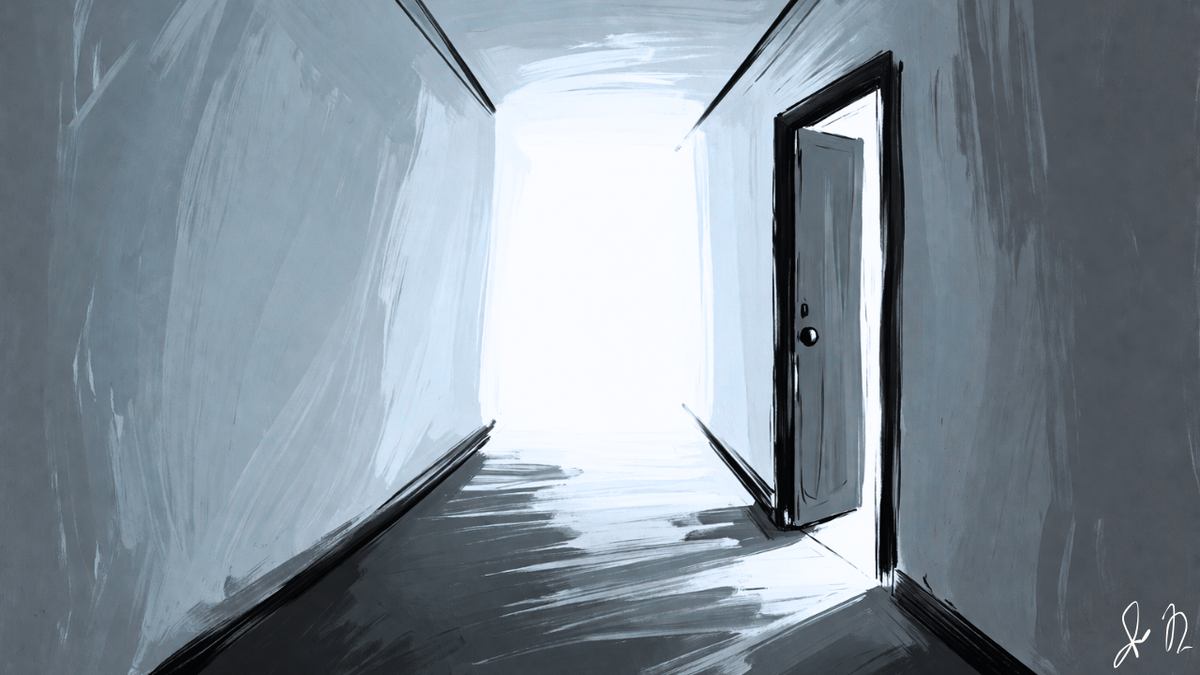
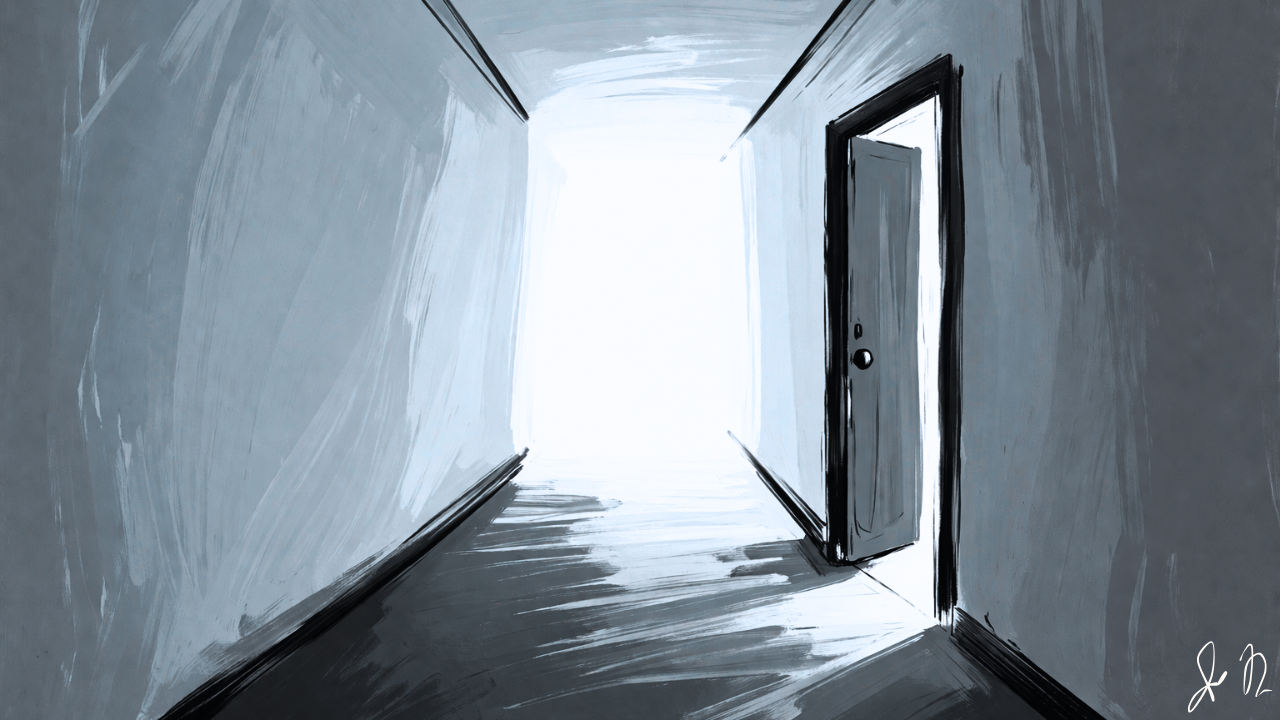
At the end of the hall is a shrooming light where my mother would have turned the corner. Bright, a paint splatter in the wrong canvas. Arabella walks through it and fades in white out.
Is this what it’s like to disappear? When people no longer wait for you to come home?
I try the door. It won’t open, so I’ll have to stand here and wait for Arabella to come back and unlock it for me.
So I wait.
And I wait, watching the whiteness spread and throb, arteries with a rhythm.
By dinner, when Arabella passes through the white, she unlocks the door. But this time, I can’t follow her inside, looping back out into the hall.
Arabella, let me in. I’m waiting for you.
The white doesn’t eat me. Not yet, anyway. A few days later, I listen to Arabella talk to her father from the other side of the door. But most often, I hear her silence as she plays music. She’s not crying as much.
Arabella calls out to me through the wood. She must be in the kitchen. “Where’s my lucky charm?”
And if I had a heart, it would sink, then fly. I’m here, Arabella, but when I bang on the door to reply to you, nothing happens. No sound.
I do like being a lucky charm. Makes me feel wanted.
The white inches closer. Maybe it means I no longer need to be your inspiration, when you finally see.
Every time Mom arrives to pay her next due, the white spreads, touching my feet. It’s time for me to go.
Mom, remember me as a name you’ve always liked. Think of getting a puppy. Don’t cry. I’m invincible so long as I’m thought of. That’s good enough for me.
Eventually, colors brighten. I taste the rain when it’s not raining, and I sigh where I don’t hurt, and I’m warm where I don’t feel.
I remember now. In the bathtub, right before I died.
“Stay with me,” Mom had said.
I was too tired to say, I’m here.
Editor's Note:
The ghost story, as a form, tends to ask the same question time and again: what does the dead want from the living? This story, with quiet originality, asks something even harder. It asks what the dead want from themselves.
The unnamed narrator — a teenager who died of a fever in the apartment where she once lived with her mother — spends the story's first half haunting Arabella, the new tenant, with a grief so ambient it poisons food, induces migraines, makes sleep cold and difficult.
Then comes the turn...the author reveals, with great delicacy, that the ghost and her reluctant host are versions of the same woman. Both abandoned. Both performing adequacy for audiences who have already stopped watching. The haunting, we come to understand, is bidirectional. Arabella's sadness feeds the ghost's. The ghost's fury fuels Arabella's worst paintings and, eventually, her most honest one.
A story about yearning, about the particular stubbornness of the unlived life. We are very glad it found us.—Jon Negroni
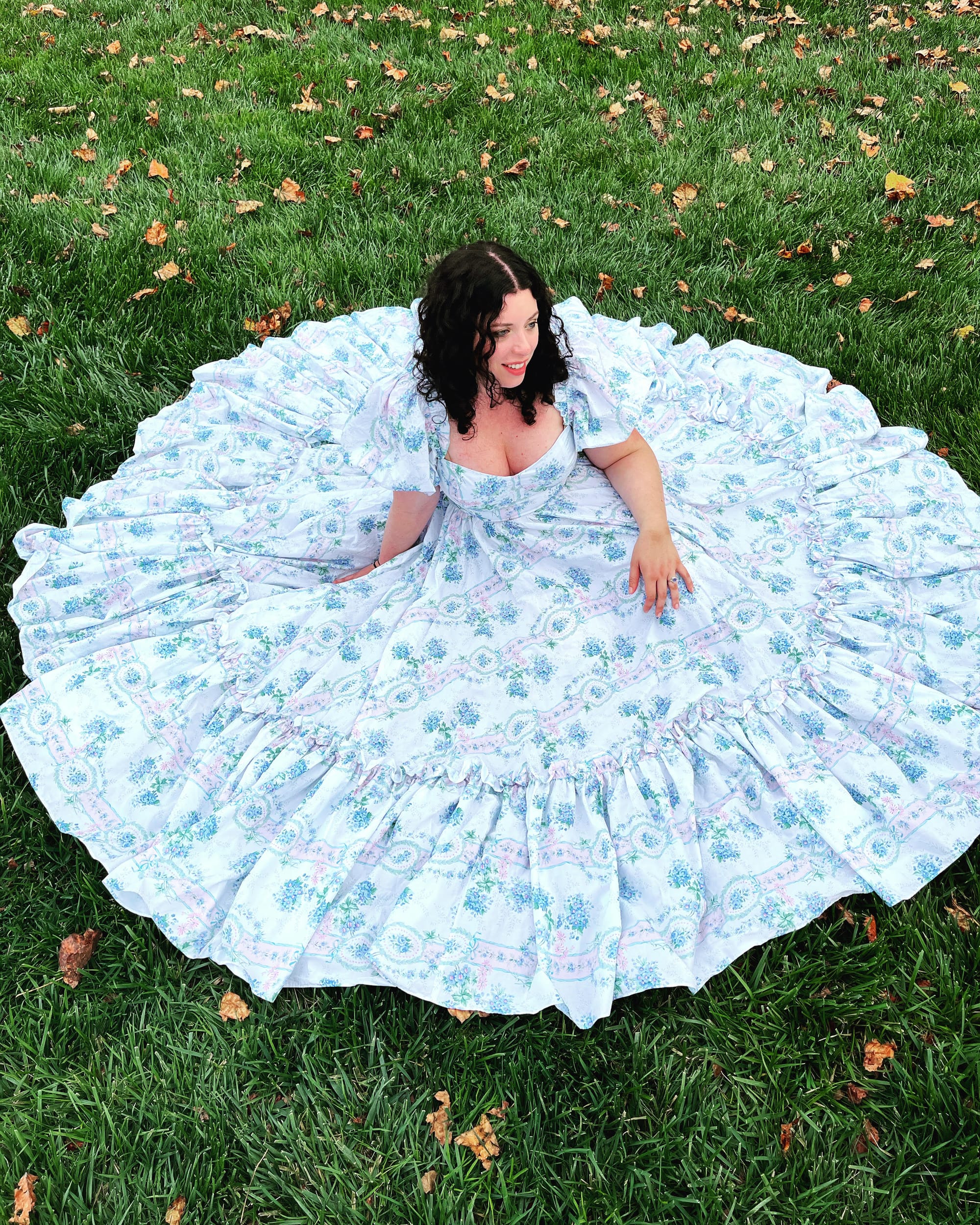
Mirav Levy is a speculative and horror Latina-SWANA writer who is passionate about creating emotionally resonant stories that stalk messy boys, chaotic girls, sentient Deaths, and memories we don't want to acknowledge. When she's not in her writerly costume, you can find her playing video games. She is currently working on her debut novel. She lives in Colorado with her husband and their menace of a cat.
Support Cetera
Paid members get exclusive perks like bonus stories, the ability to comment, and more. Plus you'd be helping us keep the bills paid. You can check out the subscription tiers below, or you can leave a one-time tip if that works better for you.