The Griefing
After her neighbor dies, Rachel becomes obsessed with the ruined house across the street. And the man waiting inside it.

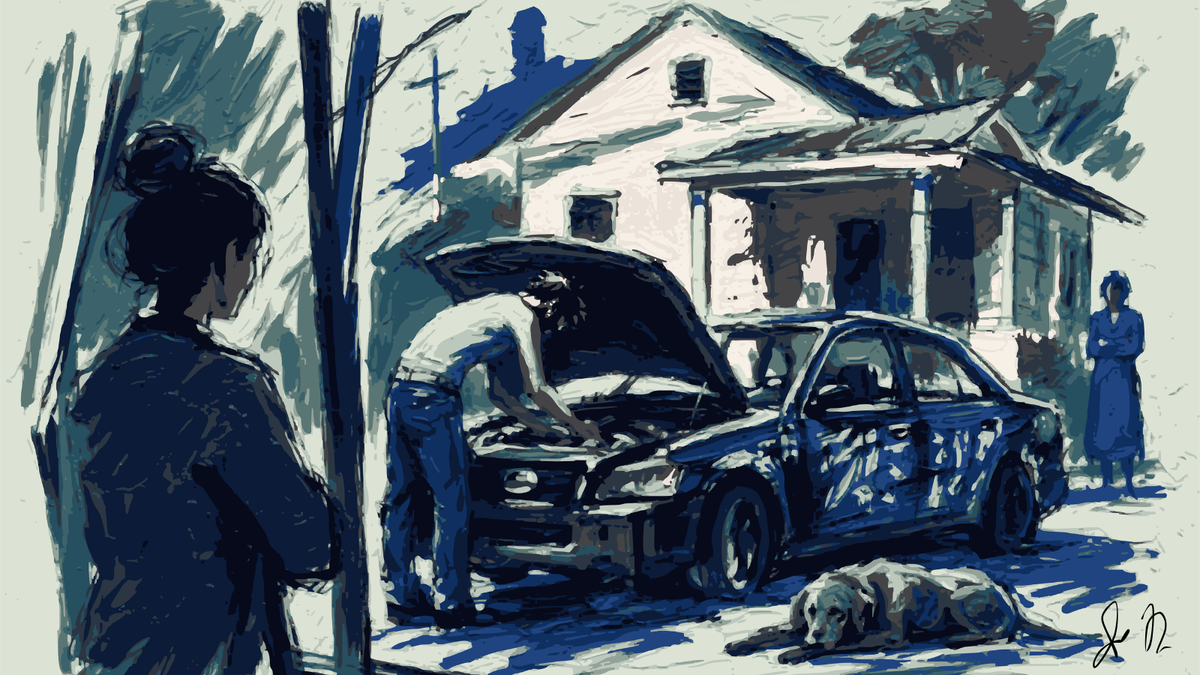
Dennis’ mother has died.
He leans into the engine of his latest project—an inoperative, battered black Lexus. Bumpers missing, windows smashed, scrawls of white graffiti on every surface. His mutt dog rests in the driveway, watching, head on its paws.
Dennis is lank and muscular from starvation, lack of sleep, and manual labor. He forgets to eat when he’s high.
My neighbor, Sherry, watches Dennis from her front window, too, her arms crossed against her stomach.
I hadn’t liked Dennis’ mother, Ernestine. The prickly octogenarian hollered at neighborhood kids when they chased their soccer balls across her yellowing lawn. She emerged once a day for her newspaper in slippers and a housecoat. She wasn’t one for neighborly niceties so never exchanged hellos and how-are-yous.
But worst—she harbored her drug-dealing son, Dennis, in her tumbledown, soaked-in-dog-piss, paint-peeling eyesore of a house.
That said, Ernestine had kept Dennis’ robust drug-centered lifestyle from ballooning into total chaos.
He doesn’t sleep. He keeps a handful of decrepit cars strewn around the neighborhood. A steady stream of visitors arrives at all hours to collude with ol’ Dennis.
Dennis strolls to their cars, shirtless, loose jeans low on his hips. He exchanges drugs for money. Neighbors have called the police, but the cops are tired of Dennis and his small-time drug deals, and the tiny force is overwhelmed with much grander illegal activities. They rarely respond.
I heat a bean burrito in the microwave and stand over the kitchen sink, chewing robotically as I stare out at Ernestine’s place.
Dennis is not in his driveway, for a change. A car pulls up—a retired cop car, a Crown Vic, still painted faded black and white—and a man with dark, disheveled hair, wearing a khaki jacket and jeans, climbs out. He strides to the front door and goes in. This is not something Ernestine would ever have allowed, one of Dennis’ friends in the sanctum of her presumably doily-bedecked home.
A man rounds the corner on foot, shuffling in worn black sneakers. I recognize my coworker Seth, who sometimes smokes cigarettes in a lawn chair on Ernestine’s driveway. He’s told me he and Dennis are old high school buddies. He’s wearing his work attire, deconstructed. Tie removed and bulging in his pants pocket. Graying white button-up, untucked and wrinkled. Seth slouches toward Ernestine’s front door but slows for a moment to glance my way. His face is cast in shadow, but I clock the crooked uptick of his smile before he, too, disappears from view.
I pour a handful of M&Ms into my mouth and crunch.
A dented green hatchback pulls up. A woman in white jeans and a black hoodie, blonde with dark roots. She walks to the front door and goes in, too, shutting the door behind her.
I run the sink faucet and stoop to slurp water in like a summer child at a hose. I drink deeply.
The alarm clangs at seven. My hangover fog greets me like an old friend—hello, you. To the bathroom and then to the kitchen window, where I see Dennis’ visitors’ cars are still parked in front of Ernestine’s place. There’s been a sleepover, now that the group is no longer banished to the yard.
“Dennis had some friends stay over last night,” I text my neighbor Sherry.
“Saw that.”
I head to my job at The Hardware Barn. It’s a fifteen-minute drive along a winding, green-wooded road, then onto the main highway, downhill to town.
I’m the opener today. Val waits by the glass double doors, yellow polo hanging loose over her torn black jeans. Ears filled with multiple silver studs and rings, hair orange. A tattoo peeks out from the neck of her collar. It’s an intricate moth that spans her chest. A worn paperback of Her Fearful Symmetry pokes out of the fanny pack strapped to her waist.
“Hey Val.” I pull my key ring out of my purse and let us in, locking the doors behind us. We don’t open until nine, so there’s time to settle in.
Val trails off to the break room to store her pack in a locker and finish her eyeliner in the tiny mirror next to a large, laminated California labor laws poster. She’ll start a pot of acidic coffee that will sit for too long on a hot burner and fill the back of the store with a bitter, burnt odor.
I swipe my timecard in the vestibule that houses our office supplies—a printer, a computer, register ink, register paper, boxes of blank name tags and yellow polos.
I unlock the office door and let it swing shut behind me. It stays locked. Register tills are stored in a waist-high black safe in one corner. I grab a till, stocked with enough bills to make change, and an empty envelope and head to the store floor to boot up Val’s register.
That done, I use a tiny key to open the donation boxes screwed into the counter at each register. The boxes have a picture of a bald child. Money donated in these boxes should go to a well-known children’s hospital. I remove wads of bills from each box, flatten them, slide them into the envelope. To anyone observing—fellow employees, customers, whoever watches through the black domed cameras in the ceiling—I am performing one of the many tasks of my job. But I take the envelope back to the office with me and zip it into my purse.
In my two years as a manager at this store, I’ve never met or spoken to anyone from the corporate office. I’ve never seen materials or directions pertaining to these donation boxes. No one has ever asked about them or seemed remotely curious about who was responsible for sending this money on to the hospital. But I watched the boxes fill with bills, no one bothering to empty them. I worked out which key opened the boxes. I removed all of the bills and stacked them in an envelope, put the envelope in the office, sealed shut and on the desk, where it sat almost an entire week. My gaze lingered on it each time I entered the room.
One day I was wrapping up my shift while Seth was starting his.
“Hey, is this yours?” He pointed to the envelope.
“Yeah. Thanks.” I grabbed the envelope, put it in my purse.
And now I take the money every week. It’s not a ton, but it helps. Rent, wine, and your hospital bills aren’t free. This is how I justify it to myself. The money doesn’t help a child with cancer, but it does help.
The day crawls by. I steal two candy bars from the stock near the registers—this I also justify, considering my low pay—and eat them for lunch.
I’m counting out Val’s till. She’s three dollars over, so I pocket the cash. I’m thinking about Dennis and his dog and his sleepover friends and the busted cars and the frequent drug deals.
“I wonder what will happen with the house,” I text Sherry.
“That’s what I’d like to know.”
A key twists in the locked door behind me. I know who it is. My whole body knows. The skin on the back of my neck tingles. I don’t turn around.
Seth turns the handle, pushes the door open, lets it fall closed. He comes to stand quietly by my side. He’s in his dingy white button-up and faded black slacks and the same worn sneakers. His dark hair flops down on his forehead and his skin is wan and yellowish. He doesn’t speak but our eyes meet, an electric charge. Every millimeter of my skin is awake. The eye contact is deranged and impossible to break. Seth smiles, eyes heavy with dark assurance. A red flush creeps up my neck, pinkens my cheeks.
Seth has an enraging appeal I don’t understand and can’t explain. He isn’t handsome. He looks jaundiced, and dark circles frame his eyes. He is soft-bodied and shorter than men I’m usually attracted to. He walks with a lazy, nearly bow-legged swagger, perpetually unhurried. He doesn’t give a shit about a single thing.
He keeps infuriating eye contact and always smiles in a knowing way, knowing he possesses a power he doesn’t deserve. He’s rubbed a genie’s lamp or made a deal with the devil to get this animal charisma, some pheromone that flips every switch. The only thing stopping me from sleeping with him is that he hasn’t tried yet.
Seth constantly asks annoying personal questions. He wants to know about my friends, my exes, the kind of men I date. He’d guessed my pants size and was exasperatingly correct. He’d asked if I wore thong underwear. He commented frequently on the state of my hair—perpetually in a bun at work—wanting to know how long it was. He asked if I shaved my legs and if so, how often. He asked what I’d had for breakfast, and what I planned to eat for dinner.
I never answer.
“Fuck off, Seth.”
Three days earlier, we’d closed the store together. Nighttime in the windowless office. We counted out the tills and placed them in the safe as Seth chattered about movies from the 90's and I did my best to ignore him, although my body betrayed me. The hair on my arms stood on end.
Finished, I stood. I searched my purse for my keys and he stood, hands in pockets, blocking the door.
“Ready?” I asked, keys in hand.
“What are you doing now?” Seth asked.
“Going home.”
“Come get a drink with me.” He cocked his head to the side.
Yes, I wanted to say.
“No.”
A beat.
“Why don’t you like me?”
He took a step toward me. I sighed impatiently to cover my panic at his nearness.
“What are you talking about?” I tried to seem bored and annoyed.
“I’m always so nice to you,” he said. “But you are so…uncivil.”
He took another step toward me. A high ringing sounded in my ears, an internal alarm. My body was awake, warm, pulsing. My breath picked up speed.
“You’re not nice,” I answered. “You’re nosy.”
The eye contact was psychopathic—no one maintained this kind of eye contact for this long unless they intended to fuck the person they were looking at. I wanted to frown but couldn’t stop the corners of my mouth from pulling up. I was delighted in spite of myself.
Seth took another step toward me.
“Maybe I just want to know more about you.”
I didn’t answer. He was so close, nearly touching me. His eyes were black pits, tractor beams. He leaned forward. My lips parted. Maybe this was just the thing to break the spell, I thought. This chemistry couldn’t possibly translate to physical touch.
His face came toward mine, agonizingly slowly. He kept his hands in his pockets though I ached to be touched. Finally, finally, a light kiss, then another, a flicker of tongue. His breath quickened. He leaned into a final, deeper kiss. Our tongues met, a disaster a lifetime in the making. I moaned softly.
Seth pulled away, his dark eyes gleaming, a smug smile painted on his sallow face.
He walked away.
My body was aflame, and he walked away.
I hated myself.
Now I’m again in his proximity. With great effort, I break eye contact and turn away, try to focus on the paperwork I need to complete for Val’s till.
“Short day today?” Seth asks from behind me. He hangs his coat on a wall peg, next to my purse and sweater.
“Yep, heading out at three.” I’m terse. There are about twenty more minutes left on my shift.
He doesn’t answer but I hear his soft steps move closer, until he is so close that his mere proximity raises the gooseflesh on my neck. His cut-grass smell fills my nose. My spine is alight and every molecule of my skin tingles in expectation.
He lays a cold hand on my neck, strokes the nape with his soft thumb. The effect of his touch radiates outward to every nerve ending in my body. I close my eyes, couldn’t stop myself if I tried. Momentarily, his hand pulls away, but it’s replaced with his mouth. He kisses lightly, tastes gently, nips at the skin playfully. My breath has deepened, head to one side to give him all the access he wants.
Seth’s hands are in my hair, pulling it loose from its elastic. It tumbles to my shoulders and down my back. I’m on my feet, facing him now. Our mouths meet again, happily. I’ve craved this, stupidly, and will eat him alive now. I wrap my arms around him tightly. His hand slides into my hair, grabs a firm handful. He’s stronger than he seems.
His hand is under my shirt, touching, fondling, and then his hand is in my underwear—it’s not a thong, it’s a full-coverage cotton brief, he notices with a snicker. His hand is there, and his mouth is on my neck. I sit on the desk, head thrown back, eyes sewn shut. I’m swathed in black velvet, tumbling in the night sky amid winking stars.
I finish quickly with a gasp. The velvet slips away and I open my eyes. Seth watches me. He moves his hand to his mouth and tastes me. It is enticingly depraved. I watch him, mouth agape.
I hate myself.
Sherry stands on her porch, holding a bag of in-shell peanuts. She’s in an oversized purple sleep shirt and her loose breasts lie flat on her chest. She flings the peanuts toward the street and screeching crows missile to the ground to fight for them.
Sherry has been feeding the crows for so long that their population has ballooned. They’ve crowded out the songbirds and the jays, raiding the smaller birds’ nests for eggs. They chase squirrels and tear them into meaty red chunks. Their raucous caws fill the hills and trees, murders of them carving the air with sharp black wings. At times they hold cacophonous funerals for their dead compatriots, streaking from the tall trees, wheeling in the sky, yelling their grief to each other.
You would not have liked Sherry.
A busybody woman, a woman who didn’t know her place. She wore neither bras nor makeup. She crowded out your precious jays with her crows. I watch her, though, backhand those peanuts into the pockmarked street. She has a strong arm, like you. You used your strength against me, though, another woman who didn’t know her place.
The phone rang early the morning you died, and the assisted living woman said I should come quick, that it was time. But I lingered at home. I showered and ate, walked slowly to my car, and drove at a reasonable speed to the facility. And when I got there, it was, “I’m so sorry. He passed before you could get here.”
They led me to your room, where you lay on your bed under a white sheet. Your toes tented the sheet so prominently. No way a dead man’s toes would stick up like that, I thought. The sheet was pulled up to your chin and your head rested on a pillow. Your mouth and eyes were slightly open. You seemed about to lurch toward me.
“Surprise! Bet I got you good!”
The assisted living woman shut the door and you and I were alone and I went to your side and sat in the chair next to you even though every hair on my body stood on end. I stared at you, waited for the inevitable “gotcha.” But your chest didn’t move and your breath had stilled.
I reached for the sheet and pulled it back slowly to reveal your brown hand, spotted with age and covered in tissue-thin skin. I held your cooling hand in mine and you stayed still. For sure you were dead if I could touch you without you telling me to fuck off.
My mouth and eyes were dry. I felt no need to stay with your shell, so I left.
Later I ate a sandwich with the hand that held your dead one, thinking now I am eating small parts of you, microscopic molecules of your body I took with me. Grinding you between my teeth and murdering you with my stomach acid.
I leave for work. A crow is perched on the roof where it peaks over the kitchen window. It turns its head to watch me with one shining black marble eye. I’m tempted to snarl at it or flip it off. I’m tired of the loud birds ruling the neighborhood. But I know crows are intelligent and remember human faces. This crow may know me, though I don’t know it from its identical brethren.
Across the street all is quiet, though now I see a pair of jean-clad legs and bare feet lying still on the ground behind the old Lexus. I walk toward the feet, feeling sure they belong to Dennis, hoping they are not deceased feet, feet that tent sheets.
I stand over Dennis. He’s unconscious, at the least.
“Dennis,” I say a few times, louder each time, and he doesn’t move.
I nudge his foot with my shoe gently, then not gently, and finally he groans and his eyes crack open.
“Whatizzit?” he slurs.
“You’re asleep in your driveway.”
“Oh, shit.”
With much effort he heaves himself to his feet and stumbles to his front door without another word.
Val is on register and I wave as I walk to the office. She lifts a distracted hand but keeps her eyes on the book she’s reading. In the office our white-haired general manager, Lenny, is busy on her laptop.
We exchange hellos and the usual information about the store and I peruse the employee schedule but don’t see Seth on it.
“Who’s covering the afternoon? Seth?” I ask.
“Who’s Seth?” Lenny asks, still clicking away on her keyboard.
“Seth, the other manager? Pale, looks like Uncle Fester in a bad wig?” I joke.
Lenny looks up at me over her readers.
“I don’t know any Seths, honey.”
She waits, watching me.
My stomach becomes a ghost and leaves my body and travels down, down into the ground, deeper, where it’s hotter, nearly to the tangerine mantle, where it sits and waits.
I release a breath like a laugh.
“Just kidding.”
Lenny’s brow is furrowed and she looks at me like she’s deciding whether I’m unhinged.
“You’ve got a weird sense of humor, Rachel.” She returns to her typing and then glances back up at me. “Eddie’s on tonight.”
Eddie, of course, the other manager. Middle-aged, sandy-haired Eddie, tall and angular Eddie.
My hands have started to shake so I excuse myself and head to the bathroom, a three-staller with fluorescent lighting. I lean over the white sink basin and stare into my dark eyes for signs of madness. Hadn’t I known that Lenny would answer the way she did? I feel convinced I knew this. Feel convinced that were I to ask Val about Seth, she would look at me the same quizzical way.
Sleep arrives early on wine’s buoyant wings. I’ve overdone it with the table red and collapse into bed. I’m millimeters from complete unconsciousness, and I feel someone sit on the other side of the bed. My pulse quickens slightly, but I can’t summon the fear required to save myself from the intruder, the poltergeist, who sits at my side as I fall into slumber.
It’s early, still dark. My mouth is a cottony cave, my head is filled with hot nails. I turn toward the window and you’re out there in the moonlight, outside my window, watching me. Your brown skin has gone ashen, your smile is malevolence itself. You raise a hand and press it to the pane. I react violently, jerk myself from the bed, push impediments from my path. A standing lamp falls, shoes fly to the opposite wall, knickknacks skitter and crash to the floor as I pull myself from the room faster than I have ever moved and slam the bedroom door behind me.
You are an impossibility. Dead, and not just dead and buried. Dead and burned, I had you burned to ash, though you’d demanded a casket.
I am drunk, I think. I am so drunk I hallucinated you. I pant in the hallway, back against the wall. It isn’t possible, so I force myself to go back in the bedroom, though I’m whimpering now and tears are running down my face, soaking my shirt collar. I twist the door handle and open the door slowly and look, and you aren’t there. You aren’t there because you don’t exist.
I am drunk.
I right the fallen lamp and turn on the light. I shut the curtains tight, bugs crawling over my skin at my nearness to the window. I leave the room and walk to the kitchen for water, water to hydrate my addled brain. I am losing my mind, my mind needs water.
I’m filling a glass with water from the tap and draining it as fast as I can and on the second refill I see him. Seth is sitting in a lawn chair in Dennis’ driveway, facing my house. His face is darkened in night’s shadow, but I know it’s him. My body goes cold, but anger rolls through my dehydrated mind.
I’m furious.
I leave the house. The night is quiet. The crows are roosting in the trees. I’m barefoot and the gravelly pavement jabs at my tender soles. I march toward him and he watches, unmoving. The only light is from the moon, and as I get closer Seth’s face takes shape and he tilts his head back. His eyes seem milky white for a moment, and then the illusion is gone and I’m right in front of him.
“Who the fuck are you?” I ask him.
He seems slow. Maybe he’s drunk or high. He smiles up at me in a mournful way, an expression that says sorry and I want you and you already know.
“You already know,” Seth says.
I bring my hands to either side of my face to hold my head together so it doesn’t come apart. Do I already know? Don’t I? I’m shaking.
“Who are you?” I whisper, my voice weak.
I walk closer to him, to his side so I can see his face more closely. His cut-grass smell is strong. He reaches one cold hand to caress my bare calf, holds it there a moment before pulling away.
“What are you doing here?” I ask him.
Seth turns his head toward Dennis’ house with a frown.
“Looking for Dennis.”
I shake my head. Nothing makes sense.
“Dennis is probably inside the house. He was passed out in the driveway earlier,” I tell Seth.
Seth nods.
“Something is wrong.”
“Something is wrong,” I agree. “Everything is wrong.”
Seth turns back to me, brow low so his eyes are in the dark.
“You seem really tired.”
Suddenly I am bone weary, drained of adrenaline and anger and fear. I yawn deeply.
“I am tired.”
“You should go back to bed.”
My vision is narrowing, a dark fog all around. I turn and trudge back to my house, where I lock my door, collapse on my couch, and fall asleep instantly.
It’s hours later. A muted light sifts in through the diaphanous curtain. An overcast day. A clamor sounds from outside, an outcry, a griefing. I stand slowly and pull the curtain back. Hundreds of crows caterwaul through the sky, slice the air in anger, cry their objection loudly. The sound is staggering.
Sherry stands in the street in her sleep shirt, hands on her hips, eyes to the sky. Her face chills me—her mouth parted, her eyes wide, she seems in a trance. I would go outside to check on her and make sure she’s okay, but the crows frighten me. There are too many of them.
My phone is on the coffee table and I pick it up to check the time but see there’s a text from Sherry that’s about an hour old.
“Dennis died last night. Overdose. Did you see the ambulance?”
My knees weaken and I sit down heavily on the couch.
“No,” I respond.
I shower and heat a frozen burrito and stare out the kitchen window. The crows have flown away. I no longer hear their cries.
I’ve been sitting here on my couch for hours, but maybe it’s days. Time is a muddled film that at one moment seems to race ahead, then stop completely and hang in the air. It’s dark and I’m watching Dennis’ house and as I watch a light turns on in his living room. I blink.
The light is warm and beckoning. I put on shoes and walk outside toward it. It is utterly silent. Even the crickets are still as they wait.
I stand in front of the door. The yellow paint is faded and peeling. I turn the handle and the door opens easily and I step into the room with the light.
The room is empty except for one chair and one man in the chair—Seth. He wears his graying white button-up and faded slacks. He is all sorrow and concern.
“I’m sorry about Dennis,” I say.
He smiles gently, the lines around his eyes deeper than I remember, his eyes kinder than I’ve seen them before.
He stands and reaches out his hand, so I place mine in his and it’s as though a welding has taken place, a machine latching together. I know he will never let go.
Seth leads me through the kitchen at the rear of the house to a door that leads to the backyard. He grabs the door handle and turns to me.
Time is unmoving. The earth no longer turns. Dust motes hang motionless in the air. The crows roost, stock-still in the trees.
He opens the door and the night floods in, a warm satin that wraps us in an embrace. We do not stand or fly, we just are, and I feel nothing except Seth’s cold hand. He watches me in this void, the inky blackness of his eyes growing larger to join the darkness around us. I float and let my head fall back.
I close my eyes.
Author's Note:
As I was midway through writing this story, my dear friend, Ben, died suddenly. There are some people who should definitely not die young, and Ben is one of them. I was bowled over with grief, and then I became very angry. So angry that it became impossible for Rachel to make it out of this story alive. But I also wanted another way to think of death other than as the unwelcome visitor who suddenly snatches the unsuspecting from their loved ones. I didn’t want it to feel terrifying or awful. I wanted it to be a warm blanket, though vast and unknowable.
While this story is an atypical exploration of grief, it also borrows heavily from my own personal experiences. It so happens that I have a neighbor who overdosed and died in his home, and another neighbor who feeds our neighborhood crows daily. I set the story in the Sierra Nevadan woods, where I lived for some time while working a newspaper job. I also used my experience working in retail to invent Rachel’s job at the Hardware Barn, and Seth is based on a combination of men I have worked with. In "The Griefing," he gets promoted to Death. The dead (and burned) relative is based on my own dead (and buried) relative: a complicated, angry man.

Erin Mayes’ work has been published in Stonecrop Magazine, Windmill: The Hofstra Journal of Literature and Art, and The Coachella Review. A former Steinbeck fellow in the MFA program at San Jose State University, Erin has worked as a journalist, and a senior editor at Reed Magazine. Erin lives in San Jose, California and is writing her first novel.
Support Cetera
Paid members get exclusive perks like bonus stories, the ability to comment, and more. Plus you'd be helping us keep the bills paid. You can check out the subscription tiers below, or you can leave a one-time tip if that works better for you.