The Heir
A reluctant heir and an anxious graduate student confront the cost of being found.

By the time Anton came out of the Tube at Edgware Road the mist that had hung over the city since dawn had turned into a light drizzle. For a brief moment the cold droplets of water were a welcome refreshment after the stale air and claustrophobia of the Tube, but a few feet away from the station the exhaust from a fry-up joint filled Anton’s nostrils and moved quickly down to his stomach. Anton’s breakfast earlier that morning had been a day-old roll and instant coffee. Now he was hungry and nauseous at the same time.
Anton picked up the pace. One hand clutched a piece of paper with his instructions, the other held the A-Z, his index finger on the page for Edgware Road. The A-Z he kept in his pocket; he had been warned that holding the street guide in front of his face made him look like a tourist. Instead of looking at the map he tried to navigate by landmarks. When he passed a Ladbroke’s he turned right, walked along two blocks of rowhouses of dreary, grey-brown brick, until he saw an off-license with dark-blue window frames. Crossing the street, he was nearly hit by a black cab, the driver not even bothering to slow down and curse him out.
The instructions were not really instructions, but notes Anton had jotted down that morning. A second year graduate student writing a thesis on Anglo-American relations, Anton had taken a job with a father and son firm of forensic genealogists, helping them burrow through records and make family trees. If they found an heir for someone who died intestate, the firm could keep anywhere between five and ten percent. Anton got his ten quid an hour. The job left little time for his thesis work. He was still sleeping when his boss, Victor, had called, and it took Anton a minute to figure out what was expected of him. Victor didn’t need him at the records office, where Anton would normally start the workday. Instead, Anton was to get ready and go to West London. He was to look for a woman who was 49 years old but looked at least a decade older. She spent her days in a park — a square, really, surrounded by rowhouses. Eddington Court. The neighbors said she usually slept elsewhere — they weren’t sure where — but from dawn to dusk she could be found in the park, in a patch of dirt between rows of hedges. The dogs apparently knew to avoid the spot, but there were some cats who liked to hang around when the woman was at her post.
Anton had memorized the instructions even before Victor had finished talking, but he held on to the piece of paper like a talisman. The assignment made him nervous, because talking to strangers always made him nervous. Simultaneously he felt ashamed that he should be so nervous about going to talk to a middle-aged woman living in a patch of dirt. He felt the nervousness in the depths of his stomach, above the groin, behind the belt of his jeans. The nausea and hunger sat higher, closer to the sternum. The shame, he knew, was in his head. An archeologist could make a nice cross-sectional diagram of his anxieties. Or perhaps a geologist. But then those people dealt with successive eras of the past. The nausea, the hunger, the anxiety, the shame, all ran concurrently.
Anton tried to focus on the task at hand, the one that would begin right after he made a right at the next corner. He reminded himself of the most important fact of all. On paper, this woman was a millionaire. That was the reason Victor was so excited.
“This woman is loaded. I mean, really loaded. Her father owned a townhouse somewhere in Notting Hill. That alone is worth close to 900 thousand pounds. And that’s not counting stocks and bonds he left behind.”
“So what’s the problem?”
“The problem is she doesn’t want to touch the money. Actually she doesn’t want to have anything to do with the inheritance.”
Anton was the one who found out that the deceased, a certain Fred Topolski, had a daughter, and that she seemed to be alive. That rarely happened in their line of work. Usually if someone died intestate there was no direct heir. Victor was sure that Anton had messed up. But there it was, in the binder for 1955. There was nothing to do but order a copy of the birth certificate and go from there. Her name was not in the register of deaths or of marriages. Eventually, not only had the existence of a daughter been confirmed, but the woman’s last known address was only two Tube stops away from where her father had died.
“There’s no point chasing this,” Victor said back then. “No doubt she’s going to claim the inheritance and if she does she’s not going to need us to help her make the case.”
But weeks went by and the Treasury’s notice was still up. Victor couldn’t stop thinking of the ten-percent commission, clearly.
“Why don’t you go and talk to her?” Anton had asked that morning.
“I tried. She told me to get lost. I think you might have better luck. You’re more personable.”
Victor seemed convinced by this. He had reason to be. Just a few weeks earlier Victor had sent Anton deep into West London to track down information about a member of the Polish legion who had settled in the city after the War and opened up a hardware store. The rowhouse that he bought in 1960 was now worth close to half a million, and he had another thirty thousand quid on his savings account. Did he really have no kids? No relatives? The UK records didn’t show anything, and the Polish records Victor had requested were a dead end. The deceased had been an only child. His parents had been taken by the Russians at the start of the war. They had siblings whose fate was unclear.
So Anton had made his way west, on a Saturday, and spent the morning and afternoon talking to neighbors, to the old geezers in a café near the Tube station, to the owner of the off-license around the corner from the deceased man’s house. They knew him, all right. The war hero. The geezers, not quite as old as the deceased, got ribbed by the Pole for missing the fight. The owner of the off-license remembered a man who came in every day to buy the Polish paper. But relatives? No, the man was a loner. Friendly enough, but a loner. When he died his body had lain undiscovered for a week. The neighbors who usually checked on him had been on holiday. Such things happened!
And then, about to give up and head home for the day, Anton had stopped by the big Catholic church near the Tube. He would have preferred not to, but he was afraid that Victor would ask him if he had really tried everything. The doors were open, and he spotted the priest talking to an older woman in a pew. When she got up to leave Anton approached. Tall, thin in the face, with short, neat grey hair and incongruously bushy eyebrows, Father Jan looked him over suspiciously.
“Vy do you vant zis informaschen?” Father Jan wanted to know.
“It’s a lot of money,” Anton explained. “If there’s an heir it could help him or her. And we will get it to them. My employer will not get a penny if we don’t, so you don’t have to worry about that.”
Good old priest. If he was miffed that the old Pole hadn’t left anything for the church he didn’t let on.
“Years ago, zer vas a girl from Poland. A refugee from the Communists. He took her on as housekeeper. And then she left. For America. I think she was with child.”
“His?”
The priest shrugged and lifted his eyes to heaven.
“And do you know where they might be?”
“She came to me and said she wanted to leave. I gave her ze address of a church and the name of a priest. In Greenpoint. Brooklyn. But the man, he vas unhappy. He thought I was interfering. That’s why I think…”
Father Jan shrugged.
Anton wrote down the name of the church and the year this woman was supposed to have emigrated. And now, Victor was well on the way to earning a hefty commission, and was convinced that Anton knew how to talk to people.
Anton would have been happier in the records office, pulling the big green binder off the shelf and running his fingers along the lists of names, and dates of birth, marriage, and death, and drawing up family trees. Anton, whose voice would shake when he ordered pizza on the phone. Confident in a seminar room; voluble, gregarious when out with his friends, he grew timid at the thought of an unscripted conversation with strangers. Now, somehow, he was Victor’s street man.
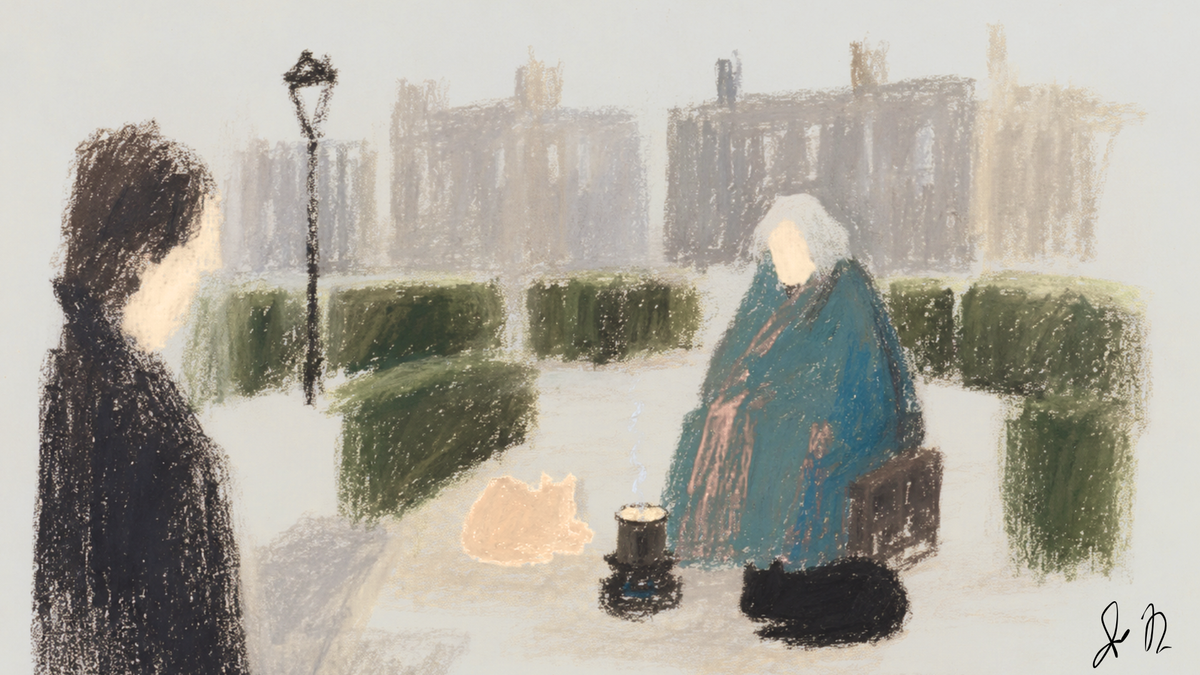
Anton spotted his target easily enough, and for a few minutes he watched her from the other end of the court, his left hand still holding the A-Z inside his pocket, the right clutching the scrap of paper with his instructions. She was more or less as Victor had described her. Straight, white hair fell over a round face, the skin smooth, the nose somehow small, the chin propping up skin that hung with late-middle-age slack down to the neck. A Central Asian kaftan, once colorful but now faded, was draped down from her shoulders and covered her legs, bunching up near the ground. She appeared to be sitting cross-legged.
He came closer. At first he thought she might be meditating, but her eyes were open. They were big and round, the pupils a brilliant blue. She was looking calmly ahead of her. Anton hesitated to get closer, unsure of where he should start.
She was the one who broke the silence.
“Can I help you, young man?” She said this with the friendly authority of a museum docent. “Are you lost? I know this neighborhood quite well. Don’t hesitate to ask. There’s nothing embarrassing about asking for directions.”
“Are you Miss Topolski?”
“I am. Who are you? Are you from the Council? You must be new — I’ve never seen you before.”
“No, ma’am, I’m not a social worker.”
“No…you sound like an American. I’ve never met an American from the Council.” Her voice was calm, soothing, settled in the middle registers. Her accent was middle-class, sliding into posh.
Anton cleared his throat and released what sounded like a cough. “Ma’am, I’m here to talk to you about your inheritance.”
“Oh, dear. Not that again! I already told that dreadful man who was here last week. I’m not interested!”
“But it’s quite a bit of money. Isn’t there anything you’d like to do with it?”
“Young man, I’m perfectly aware that it is a substantial sum. But I have no interest in it. I don’t care what happens to that money and I want nothing to do with it.”
“Can I ask why?”
“You most certainly may not!” She looked at him sternly. The blue eyes were no longer friendly. They were piercing. “Look here, my curly-haired American friend. You seem to be a polite young man and I certainly like you more than that distasteful fellow with the beady eyes who was here before. But my answer is going to be the same.”
Anton went over the instructions in his head. He prepared to shift his approach.
“I heard you played the piano.” Anton wasn’t sure how Victor had gotten this information.
“I did.” She looked directly at him. To his relief, she seemed bemused rather than suspicious.
“Did you study at the conservatory?” He was following Victor’s script. For now.
“Yes. The Royal Conservatory. And what of it? That was a lifetime ago.”
It was time to improvise. “My brother is a musician. Classical. He’s a cellist.”
“Is that so?”
“Yes. He’s with a trio based out of New York.”
“Well, yes. They have some good musicians there. It’s a rough place, though.”
“New York?”
“America.”
“Yes, it’s true. Well, my brother gives some private lessons too, so that’s how he gets by.”
Suddenly Anton felt homesick. But the image that formed in his head was not of his brother, or his parents back in Brooklyn, but of the September sun setting behind the city as he saw it from the runway of JFK. Between the airport and the city stretched miles of highways and interchanges and parking lots and industrial parks and rowhouses as dreary as the ones he had walked past that morning and much more dilapidated. And yet this was the image that came to him in that moment.
Anton reminded himself that he had a job to do. “I used to play the piano,” he offered.
“Did you now? Yes, you’ve got the hands for it.”
Without thinking about it, Anton admired his fingers. And then he noted that the woman had long, slender fingers herself. They were remarkably clean for someone who lived on the street.
“Yes, I stopped after five years,” Anton continued. “I wish I’d kept it up.”
“There’s nothing stopping you from taking it up again.”
“No, I suppose not. Well, you need an instrument. And money for lessons. Do you teach?”
“Not anymore. All of that was a lifetime ago.”
“I see.” He had gone as far away from the target as he could go without entirely losing the thread. It was time to get back to the issue that had brought him here.
“My brother is the real musician in the family, of course. He got a scholarship to Julliard. You know, the conservatory? Full ride. He never paid a dime. And now he has no debt, which is great.”
“That’s a very American problem, isn’t it? Debt.” She seemed to be looking at some point on the opposite wall.
“I suppose it is,” Anton agreed, even as he thought about the loan he had taken out to come to London. “It’s just, you know — I was thinking. This money — if you don’t want it, and I really respect that, I do, well, maybe you could give it to a conservatory. Or a music school. And it could help people like my brother.”
This was what Victor had told him to do. If she really doesn’t want the money, get her to donate it. Victor would still get the commission.
“Young man! I thought I had made myself perfectly clear. I have no interest in this money. I don’t want to be involved in any way. Now, if you want to donate this money to the Royal Conservatory, or Julliard, or the London Zoo, you’re welcome to do that. But I want no part of it!” She was getting agitated, but Anton felt he had gone too far to back up.
“I appreciate what you’re saying,” he said. “I really do. But here’s the problem. We can’t just donate it. Not without your signature, at least. That’s really all it would take. But if you don’t take the money, and you don’t direct us to send it anywhere or do something with it, then it will all just go to the government.”
“Look,” Anton said, remembering what Victor had told him: if there was a direct heir, it was almost always an ugly story. Abuse. Abandonment. Alcoholism. “If this is about your father...”
“That is incredibly presumptuous!” She looked directly at Anton, her eyes menacing, the muscles of her face visibly tense beneath her skin. “My father was a perfectly good man. My mother too.”
“Well, then, what is the problem?”
“Have I not been sufficiently clear? I want nothing to do with the money!” She was nearly shouting now. A middle-aged man, ruddy-faced, looked over in their direction, then turned back to pick up the fresh turd his dachshund had just released near a rosebush.
“I didn’t mean to upset you,” Anton said, attempting a calming voice. “I’m very sorry. I’ll let you be.”
“Well, that’s entirely up to you. You can stay or you can go. This is a public space, after all. But you will kindly refrain from talking about this money.”
Anton considered this. He could go back to his room and climb into bed. Better yet, he could go to the library and work on the seminar paper he was supposed to present in a week’s time, and which still existed only in outline form. But he was getting paid by the hour, and he needed the money. At ten quid an hour he needed to work fifteen hours a week to make rent, twenty if he wanted to eat. More than he was technically allowed to by his graduate program and the terms of his student visa, but then again neither the authorities nor the university expected him to starve, presumably. No, he’d need to make this last a bit longer.
“Can I buy you a coffee?”
“I don’t drink coffee.”
“I mean, do you want to go to a café? We could get warm. Get some tea. Some food. My treat.”
Anton fingered the money in his pocket. There was a ten-pound note and two one-pound coins. Enough for a fry-up and a cup of tea. Victor had promised to cover reasonable expenses.
“I’m quite warm, here, thank you. But you go on, if you want to. It is getting close to lunch time. I’ve got food right here.”
Anton had expected her to take out some stale bread, or a packet of crackers. Instead, she lifted up the skirts of her kaftan and pulled out two large potatoes, a few packets of salt, a tin, a pocket knife, and what looked like a primus burner. With her kaftan open Anton realized that she was sitting on a plastic crate and this made her seem taller. Closing the kaftan back over her knees, the woman set to work on the potatoes, letting the peels drop on the dirt in front of her.
“Of course,” she said, tilting her head slightly to the left, “it would be better to cook the potatoes with the skin on, from a nutritional point of view, but I’ve never liked the taste of potato skins.”
She turned to Anton.
“I assume you’re hungry, otherwise you wouldn’t have suggested going to a cafe. The second potato is for you. Of course, if you don’t want it, you mustn’t feel obliged. I’ll save it for later.”
Anton realized that it had been five months since he’d eaten a home cooked meal, not counting the eggs he scrambled in the shared kitchen of his dormitory, on a frying pan with peeling Teflon coating.
“I’ll join you,” he said. “Thank you.”
She tilted her head slightly to the right.
“And do you want your potato peeled or skin-on?”
“Skin on, please. Thank you.”
“Then you’ll want to go and wash it. There’s some water over there.” She pointed with the tip of her knife to the middle of the little park, where a ceramic fountain spouted a weak but steady stream of water. “And while you’re there, fill up this tin about three-fifths of the way up.”
Anton did as he was told.
The woman produced a box of matches and lit the burner, carefully setting the tin on top. She emptied a packet of salt into the water. As the water warmed up she skillfully cut the potatoes into pieces and dropped them into the tin. Anton sat down next to her, using a fallen branch for a bench. It seemed to take forever for the water to boil, but he wasn’t in a rush. In fact he felt strangely calm. To his surprise, the woman did not give off a strong smell. He noted the slight dampness of the kaftan, but it was not unpleasant, and beyond that there was only the smell of the wet earth beneath his feet. Eventually the water boiled, and after a while the woman produced a fork and poked the potatoes. When she was satisfied that they were done she grabbed the tin with the edges of her kaftan and spilled out the boiling water.
She opened another packet of salt and sprinkled some over her potato. Then she handed the packet to Anton, inviting him to do the same. They ate their respective potatoes – hers peeled, his with the skin on. The woman apologized for not having any butter, and he told her it was all right. He missed the butter, but he still enjoyed the potatoes. It reminded him of camping in the Adirondacks with his parents and brother, in front of a tent surrounded on three sides by trees, on a sandy patch near a bubbling brook.
Now the potatoes were finished, and it had begun to drizzle again. The warmth he felt while eating gradually dissipated. He wished he’d brought an umbrella. He was worried about forgetting it on the Tube, but leaving it behind that morning had been a bad decision. It had not been the only one he was now being forced to reconsider. Take the pea-coat he was wearing for instance. It had protected him in New York and even in Boston, so that even with the icy winds blowing off the Back Bay or the Narrows in the coldest days of January and February he had felt warm. In London, the coat seemed to absorb the dampness, so that he often felt like he was walking around wrapped in cold, wet towels. He doubted the wisdom of going to work for Victor, even though it paid double what his previous job in a pub on Kingsway paid, the first gig he got in London, itself a terrible decision. He thought about the seminar paper he was supposed to present next week. He was going to make an ass of himself, he realized. He had no business going to grad school. Not in England, anyway. He wondered if Victor was going to fire him. He was already on thin ice, having screwed up the week before by looking for an Abrams instead of an Abraham, allowing one of Victor’s competitors to get to the heir first.
Anton shook his head, trying to chase away that whole string of thoughts. He tried to focus instead on something pleasant, something he could look forward to. At 5:30 he was supposed to meet Giacomo at a pub near Holborn. And that was always fun. They would sit at a high table by the window, Giacomo with his lager and Anton with an ale, and it would be warm. Giacomo would appreciate the story about the old woman. He’d laugh at Anton for spending the whole day with her. “Ya gotta beat that competition!” he’d say, in his mock Texan accent. He’d have some funny things to say about the pub patrons, too. Giacomo looked down on the British with the snobbery of an Italian aesthete.
The rain had stopped. Anton checked his phone and saw that it was 3pm. And there were five missed calls from Victor.
The woman was asleep, her chin on her chest, snoring peacefully. Two mangy cats, one orange and the other black, had curled up in front of the woman, their tails hidden under her kaftan. Anton got up as quietly as he could and tiptoed his way back out to the street, preparing to retrace his steps back to the Tube. Nervously he prepared to dial Victor’s number.
“Where the hell have you been, mate? I’ve been trying to call you.”
“I was with the woman, trying to convince her to take the money.”
“All day? Well, any luck?”
“Look, Victor. I did my best, really. I don’t think it’s going to work.” Anton proceeded to give Victor an accounting of the day, skipping only over the part where he ate a potato.
Victor listened quietly. Anton was steeling himself to be fired. “I treat labor as a commodity,” Victor had told Anton during the interview.
But Victor surprised him.
“Well, actually, this isn’t bad at all.” He said after Anton had finished.
“It’s not?”
“No. This gives me an idea. We’ll have her declared insane and put in an institution. And then the money will go to the institution to pay for her care and we’ll still get our cut.”
Anton knew that the “we” meant Victor and his father. Not Anton or the three other employees they had working for them part time.
“Victor,” he said. “I don’t think she’s crazy at all.”
“No? She’s turning down an inheritance. She spends her days sitting in a dirt patch at the edge of a public square. In the rain. She cooks potato in empty tomato tins. I think a magistrate would agree she’s off her rocker. All this when she could be a millionaire. You don’t think that’s insane? Come on, mate. You did well! Write up what you just told me so I can run it by my solicitor and I’ll pay you for the full day. See you next week. And good luck with that seminar paper!”
Anton stood at the entrance to the Tube, the phone still in his hand. People were streaming in and out of the station, rush hour always starting early on a Friday. He stood there, his back to the window of the café that had made him nauseous that morning. Not getting fired had been a pleasant surprise. Getting paid for a whole day would be even better. He added up the hours he had worked since the first of the month and multiplied the number by ten. He doubted that Victor could actually convince anyone that this woman should be committed, but what did he know? Maybe that’s how things worked here. And maybe Victor was right. The old lady was crazy for not taking that money. He could certainly find some use for a million, if someone had left it for him. But still, it was her right to reject it. It would be nice, he thought, to say no to everyone for a change. To Victor. To his thesis supervisor. To his landlord.
Anton thought about going back to warn the old lady. But it would be awkward. And what if she took his warning as another attempt to convince her that she should take the money? Or as a threat? Things could get ugly.
Across the street three pigeons were pecking at a kebab that had been dropped, half-eaten, between two parked cars. Two of them were successfully pulling back what was left of the wrapper, tearing off shreds of pita and meat. The third, one leg tucked under his breast, hobbled between them, picking at the scraps.
Anton stood there for a few more minutes, watching the pigeons, then followed the stream of commuters into the station.
Editor's Note:
There are dozens of ways to write about inheritance. The family wound, the contested will, the revelation that changes everything. Yet with The Heir, Artemy M. Kalinovsky avoids all of them. What he gives us instead is a story about a man who does his job competently and still finds himself standing at the entrance to a Tube station, watching pigeons, knowing exactly what he should do next and choosing not to do it. It's a fascinating portrait.
Anton is a wonderful creation precisely because he is not a hero in any direction. He's not brave enough to refuse Victor, not corrupt enough to feel good about helping him, and not self-aware enough to understand that his ten quid an hour and Miss Topolski's million pounds are versions of the same trap. He's just a person who reads records for a living and handles the phone badly and thinks about his brother when he needs to feel something real. The story trusts him completely, which is why we do too.
Miss Topolski is the more difficult achievement. The story never tells us why she won't take the money, and I want to be clear that this is exactly right. The moment Kalinovsky explains her, she becomes a case study. Unexplained, she remains a person, which is precisely what Anton's employer cannot afford her to be. Her refusal is the story's beating heart, and the story is generous enough to leave it alone.
The potato scene will stay with me. Two people eating boiled potatoes with salt on a fallen branch in a London park, the drizzle starting again, neither of them asking for more than what's in front of them. It's the only moment in the story where Anton isn't performing competence or nervousness or even shame. He's just eating a potato. That's the inheritance Kalinovsky is actually interested in. The kind you can't put in a binder.—Jon Negroni

Artemy M. Kalinovsky is the author of A Long Goodbye: The Soviet Withdrawal from Afghanistan (Harvard University Press, 2011), and Laboratory of Socialist Development: Cold War Politics and Decolonization in Soviet Tajikistan (Cornell University Press, 2018). His essays have appeared in Foreign Affairs, the European Review of Books, the Washington Post, and the New York Times.
Support Cetera
Paid members get exclusive perks like bonus stories, the ability to comment, and more. Plus you'd be helping us keep the bills paid. You can check out the subscription tiers below, or you can leave a one-time tip if that works better for you.