Kids Eat Free
A tiny pet funeral becomes a strange, funny journey through grief and motherhood.

When my mother was still alive, she goaded me to have kids. “Children are the angels who will save this earth,” she said, her voice a steady hoarseness that warmed me like a cheap wool blanket.
“Not any that come from these ovaries,” I had said back, and I remember laughing. That conversation probably ended with her smoker’s hack, a cancer already lurking deep within her lungs, perhaps sensed—but untended. She thought she sensed something in me.
“Be ready,” she said, unmistakable glance at my flat stomach. “You’ve got one in there already.”
But she was wrong. I wouldn’t fall pregnant until her urn had gathered five-years’ worth of dust on my bookshelf.
Well, Mother, what absolute bullshit. I hope you're enjoying your eternal smoke! I scream—into my head of course, since I'm not one of those mothers who cuss in front of their kids.
I haven’t even reached the silverware (the bottom in the hierarchy of wet chores) when Arnie whines from the living room, “Lex is blocking the TV again!”
“Sweetie, sit on the couch so your brother can see the TV,” I yell, but my voice is drowned by Arnie’s hitting the volume button up to 99.
“Here at the Happy Bunny, we take your hunger needs seriously,” the male voice on the TV says. This is followed by a chorus of female backup singers,
Come and take your honey
down to the Happy Bunny
Where kids eat free!
The three of us–myself, Arnie, and Lex—sing along of course, after which I yank the controller from Arnie and mute it.
“Mom! You're getting the controller wet!” Arnie yanks it back and I leave as he dries it with his Zombipocalypse t-shirt. You never have to worry about kids and electronics. They care for the things probably better than I cared for them as babies. Hopefully by the time I’m old enough to be thrown into a nursing home, I’ll have been turned half-tech and not so easily discarded.
Back to the sudsy peaceful scrub that requires a percentage of my awake time so large that I don’t want to know the number. Yes, Mother, I do know that the cheddar melts on cast-iron like hardened lava rock. Yet I do let it melt over the salt and pepper patties. It's probably a self-loathing thing. But now there's not enough elbow grease left in me to loosen this.
Lex runs through the kitchen to her room, a five-year-old’s flat-footed patter. The red of her gown whirs by like passing a traffic light. I've got the chainmail scrubber out now, the big daddy, staring down demon-fested, cemented cheese, pumping myself up.
Come and take your honey, I belt, digging the edger beneath. “Never, I mean never, use soap on my cast iron,” my mother had said, when she was still alive. “A little bit of water. Boil. Soak. Not too long or you'll get rust and have to reseason."
Scrub, and scrub, and SCRUB. The top layer of the cheese releases, floats like an island in the oily ocean I've made in the sink. “Fergodsakes, don't soak my cast iron,” and scrub and down to the Happy Bunny, and scrub and “Mom! Lex got her hamster out of the cage!” and scrub, and Lex: a cry that starts low and slowly lifts up in tone and volume and I know without seeing her that she's standing still with both hands to her eyes, and kids eat free…
“Lexi, what's wrong? What happened?” I slide my wet hands up and down the satin sleeves of her nightgown. She points to the couch, where lies her one-eyed hamster, apparently dead.
Arnie, three years older, scrambles off the couch. “Eww!”
“Don't say ‘eww’!” Lex says.
“It's a dead rodent,” Arnie ews.
“It's my friend.”
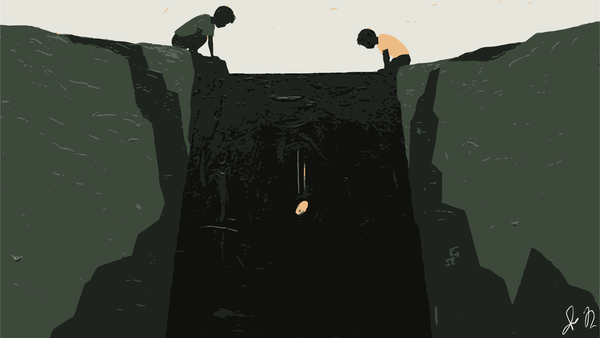
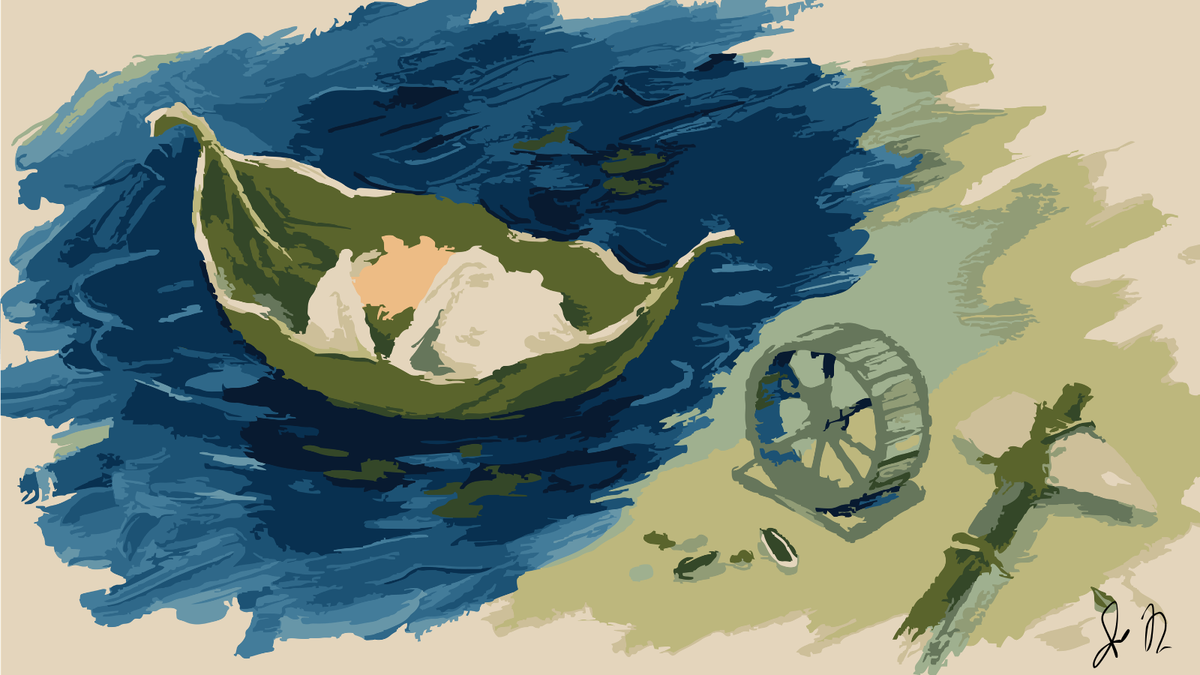
We roll Lucille the one-eyed hamster in her favorite $10.99 flannel blanket with pink hearts and bury her with her favorite wheel and some food for her journey in the afterlife, since Arnie's latest obsession has been the dead rituals of ancient Egypt.
“She'll need something for protection, and a boat,” he says, scanning the dark backyard. A car brakes at the overpass that sits almost directly above our neighborhood, then moves on. We are in near total darkness, no moon, no sky, no street lamps since they blew two years ago. Arnie ties a piece of white limestone gravel to a stick with a vine of creeping Charlie, the sharp end becomes a miniature axe. I am outwardly impressed with his ingenuity.
“Here,” Lex holds up a perfectly cupped magnolia leaf. “A boat for Lucille.”
“To cross the River Styx,” Arnie adds expertly.
I dig up a single chunk of wet clay, grass-topped like a shrunken head, and Lucille the one-eyed is sent off to the underworld.
“You were a good friend,” Lex whimpers. Arnie puts his arm around her shoulder. We follow the path of light that leads to our backdoor, where I remember that Mom’s cast iron skillet is taking a peaceful sudsy soak in the dishwater. Oops.
Some days later, the spring air picks up and I take the clothes outside to hang on the line and dry in the wind, heavy with the scent of our neighbor’s pink mimosa tree. I like the way the clothes look, and how they smell once dried. But mostly it’s the barrier they make. Inside their triangle, I am a small girl amid a crowd of dancing gentlemen and ladies, trampled in sheet dresses and pant legs high and moving with their unpracticed yet perfectly choreographed steps.
The blue sheet blows out a strong wind, then falls back and there it sucks in around the figure of Lexi. Her pointed nose came from my mother, not from me. It could cut the fabric, it’s so sharp.
“Mom,” her muffled voice. “There's a ghost in our yard. WooOoooh.”
“Not another ghost!” I say.
Arnie pulls the sheet down from behind, exposing Lex in her dingy play shorts and plain purple shirt that is now small enough on her that it rises above her outie belly button. Her stomach is round like a balloon. I am immeasurably proud of its fullness.
“Arnie!” Lexi and I both yell. Except I am laughing and Lex is not.
“Polly says death comes in threes,” she says. “And you're next.”
Arnie stops laughing. “Bullshit,” he spits.
“Arnie, language!” I say. “And Lex, when have you been talking to Polly?”
“Polly’s an old know-it-all goat who thinks she can predict the future,” Arnie says. He plucks the line and the clothes tremble nervously.
“She can predict the future,” Lex says. “She told me death comes in threes and first her husband died, then Lucille.”
I pause with my arms halfway up the line, pull the clothespin from my mouth. “Polly’s husband died?”
Lex nods.
I am shocked. Polly is a busybody for sure, but I like the way she makes our lives under the bridge like one of Mom’s midday TV soaps. How could her husband have passed without anyone knowing?
“When?”
“I think maybe it was the same time as Lucille, I guess,” she says.
“What are you doing going over to Polly's house alone?” Arnie says. “Goats eat little girls.”
“She won’t eat me.”
“You’re a little girl aren’t you?” I ask, finishing the line.
“She said I was as good a listener as Henrietta, her chicken. And people don’t eat chickens.”
Arnie, surprisingly, let that one go.
“I made a lasagna in a glass casserole dish. You can portion it and freeze it.”
Actually, I made two. One for my children, and one for newly-widowed Polly who answered the door in her floor length, fur bordered “grieving gown.”
“It's how I show my respect to such a maaan.” She slurs, and the way she says “maaan” makes me want to cover my kids’ ears. “Come in, please.”
I glance inside. Trinkets: cats laying, cats in dresses, cats growing gardens, cats painting on ceramic easels; rows of glass shelving and a glass coffee table, mirrored coasters. Jesus does she Windex every twenty minutes? My kids are doing the jitter-bug behind me. “Uhm, no I think we will let you have your privacy.”
A red fingernailed hand reaches out and successfully grasps my elbow, tugs me firmly inside. “I insist,” she says. “Bourbon?” She holds up her glass. The ice cubes tink.
“I’ll have some,” Arnie says, and Polly pours a glass and hands it to me.
“I'm sorry for your loss, Polly. He was…a good man.”
Actually, I don’t remember him. I don’t think I ever laid eyes on him. Polly gossiped about every single person in our neighborhood as though she’d been a fly on their wall during their most intimate times, but not a word about her late husband.
“He wasn't, but thank you for your sympathies. He was my third so, you know.” She swats her hand at me. “Not my first time around a hearse if you know what I mean.”
I did not know what she meant. Or did I? No, I don't think I did. Did I?
“Am I going to die, Mommy?”
Mommy. I haven't heard it in his voice in so long. Two years, probably. As long as the streetlights have been out. As long as we've been fumbling around in the dark.
“No, Polly’s an old goat, remember? She doesn't know her ass from her elbow.”
This one, I do say out loud, and my mother rolls a little in her grave, and Arnie smiles some because that's the power of words.
“You said ass.”
So powerful.
“But you aren't allowed to say ass.”
“Then who is the third? Who is going to die next?”
“Probably your gramma’s cast iron skillet,” I say. “Now go to bed. Summer waits for no kid.”
When I leave him, the house is quiet. A ladybug flits around the ceiling light and doesn't come back from the frosted glass lampshade. The couch groans as I sit with my two-hours-cold coffee in hand, which I rewarmed in the microwave and then forgot about again. I drink it anyway. Where will they go if I die? My only known relative, my mother, dead. Their father, who knows? Flip a coin–but not a valuable one. He’d steal it.
That’s it. The end of the list. Who am I, Mother, to feel so important that my children can't survive without me? Who am I to consider that I am the center of their universe still, when one is five, the other eight–
“Mom?” It's sleepy-eyed Lex.
I open my arms and she collapses onto my lap, her head fits perfectly in the curve of my neck and shoulder because it was made for her. “What's wrong little girl?”
“I miss Lucille.”
I squeeze her tightly.
“Do you think she made it past the river stinks?”
“She escaped that cage so many times, I bet she's already to her palace by now.” I can’t remember what came at the end of the ancient Egyptian afterlife journey, but a palace sounds nice.
“It's a field of reeds,” Arnie calls from his room.
“See there? Lucille loved grass.”
We watch another ladybug dip into the lamp. I say, “Did Polly really tell you that your brother is going to die?”
“I don’t remember,” she says, in the same voice she uses for cookie-thieving confessions. “Does death really come at three?”
“In threes,” Arnie calls from his room, annoyed.
“No,” I say. Mother, I think. Where are you on your voyage?
“Welcome to the Happy Bunny what can I get hopping for you?” It's so late that the paunchy, thick-haired night cook is the one unhappily taking our order. He scratches behind his ear with the blunt end of his capped pen. A once-white apron is tied loosely at his neck and waist, a hairnet hardly covers the sprigs of red hair on his head.
The menus are one-piece, laminated slats as big as Ten Commandments tablets. They stick together. Lex runs her finger over the pictures of whipped cream and strawberries and sprinkle-laced pancakes as seriously as if she was picking a place on a map to live for the rest of her life. Where are you, Mom?
“I want the bunny cakes,” Lex says sleepily. Oh, now she can sleep, after I’ve dragged them out for this late-night meal. She leans into the nook between my side and arm.
We order. Bacon, eggs, orange slices, bunny cakes. We eat. The waiter brings the check which includes a subtotal for three full meals.
He’s a step away, heading to the end of the dining room and the beginning of what could be eternity behind those double swing doors, when I stop him. I clear my throat. Root my feet into the ground, because I’m standing now. “Hey, yeah. This check isn't right. Remember the jingle?” and I sing it, half silly, half near tears, and another unmathematical half with a foot already in my own mouth, “and these two are clearly kids who ate kids’ meals.”
He has been listening to me with his arms folded. Tattoos splattered across them, well done really. A dolphin smoking a shrimp? Maybe not so well done. When I'm done speaking, he points to the window sticker that clearly says “KIDS EAT FREE.” With an asterisk. “There's always an asterisk, isn't there, chef fucking Ramsey.”
Behind me, Arnie half shoots his fist into the air above the table, “Yeah mom!”
I refuse to read it. “I don't have to read the fine print to know it says something like *when accompanied by two happily married adults, or *between 9 and 9:30 am on Tuesdays only, or *after an eclipse, when accompanied by a giraffe no taller than 6 feet, and between the Victorian and Edwardian.”
I take a breath. I'm huffing bacon and coffee breath into his face and he's as stoic as a Roman bust. Minus the smooth chin.
I look behind me at my children, who are glued to this interaction, waiting for my next move. What is the next move, Mom? Whatever I do will forever be the act by which they calibrate their moral compass. Their faces are eager, sweaty, dirty. I want to kiss them.
“I'm not paying it.” I declare. My heels dig into the crumby carpet. My untattooed arms are crossed. “I'm not.”
The cook/waiter/bunny bouncer shrugs, takes the check, and exits scene to the kitchen, where he disappears from all known existence. To us, at least.
“Mom, whoa,” Arnie says. He's hugging me from behind.
“Holy shit Mom,” Lex, hugging me from the front.
I let her mouth slide. I am too happy right now to bother with trivial things we give meaning to. I am grinning. I touch my cheeks. They are red hot oracles of triumph.
We have leftovers that we take to Polly late the next morning. She doesn't come to the door. I try the handle; locked. Through the front window, I see that the TV is on. I send the kids home; I know what this is. She’s in her bed, having passed peacefully overnight. Or she’s in her recliner, a heart attack/stroke/aneurysm while watching reruns of Unsolved Mysteries. Or something gorier–a slip and fall getting out of the tub, except she hit her forehead on the toilet, gnashing into it a bloody line of indent. Dead as a doorknob.
I jimmy the backdoor. It’s a handle-lock and not difficult. Inside, it’s the kind of hot you expect in a house that has its only window AC unit in the bedroom. I think about my mother, sitting at Polly’s round kitchen table, a fan of cards in one hand, a cigarette in the other, her arm stretched out long and elegant, like a movie star. God, she loved to smoke. If we had packed for her journey through the underworld, I would have thrown in a pack of Camels, the kind she smoked on special occasions, instead of her everyday Pall Malls.
“Mom,” I whisper, touching the table. Nothing moves, and there are no sounds, because my mother is dead and not a ghost in Polly’s house.
I step to the living room, and Henrietta the chicken boks at sight of me, then pecks at my shoelace. But there’s no Polly here. The bathroom, no Polly there, either. She’s in the back bedroom, a second bedroom that couldn’t be larger than ten by ten. The door is ajar, and a green light spills gently into the hallway.
“Polly?” I push it open, and she’s very much alive, sitting at a vanity table with a glowing crystal ball, its brazen black cord plugged into the wall outlet. She is pretending to be in a trance. Her hands hover above, her gilted eyelids ripple in a hundred folds. Her painted brows knit together, fall apart, talking to each other or thinking. “Polly, I don’t mean to interrupt,” I say. She moans in her trance. I’m glad the children aren’t here. It’s a confusing sound. “We brought you some leftovers from the Happy Bunny.”
An eye opens. “What are they?”
I pop the Styrofoam lid, accidentally breaking its lip. “A pancake, bacon strip, and a cup of fried apples.”
“I’ll take the apples,” she says. Both eyes closed again.
“OK, should I just–” I set the box down, lift it up. Unsure of my place in Polly’s home, intimated by her self-assuredness.
“Stay,” she says. “I’m talking to my husband.”
A sound fights its way out of my mouth, but it doesn’t mean anything. Her hands continue to move in half circles around the ball. It changes color, milky purple into reds and greens like passing through galaxies. Time. You can’t even see the lightbulb on the inside.
After a moment, she stops. “That smells good. Why don’t you take over.” She takes my hand by the wrist and places it an inch above the crystal ball.
“Uhm.” Another sound with no meaning.
“Circle your hands, like this,” and she shows me the motion, a strip of bacon tucked between her right thumb and forefinger. She stops to take a bite. “Concentrate on passing through the walls of time and space. It’s all molecular. You are molecular. You are meaningless. You are nothing.” She waves my look of disdain away. “Float, disintegrate. Vapor mixes with other vapor. Grab hold of a familiar molecule. Find the one that looks like my husband.”
The molecule that looks like her husband in the blackness of my mind. The fuck? My eyes are closed but I know she’s picked up the pancake and folded it like a slice of pizza. Her lips smack immodestly.
But, it is sort of nice. Floating in space and time. Not existing as I exist. Separating into molecular energy and the tiniest of particles. It is peaceful, actually. It is at least more peaceful than washing dishes. I have forgotten about Polly’s husband.
“Mom,” I whisper inwardly. And that’s all. Just, “Mom.” And I pretend I can see her shape in molecules, spread apart in the black of space like a constellation. Lumpy and short and her back bent over at the top. I reach out to touch her and it is like skimming your hand over lakewater. As I’m traveling through mental space, singing propels me. It’s a song I know. It echoes like a voice against walls in an empty warehouse. Come and take your honey down to the Happy Bunny where kids eat free…
Polly is so close I can smell her exhale, and the dust of powder she’s caked beneath her arms. A sheen of bacon grease makes her lips look simultaneously youthful and disgusting. “I love that song,” she says.
“Yeah,” I nod. “It’s catchy.”
“But they don’t eat free,” she says.
“No, they don’t.”
“Took my grandkids there last year. It was bullshit.”
“Definitely. Bullshit.”
“I left them a bad review.”
“Yeah.”
“Good food though.” She crushes the Styrofoam container into a small, bagless waste bin.
“Yeah,” I say. “Good food though.”
Editor's Note:
It isn't often that we get to read domestic comedy in "disguise." Or rather, in this case, the disguise of grief. The narrator — a single mother still processing the loss of her own mother, still scrubbing her dead mother's cast iron skillet while her daughter's hamster gets a proper Egyptian send-off — never truly spells out what the story is actually about. It catches you up on its own by using a jingle, an asterisk, and a diner confrontation.
What truly earned our acceptance of this piece, though, was the voice. Stacey Lounsberry has found a narrator who is exhausted, funny, and genuinely moving without ever asking to be. The tenderness is withheld until it can't be anymore, which is such an honest way to portray this sort of grief-fueled malaise. When Arnie calls out "in threes" from his bedroom, annoyed, to correct his little sister's grammar, we believed completely in these children. In the uncanny, observed weight of who they are in the space of these sentences.
Additionally, the Happy Bunny works on multiple registers. The jingle is faintly predatory from the first time we hear it (fitting considering it's a bunny as prey). The diner standoff that closes the story's middle sections is its true climax, and Lounsberry earns every word of it. "Whatever I do will forever be the act by which they calibrate their moral compass" is the story's most naked sentence, and it works because everything before it has been so carefully oblique.
This is the territory Cetera exists to publish. Work that holds the world together through sheer stubbornness while quietly asking who holds the person doing the holding.—Jon Negroni
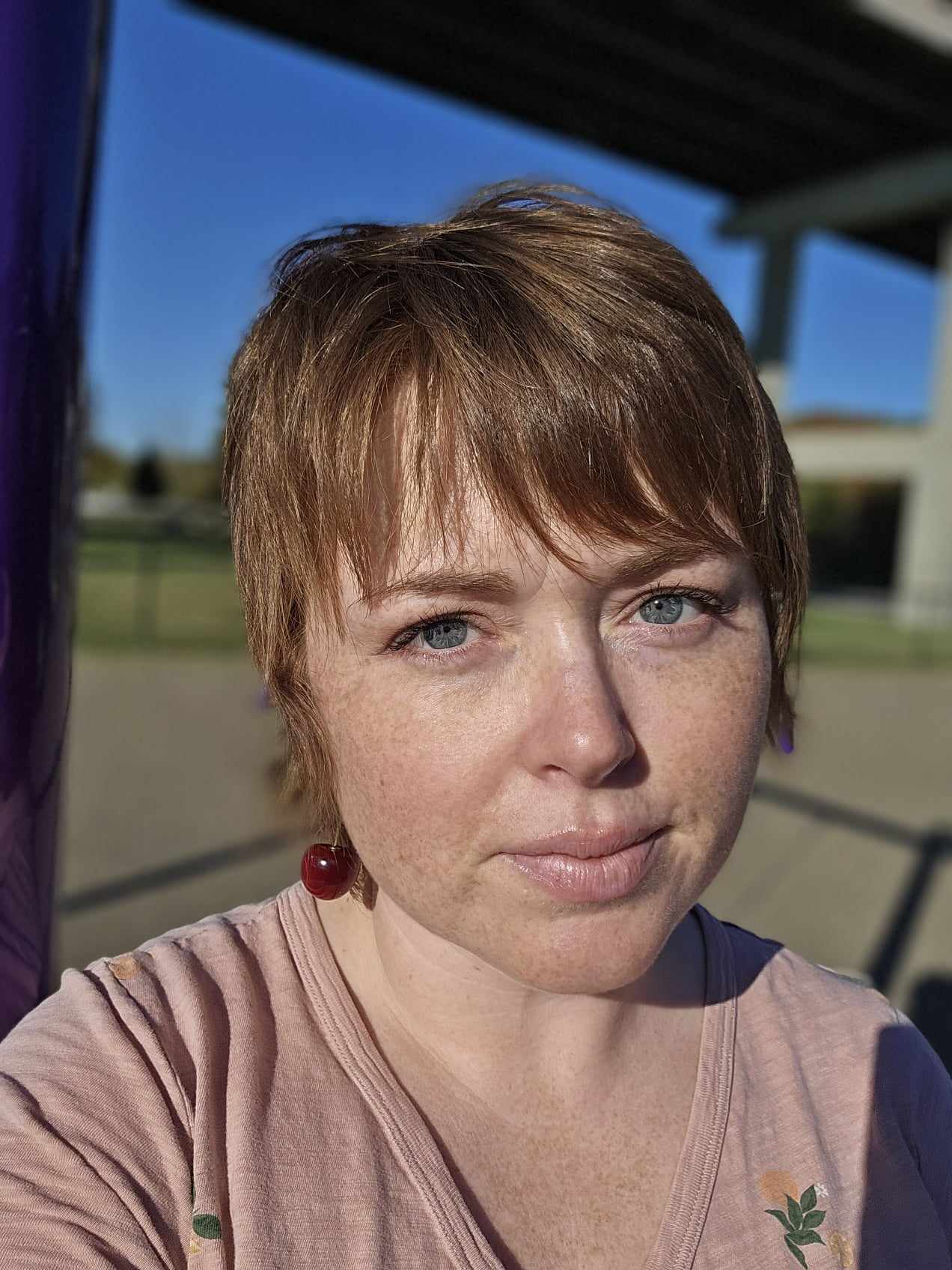
Stacey Lounsberry has been twice nominated for the Best of the Net award (fiction, 2025, The Mersey Review; poetry, 2026, January House Literary), and her chapbook, The Bloodshed in Her Pocket, was a semifinalist for The Black River Chapbook Competition (2025). Other works have appeared in Appalachian Places, SBLAAM, and Bright Flash Literary Review, among others. Find her in Eastern Kentucky, reading prose for Broad Ripple Review, or online at www.sglounsberry.com.
Support Cetera
Paid members get exclusive perks like bonus stories, the ability to comment, and more. Plus you'd be helping us keep the bills paid. You can check out the subscription tiers below, or you can leave a one-time tip if that works better for you.